











When organizing a productive home office or creative studio, surface area is only half the equation; surface depth dictates how equipment, paperwork, and peripherals actually fit into daily routines. An l shaped desk 30 inches deep offers a commanding, high-capacity footprint that accommodates larger computer monitors, expansive drafting pads, and extensive accessory setups without feeling cramped.
Standard workstations often prioritize compact depths to conserve floor space, but demanding workflows benefit significantly from the increased distance between seated users and their primary displays. Understanding how deep-profile corner desks interact with room architecture, seating travel, and under-desk organization ensures your layout remains balanced, functional, and visually appealing.
The Depth Advantage: Why Choose an L-Shaped Desk 30 Inches Deep?
Desktop depth fundamentally shapes how you interact with your tools throughout the workday. Shallow work surfaces frequently force keyboards, audio interfaces, and reference documents into the narrow footprint directly beneath monitor stands. Choosing a 30-inch deep workstation introduces several functional advantages:
- Generous Visual Distance: Deeper surfaces allow large monitors, dual-display arms, or ultrawide screens to sit further back, helping users maintain comfortable viewing angles and clear foreground task space.
- Uncluttered Peripheral Placement: Hardware such as studio reference monitors, full-sized mechanical keyboards, drawing tablets, and desktop audio gear can stay permanently positioned without overlapping primary writing zones.
- Dual-Layer Task Surface: A 30-inch depth naturally creates two functional surface layers: an active foreground area for immediate typing or note-taking, and a stable background tier for lighting, charging docks, and display mounts.
- Reduced Visual Clutter: Because gear is not crowded toward the edge of the desk, wire paths and desktop organizers can be neatly routed along the back edge.
Depth Configurations: Symmetrical Wings vs. Stepped Returns
L-shaped desks come in various dimensional arrangements. When planning around deep surfaces, it helps to understand whether a uniform depth or an asymmetrical stepped profile suits your workflow best.
Uniform Deep Geometry
In a fully symmetrical 30-inch deep L-shaped layout, both the primary span and the connecting return share the same generous depth. This layout provides massive surface territory, making it ideal for professionals who switch between two equally demanding tasks, such as digital software development on one side and manual assembly or physical document review on the other.
Stepped Return Configurations
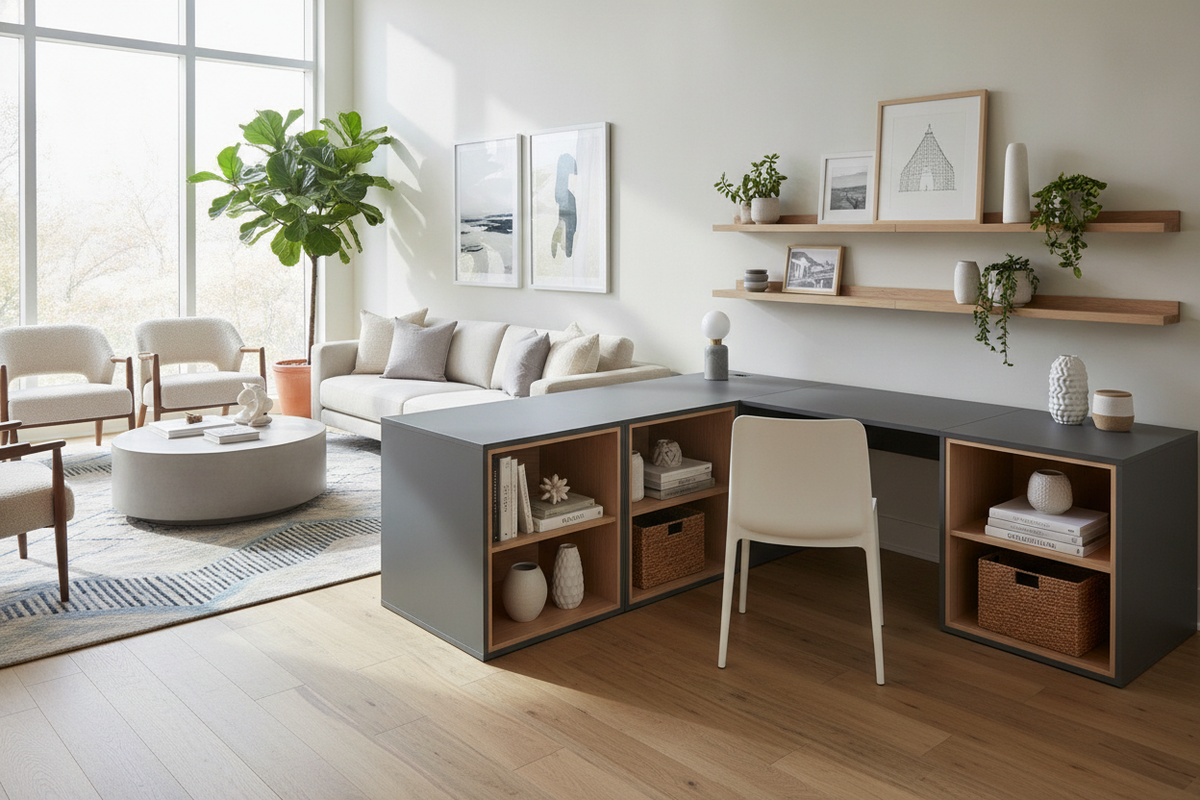
Many room arrangements benefit from a stepped return design, where the main desk features a 30-inch depth while the auxiliary return is slightly narrower. Exploring white corner L-shaped desk configurations with varied surface proportions can help maintain open walk-through paths in rooms where full 30-inch depth along both walls might impede door swings or closet access.
Room Planning and Clearance Requirements for Deep Workstations
Because deep L-shaped workstations occupy substantial visual and physical volume, spatial planning is essential before installation. For detailed layout strategies, review our guide on mastering office room flow with L-shaped desks to balance furniture placement with everyday comfort.
Chair Travel and Recline Clearance
A deep desk naturally encourages dynamic seated movement. Ensure you reserve adequate floor area behind the primary seating zone so your ergonomic chair can roll back, rotate, and recline without bumping against walls, bookshelves, or radiators.
Corner Placement and Diagonal Spans
When placed deep into an interior corner, the inner diagonal intersection of an L-shaped desk creates an expansive center zone. Consider whether you plan to position your primary display directly in the corner diagonal or along one of the flat straight spans, as this decision determines your required reach distance to wall outlets and cable access grommets.
Multi-Zone Workflow Applications
The expansive surface of a 30-inch deep corner desk accommodates specialized multi-zone work styles that struggle on conventional shallow desks:
- Developer and Data Stations: Host multi-screen mount arrays on the primary deep wing while reserving the secondary wing for laptops, reference manuals, and physical note tracking.
- Creative Production Suites: Position synthesizer modules, mixing controllers, or secondary tablets on the return wing while keeping primary editing screens at proper optical distance.
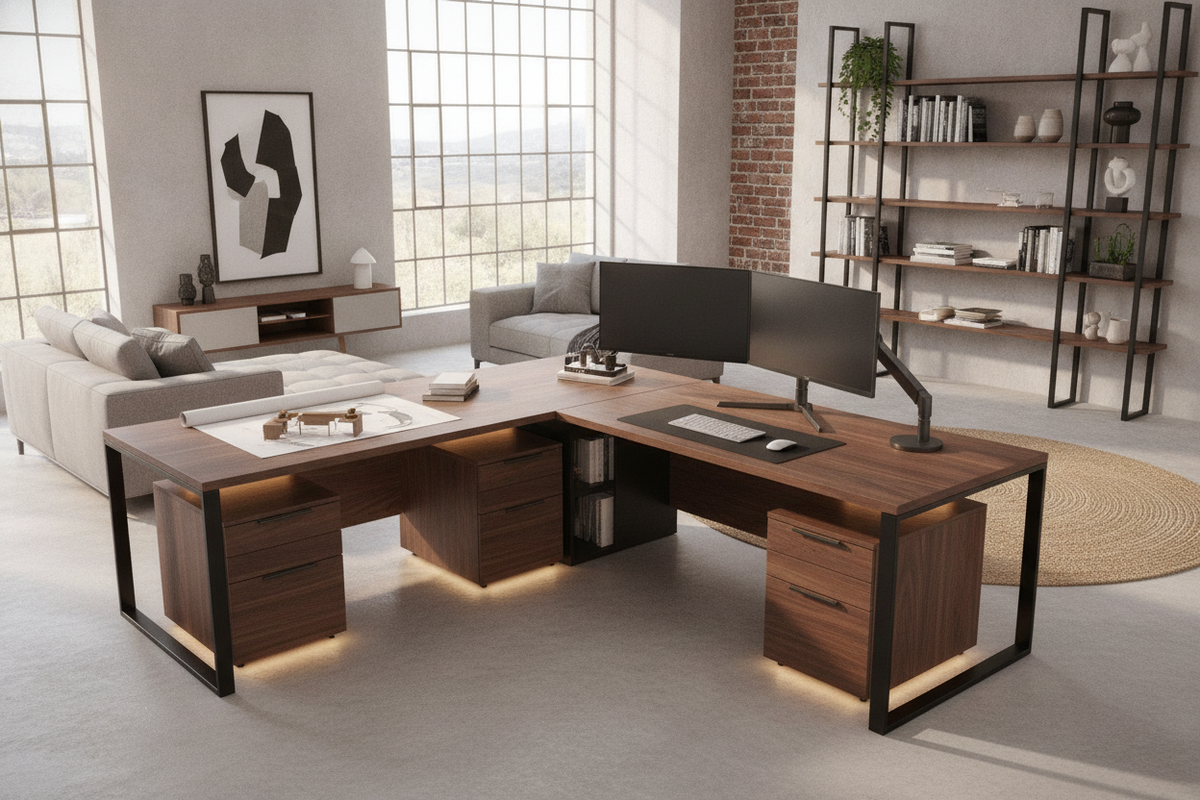
- Executive Digital and Paperwork Setups: For grander office suites, executive L-shaped workstation layouts establish a defined command center where digital tasks remain separated from formal document signing and client-facing areas.
Storage Architecture and Under-Desk Legroom Planning
One major benefit of a 30-inch deep profile is the extensive volume created underneath the desktop. However, poorly positioned storage can quickly limit your ability to swivel smoothly between wings.
When evaluating corner desks with integrated storage architectures, place mobile pedestals, tower shelves, and filing drawers along the outer perimeters of the desk wings rather than inside the central corner. This keeps your leg channel entirely unobstructed, ensuring effortless rotation when switching from your primary keyboard to your side return.
Frame Construction, Load Distribution, and Materials
Deep desks bear substantial weight across broader surface areas. Selecting high-grade construction prevents desktop bowing and maintains structural integrity over years of use:
- Under-Desk Support Beams: Look for heavy-gauge steel framework or thick perimeter aprons that run beneath the work surface to distribute downward pressure evenly.
- Corner Leg Strategy: Well-engineered corner desks often utilize recessed corner supports or reinforced cantilevers to maximize knee clearance while preserving absolute frame rigidity.
- Durable Surface Finishes: High-pressure laminates, melamine coatings, and treated engineered wood finishes resist everyday scratching, heat from electronics, and mouse wear across large working surfaces.
Step-by-Step Decision Checklist Before Purchasing
Before selecting your deep corner desk, verify these critical room and workflow factors:
- Measure Entryways and Hallways: Confirm that packaged desktop panels and support frames can easily navigate stairwells and door frames during delivery.
- Check Wall Outlets and Cable Paths: Plan power strip locations so cords reach rear power points comfortably across the 30-inch depth.
- Verify Chair Swivel Clearance: Ensure unobstructed floor space across the entire arc between the left and right wings.
- Map Accessory Footprints: List your primary equipment (monitors, desktop towers, audio gear) to confirm wing length and depth balance your intended workflow zones.

Dejar un comentario
Este sitio está protegido por hCaptcha y se aplican la Política de privacidad de hCaptcha y los Términos del servicio.