










I remember unboxing my first low-profile media unit like it was yesterday. It was a gorgeous walnut piece with legs like toothpicks and a profile so slim it barely reached my knees. I thought I had finally achieved the 'adult' living room look. Then I tried to hook up my 2015-era cable box and a surround sound receiver. The receiver stuck out four inches past the edge, and the cable box looked like a dusty cinder block sitting on top of a fine piece of art. Buying a modern television stand is an exercise in aesthetic discipline, not just a shopping trip.
- Minimalism requires a tech audit; your old VCR and bulky receiver aren't invited to the party.
- Measure your deepest device—usually the AV receiver—before clicking 'buy' to avoid the 'hanging off the edge' look.
- Cable management is a mandatory weekend project, not an afterthought you can skip.
- Hidden storage with ventilation is worth the extra $200 to keep your consoles from melting.
The Minimalist Trap: Expectation vs. Reality
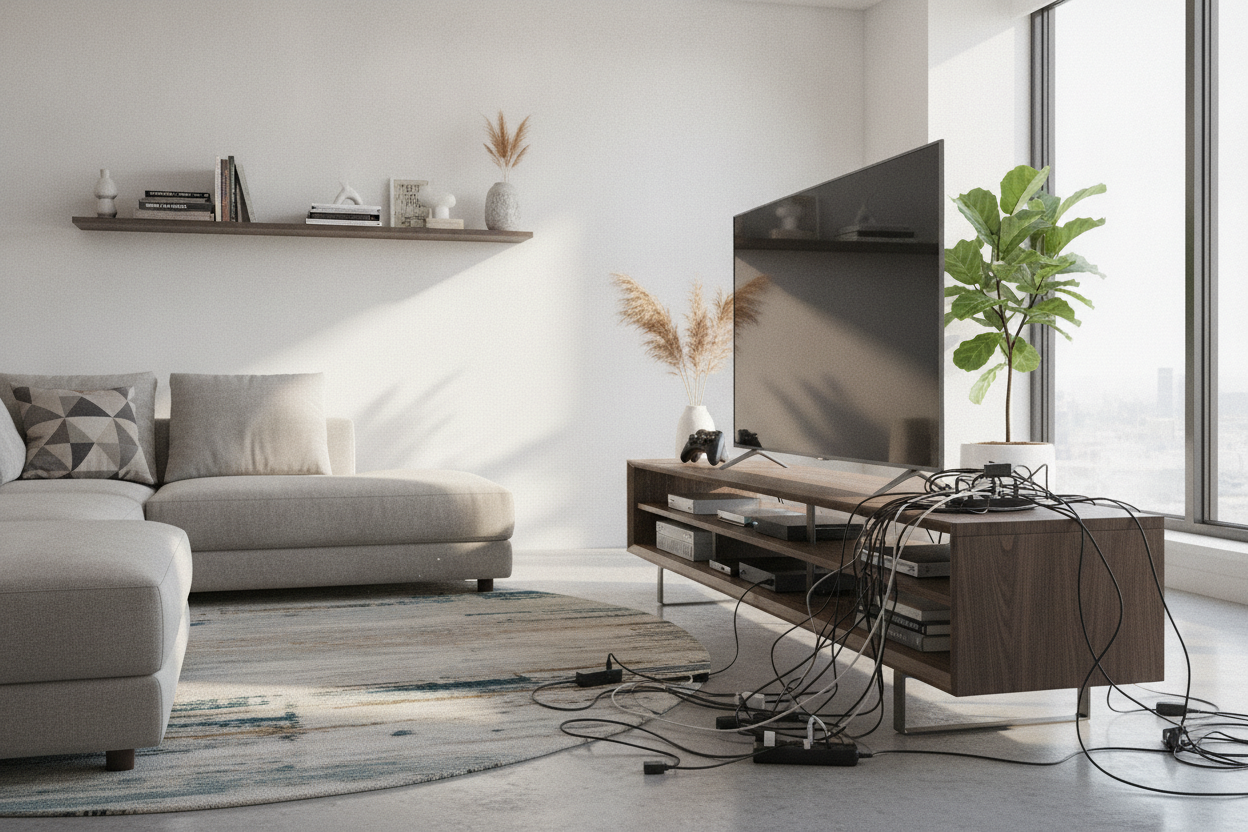
That photo you saw on Pinterest is a total lie. There are no wires in those professional shots because the TV isn't actually plugged into anything. When you bring home a modern t v stand, the reality of physics hits hard. Those airy, open shelves that looked so 'Scandinavian chic' in the showroom are now holding a dusty router and a tangled nest of HDMI cables that look like a plate of black spaghetti. I once spent three hours trying to tuck a power strip behind a leg that was only an inch wide, only to have it fall over five minutes after I sat down.
If you have a massive AV receiver or five different gaming controllers, a minimalist unit will expose every single flaw in your organization. It is a shock to the system when your furniture stops being a shield for your clutter and starts being a pedestal for it. You can't just shove things into a dark corner anymore. Every device you own is suddenly on display, and if those devices are covered in dust or have mismatched cables, your whole 'fashionable' vibe is ruined. You have to be prepared to spend as much time on wire ties as you did on the furniture assembly itself.
Do You Really Need All Those Black Boxes?
Before you even move your new furniture into place, you have to ask yourself: do I really need the physical disc player? Most fashionable tv stands are designed for the streaming era. They assume you have a thin TV and maybe a soundbar. If you are still clinging to a stack of 'black boxes' from 2012, you are going to hate your living room. The footprint of a modern television stand furniture piece is often much smaller than the heavy oak behemoths we grew up with, meaning every square inch of shelf space is at a premium.
When post modern TV stand aesthetics became my goal, I had to ditch my old stereo system for a sleek, compact setup. It felt like a sacrifice at first—I loved that old receiver—but the visual relief of not seeing a glowing orange display through the glass was instant. A modern console tv setup works best when the tech is as invisible as the furniture is prominent. Purge the old Wii you haven't played in three years. Get rid of the DVD player if you only stream. Your living room will feel twice as large once you stop prioritizing outdated hardware over your actual floor space.
The Holy Grail: Finding a TV Console With Storage Modern Enough for Your Space
If you aren't ready to go full digital and still need your physical consoles, you need a tv console with storage modern enough to handle the heat—literally. Most cheap units are just MDF boxes that trap heat and kill your PlayStation within six months. I have learned the hard way that 'hidden storage' usually means 'zero airflow.' I once found a unit that looked perfect, but after two hours of Call of Duty, I could have fried an egg on the top surface. It was a disaster waiting to happen.
Look for 'slat' doors or perforated metal fronts. I finally found a modern minimalist tv stand with hidden storage that actually used ventilated back panels and soft-close hinges. It is the only way to keep the 'clean' look without your equipment melting into a puddle of plastic. This is where modern tv stand furniture separates the pros from the amateurs. You want internal cord channels and pre-drilled holes that actually line up with where your devices sit. If a unit doesn't have a pre-drilled hole for cables, walk away. You shouldn't have to take a hole-saw to your new $600 cabinet just to plug in a lamp.
Also, pay attention to the weight limits. Many modern television cabinets use thinner materials to achieve that floating look. If you have an older, heavier 65-inch TV, check the specs. I have seen more than one 'minimalist' stand start to sag in the middle after just a few months because the owner ignored the 50-pound weight limit. A sagging shelf is the fastest way to make expensive furniture look like junk.
3 Rules for Faking a Cord-Free Zone
Since many modern television cabinets often sit on high, tapered legs, you can see right under them. This creates a 'cable waterfall' that ruins the entire aesthetic. My first rule is to use Command hooks on the back of the legs to run wires down where they are hidden from the front. If the wire has to travel along the wall, use a cable raceway that matches your paint color exactly. It takes twenty minutes to install and makes a $200 stand look like a $2,000 custom built-in.
My second rule is to use blackout window film on the inside of any glass doors. It keeps the 'shiny' look of the glass but hides the blinking blue and green lights of your router and modem. It is about creating an illusion of emptiness. Finally, invest in a 'cable management box' for your power strip. Instead of a tangled mess on the floor, you have one clean box with a single cord coming out. You want people to wonder how the TV is even getting power when they walk into the room.
Ready to Let Go of the Clutter?
It is a lot of work to make a minimalist setup actually look good, but once you clear that visual noise, your living room changes. It stops being a place where you stare at electronics and starts being a place where you actually relax. The effort of hiding every cord and purging every unnecessary box pays off the first time you sit down and don't feel the urge to tidy up. If you are tired of the bulk and the dust-collecting cabinets of the past, browsing a collection of tv stands modern designers have perfected is the first step toward a cleaner home. Just remember to buy some Velcro ties and a cable box while you are at it—you are going to need them.
How high should my TV stand be?
Your eyes should be level with the middle of the screen when you are seated on your sofa. For most standard setups, that means a stand between 18 and 22 inches high. If you go higher, you'll be crane-necking it like you're in the front row of a movie theater.
Will my remote work through solid wooden doors?
Not unless they are slatted or you use an IR repeater (a cheap little device that passes the signal through). However, most modern gaming consoles and streaming sticks use Bluetooth or RF, so they don't actually need a line of sight to work.
Can I put a 75-inch TV on a 60-inch stand?
Technically yes, if the weight limit allows, but it looks terrible. It makes the whole setup look top-heavy and cheap. You should aim for at least 3-5 inches of 'breathing room' on either side of the TV screen for a balanced look.

Dejar un comentario
Este sitio está protegido por hCaptcha y se aplican la Política de privacidad de hCaptcha y los Términos del servicio.