










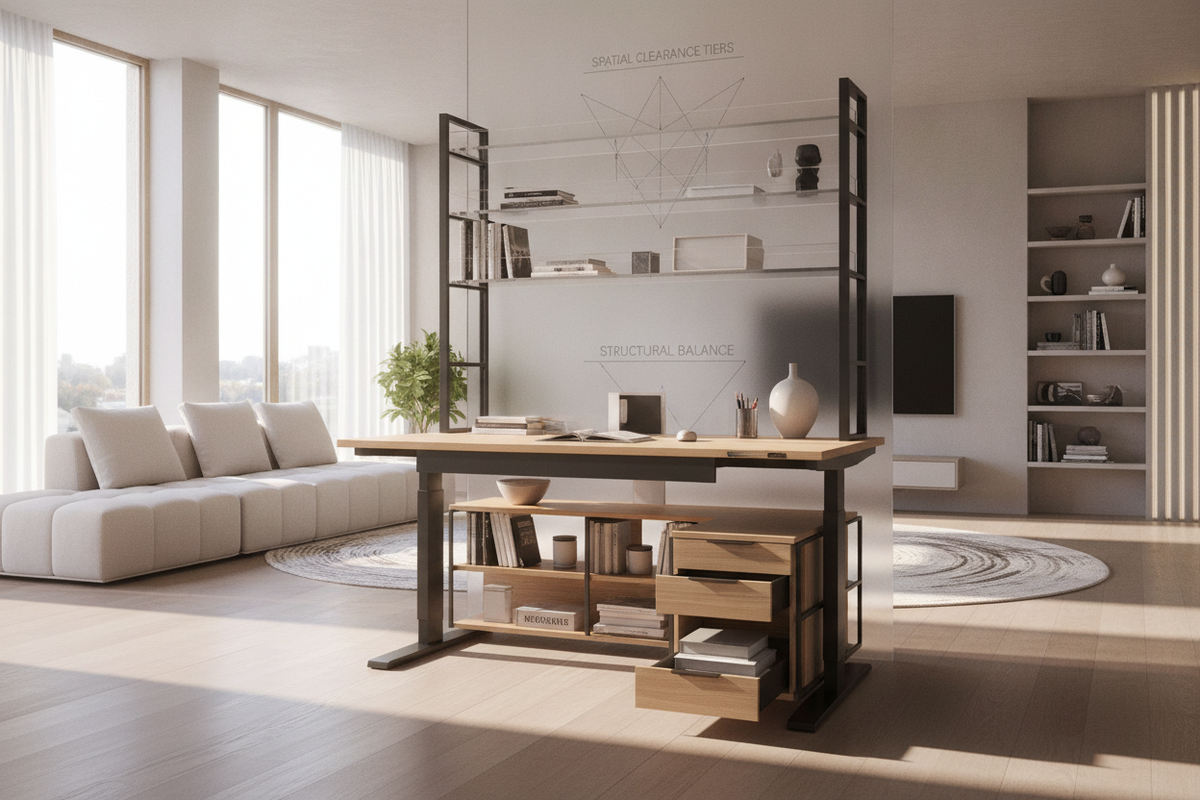
Integrating vertical organization into dynamic height-adjustable workstations creates a balanced blend of ergonomic movement and organized storage. An adjustable desk with shelf setup allows remote professionals and creators to preserve desktop surface area while keeping reference materials, secondary screens, and daily accessories easily accessible. Achieving a seamless layout requires understanding spatial clearance pathways, weight symmetry across height transitions, and stylistic alignment with nearby furniture.
Spatial Clearances and Dimensional Tiers for Shelved Adjustable Desks
Choosing an adjustable desk with shelves requires balancing physical footprint with spatial volume. Because height-adjustable frames move along a vertical plane, their dimensions demand careful evaluation in both seated and standing positions.
Desktop Footprint Tiers: Compact Pods to Executive Spans
Workstation footprints generally fall into three distinct structural categories:
- Compact Pods: Designed for urban apartments and secondary alcoves, compact surfaces prioritize a minimal horizontal footprint while relying on multi-tier shelves above or beneath the main surface to preserve work zones.
- Mid-Size Workstations: Offering a balanced surface width, these frames accommodate single or dual monitor arrangements alongside integrated tier organizers without overwhelming standard residential rooms.
- Executive Spans: Wide worktops provide expansive lateral space for multi-display setups, peripheral gear, and continuous upper or lower shelving arrays suited for dedicated home offices.
Vertical Travel Zones and Wall Clearance Geometry
When operating a sit stand desk with shelf, dynamic movement alters spatial interactions with surrounding architecture. Desks must maintain adequate distance from back walls, baseboards, and window trim to prevent friction during elevation adjustments. Furthermore, overhead clearances must account for lighting fixtures, floating wall shelves, and angled ceilings when the desk reaches its maximum height setting.
Storage Architecture: Overhead Hutches, Under-Desk Racks, and Modular Tiering
The structural placement of shelves relative to the moving frame defines both daily accessibility and mechanical balance during continuous height transitions.
Kinetic Balance and Load Symmetry Across Moving Tiers
Shelving fixed directly to the elevating desktop moves in unison with your primary work area, keeping peripherals within arm's reach. However, uneven weight distribution across elevated hutches can introduce mechanical strain on lifting columns. Centering heavier items—such as audio monitors, printers, or book collections—along the main center of gravity helps maintain smooth, level operation throughout daily use.
Modular Lateral Shelving and Complementary Cabinet Synergy
For extensive equipment storage, pairing your dynamic desk with stationary perimeter pieces prevents overloading the moving frame. Exploring a comprehensive adjustable shelf collection allows you to introduce freestanding tall shelving, matching bookcases, or credenzas adjacent to the workstation. This decoupled approach provides abundant storage volume while keeping the primary lifting mechanism responsive and uncluttered.
Material Dynamics and Framing Rigidity for Dynamic Workstations
The performance of an adjustable workstation carrying elevated storage tiers relies on robust material engineering and stable base construction.
High-Density Surface Materials and Resilient Finishes
Worktops and integrated shelves endure constant contact, localized weight, and shifting equipment. High-density engineered wood composites and treated laminate veneers offer dependable resistance against daily surface wear, scratches, and edge pressure. Consistent finishes across both desktop surfaces and elevated tiers deliver a cohesive visual presentation that resists sagging under regular use.
Reinforced Steel Framing and Anti-Torsional Bracing
Elevating shelf weight introduces increased leverage against the desk base. Workstations engineered with high-grade tubular steel legs, wide ground runners, and solid crossbeam assemblies minimize torsional flex and lateral sway. This foundation ensures that upper shelves remain steady during typing, writing, or transitioning between seated and standing postures.
Dynamic Wire Management and Power Routing for Shelved Desks
An adjustable desk with shelf integration introduces multiple operational levels, requiring thoughtful cable pathway planning to avoid cord tension or clutter.
Articulated Cable Trays and Flexible Conduit Pathways
Because the distance between stationary wall outlets and moving shelves changes continuously, cable management must accommodate full travel range. Flexible spine channels, articulated snake conduits, and under-desk wire trays provide defined conduits that expand and contract smoothly, preventing cables from tangling or disconnecting during frame adjustment.
Tiered Power Hub Positioning for Peripherals and Task Lighting
Mounting multi-outlet power strips directly beneath the desktop or behind elevated shelf risers creates a localized power hub. By routing shelf-mounted task lamps, monitors, and device chargers into a centralized on-desk hub, only a single master power cord needs to traverse the dynamic vertical span between the frame and wall outlet.
Room Layout Strategies and Cross-Functional Interior Styling
Positioning a shelved standing workstation within a multi-use room requires balancing ergonomic flow with the broader interior aesthetic.
Dedicated Office Niches vs. Open-Concept Integration
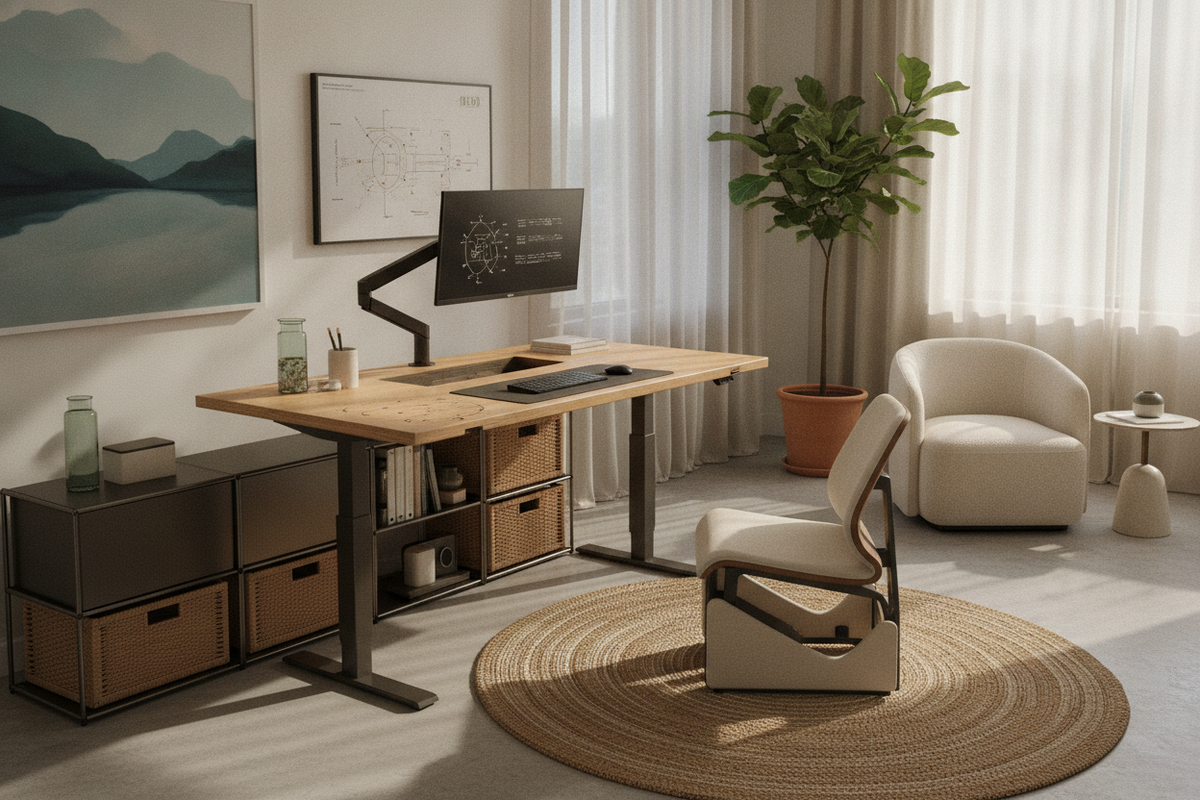
In dedicated office rooms, placing an adjustable desk perpendicular to natural light sources reduces screen glare while allowing overhead tiers to stand clear of decorative wall features. In open-concept living or bedroom areas, positioning the workstation along a continuous perimeter wall maintains natural walking paths while creating a defined zone for productivity.
Styling Continuity with Adjacent Living and Storage Furniture
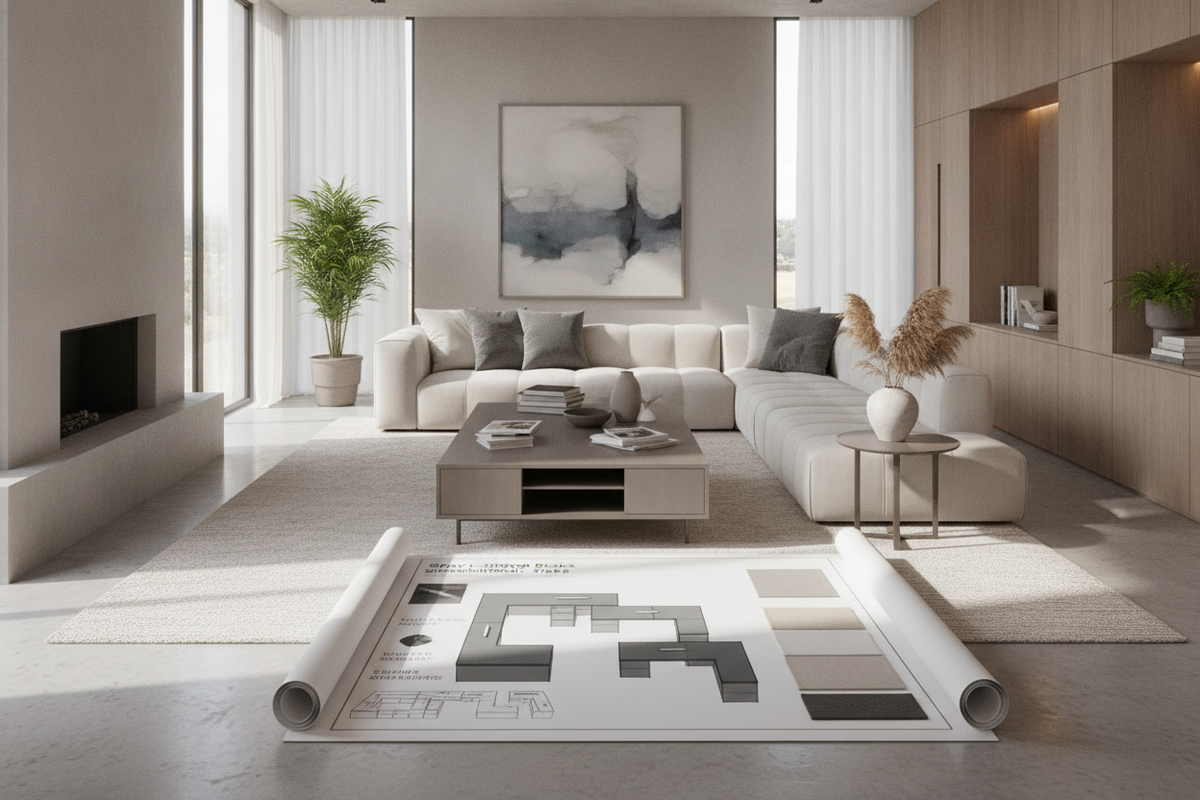
To integrate an office setup seamlessly into shared rooms, match the desk's wood tones, metal framing, and handle hardware to nearby living furniture. For insightful styling advice, reviewing a stand adjustable shelves guide helps coordinate shelf profiles across entertainment units and office storage. Pairing your workspace with refined accent pieces, such as a stand adjustable shelf product, unifies metal accents, wood grain finishes, and storage functionality across the entire living environment.

Dejar un comentario
Este sitio está protegido por hCaptcha y se aplican la Política de privacidad de hCaptcha y los Términos del servicio.