











Short answer: the best lighting for makeup is bright, diffused light that hits your face evenly from the front at eye level, with a neutral-to-daylight color temperature of about 4,000 to 5,600 Kelvin and a color rendering index (CRI) of 90 or higher. Natural daylight from a window you face is the benchmark during the day; a dimmable LED mirror or two side lights reproduce it at night.
Lighting changes how foundation, blush and concealer look more than most people expect. A warm bulb can make you apply too much bronzer, and an overhead fixture hides dark circles until you step outside. This guide explains the four settings that matter, color temperature, CRI, brightness and placement, so you can judge any lamp, bulb or lighted makeup mirror. If you are choosing a vanity at the same time, the FUFU&GAGA makeup vanities list whether each mirror is lighted and whether the lighting is adjustable.
Color Temperature: Which Kelvin Is Best for Makeup?
Color temperature describes how warm (yellowish) or cool (bluish) white light looks, measured in Kelvin (K). As the ENERGY STAR light bulb purchasing guide puts it, lower K means warmer, yellowish light and higher K means cooler, bluer light; its scale runs from about 2,200K to 6,500K, with daylight at the top.
| Color temperature | Looks like | Effect on makeup | Use it for |
|---|---|---|---|
| 2,700–3,000K | Warm white, like a classic incandescent bulb | Masks redness and uneven tone; makes it easy to over-apply bronzer and foundation | Previewing evening and restaurant looks |
| 3,500–4,100K | Neutral to cool white | Balanced, slightly flattering; good everyday compromise | Daily makeup in bedrooms and bathrooms |
| 5,000–5,600K | Daylight | Closest to outdoor light; shows true skin tone and blending lines | Foundation matching, concealer, brows |
| 6,500K and up | Very cool, bluish | Can make skin look pale or gray; tempts you to add too much blush | Best avoided for application |
For most people, a daylight setting around 5,000K is the most accurate choice for applying makeup, and a neutral 4,000K is a comfortable everyday option. Keep warm white for checking how a finished look reads in candlelight or at a dinner.
One more rule: do not mix color temperatures. A warm ceiling bulb combined with a cool mirror light creates a two-tone cast on your face. The U.S. Department of Energy notes in its lighting purchasing guidance that a jump from 2,700K to 4,100K is clearly noticeable, so match bulbs in the same room.
CRI: Why Color Rendering Matters for True Skin Tone
The color rendering index (CRI) rates, on a scale up to 100, how faithfully a light source shows colors compared with a reference light. The Department of Energy describes CRI as a measure of light quality, with a higher value indicating a better light source, and ENERGY STAR certified bulbs must reach at least CRI 80.
For makeup, aim higher: CRI 90 or above. Low-CRI light flattens subtle differences between shades, so a foundation that looks matched at your vanity can look gray or orange in daylight. High-CRI LED strips and bulbs often print the value on the box as "CRI 90+" or "Ra 90". If a lighted mirror does not state a CRI, compare a swatch on your jaw under the mirror and next to a window; a big difference means low color accuracy.
Brightness and Dimming
Brightness is measured in lumens, not watts. For reference, ENERGY STAR lists about 800 lumens as the equivalent of an old 60-watt bulb and 1,100 lumens for a 75-watt bulb. A makeup light should be bright enough to see fine hairs and texture without making you squint, and that point differs from morning to night.
That is why adjustable brightness is worth having. A dimmable light lets you work at full brightness for detail work like liner and brows, then lower it so your eyes are comfortable. Many LED vanity mirrors use touch controls to step through brightness levels, and some remember the last setting.

Light Placement: Front Light vs Overhead Light
Placement decides whether light reaches your whole face or leaves deep shadows. Light from directly overhead, the typical ceiling fixture or bathroom mirror bar, falls on your forehead and nose and leaves shadows under the eyes, nose and chin. You end up applying concealer to shadows that are not really there.
The fix is light at face level, from the front and both sides:
- Perimeter-lit or Hollywood-style mirrors surround your face with light, which fills in shadows from every angle.
- Two side lights (sconces or lamps) placed symmetrically at eye level on each side of the mirror give even illumination. One light on one side only will leave half your face darker.
- A tri-fold mirror with built-in lights lets you see both profiles under the same light, useful for contouring.
- Ring lights give flat, shadow-free front light, popular for video, but the small circle can create a ring-shaped reflection in your eyes.
Keep the light source in front of you, never behind. A window or lamp behind your head puts your face in shadow and makes the mirror glare.
Natural Light: The Benchmark
Natural daylight is the reference most makeup artists use, because it has the full color spectrum and it is the light most people will see you in. Set up your vanity facing a window or at a right angle to it, so daylight falls on your face rather than from behind. Indirect light from a north-facing window or through a sheer curtain is softer and more even than direct sun on a sunny day, which can cast harsh shadows.
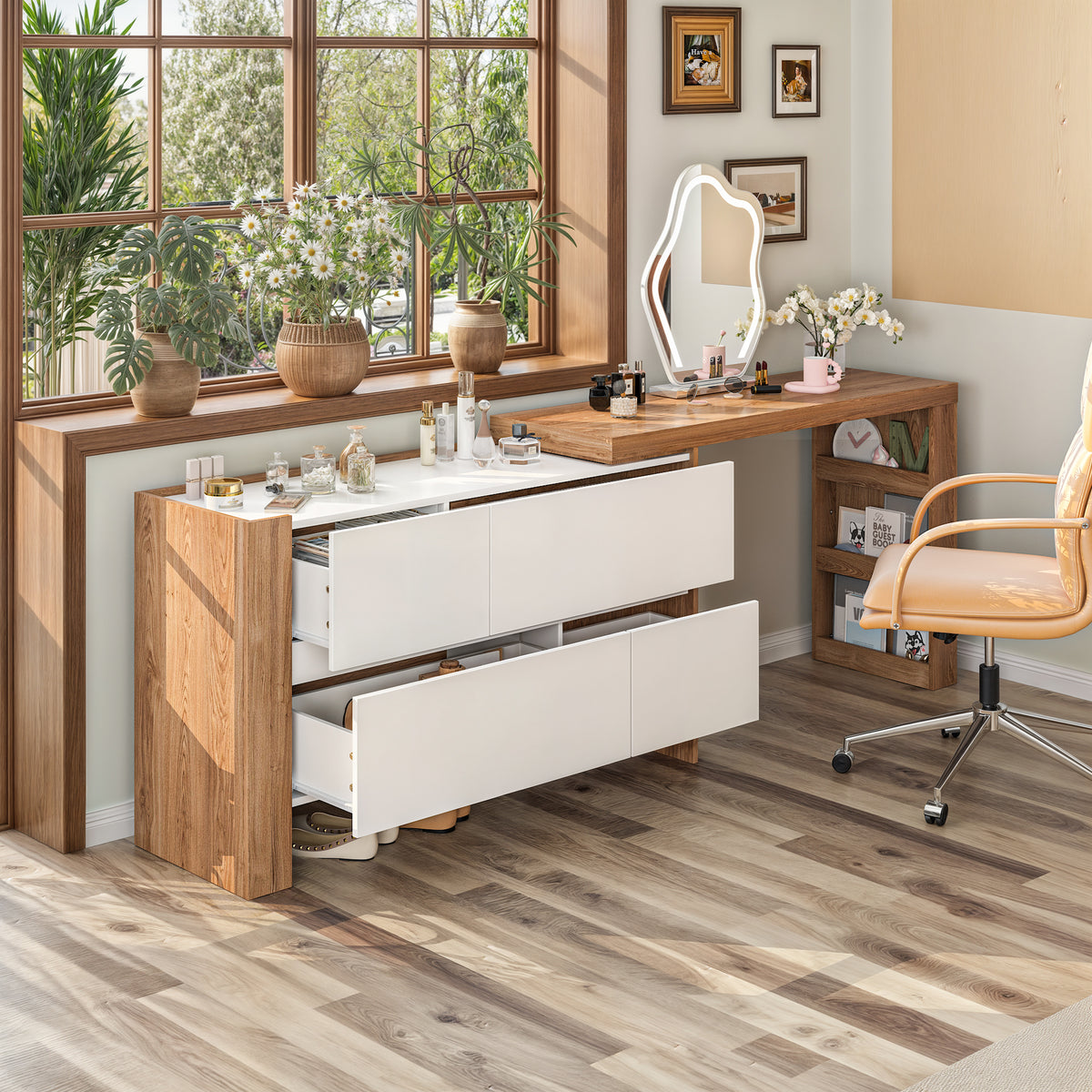
Daylight is not constant, though. It shifts through the day and disappears in the evening, so it works best combined with a consistent artificial light source. For tips on angling a vanity toward a window, see where to put a vanity in a bedroom.
LED Mirror Light Modes Explained
Most LED vanity mirrors now offer more than one white. Many cycle through three modes, a warm white, a neutral white and a cool white, using two sets of LEDs. The Department of Energy explains that white-tunable LED products raise and lower the output of a warm-white and a cool-white LED group to shift the color temperature in between.
How to use the modes:
- Apply base, concealer and brows in the neutral or cool (daylight) mode.
- Switch to warm to see how the look will read at an evening event.
- Use the dimmer to reduce glare once the detail work is done.
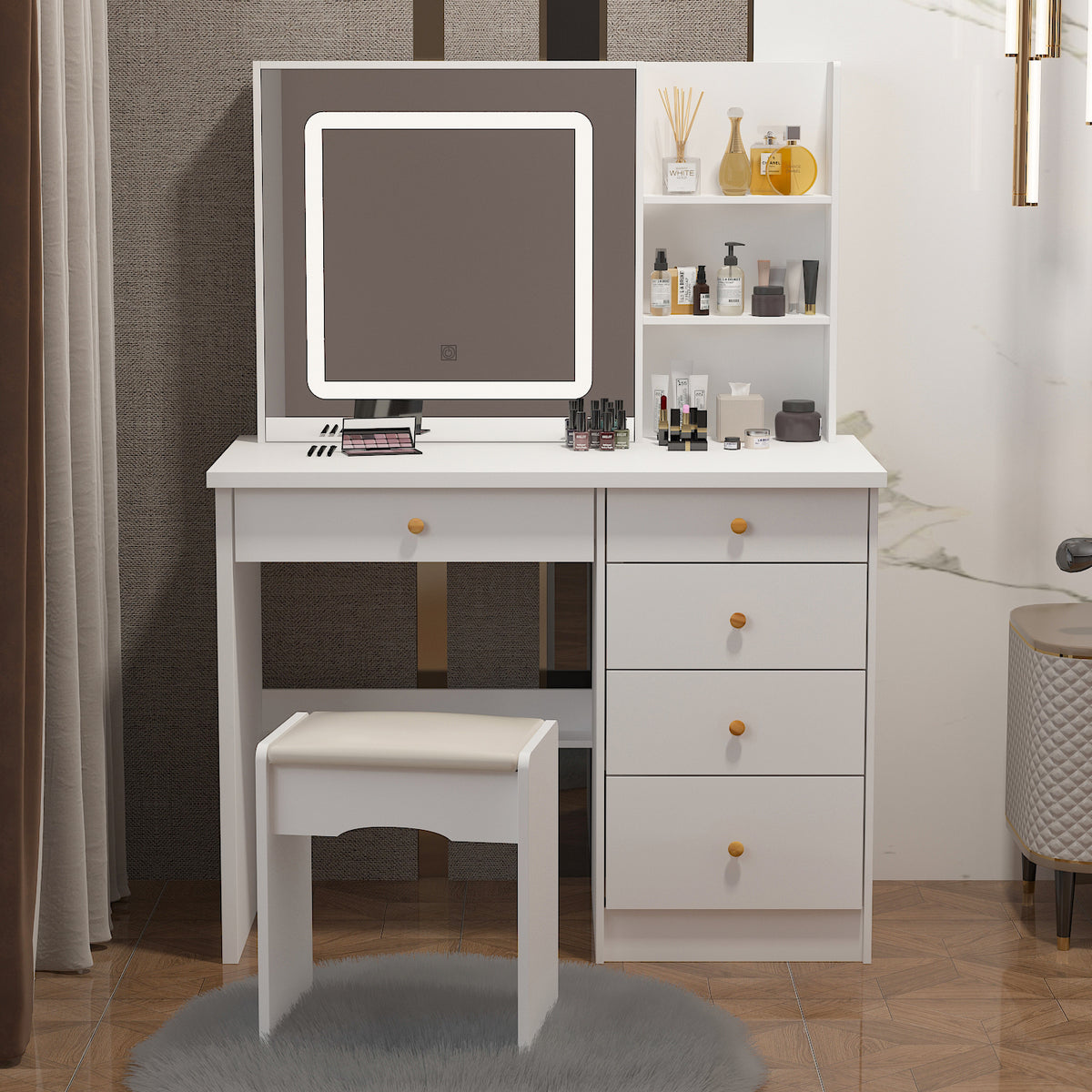
In the FUFU&GAGA range, 26 of 37 vanities have a lighted mirror and 13 list adjustable lighting. Examples include the 43.3" dressing table with tri-fold lighted mirror, the 39.4" vanity desk with sliding lighted mirror and built-in outlet, the 31.5" vanity desk with LED mirror and matching stool and the 47.2" vanity with full-length LED mirror. Check each product page for the exact lighting features. For a feature-by-feature look at lighted vanities, our guide to lighted vanities covers styles and storage.

Common Mistakes in Makeup Lighting
- Relying on overhead light only: the most common mistake; it creates deep shadows under the eyes.
- Warm bulbs below 3,000K for application: skin looks more even than it is, so foundation and bronzer go on too heavy.
- Very cool light above 6,500K: skin looks washed out, and blush goes on too strong.
- Mixing color temperatures in the same room or on the same mirror.
- Ignoring CRI: a bright light with poor color rendering still distorts shades.
- Light from behind or one side: puts part of your face in shadow and causes glare on the mirror.
Quick Setup for the Best Makeup Lighting at Home
- Face a window or angle the vanity beside it for daytime light.
- Add front or side lights at eye level: a lighted mirror or two matching sconces or lamps.
- Choose about 4,000 to 5,600K and CRI 90+ for those lights.
- Make them dimmable, and match the color temperature of any ceiling light.
- Check the final look in daylight or warm light, depending on where you are going.
Ready to set up a station? Browse lighted mirrors, tri-fold dressing tables and compact flip-top designs in the makeup vanity collection, and compare mirror styles in our guide to vanity mirror types. LED lighting components on FUFU&GAGA vanities are covered by a 1-year limited warranty.
FAQ
What is the 3 lighting rule?
In interior design, the three-layer rule means combining ambient light (general room light), task light (focused light for an activity) and accent light (decorative). At a vanity, the makeup mirror or side lights are the task layer; ceiling light alone is only ambient and is not enough for makeup.
What lighting makes your face look the best?
Soft, diffused front light at eye level is the most flattering because it fills in shadows and texture. Slightly warm light flatters skin, but for applying makeup accurately, neutral or daylight-balanced light gives truer results.
Is warm or cool light better for makeup?
Neither extreme. Warm light below 3,000K hides redness and leads to over-application; very cool light above 6,500K washes skin out. A neutral-to-daylight range of about 4,000 to 5,600K is the best compromise.
Are ring lights good for makeup?
Ring lights give even, shadow-free front light and are popular for filming tutorials. For everyday application, check that the color temperature is adjustable and the CRI is 90 or higher, and avoid placing it so close that it causes glare.

Dejar un comentario
Este sitio está protegido por hCaptcha y se aplican la Política de privacidad de hCaptcha y los Términos del servicio.