








Short answer: changing table safety comes down to a few habits and a sturdy setup. Use a stable changing table with barriers on all four sides and a snug, secured changing pad; anchor any dresser to the wall; buckle the safety strap but never rely on it; stay within arm's reach of your baby for the entire change; and keep supplies ready before you start. Stop using the table when your baby reaches the age or weight limit on its label, typically around 30 pounds.
Falls are a key hazard with any raised changing station, and as the required warning label puts it, falls can happen quickly. This guide explains what the federal standard requires, how to set up a dresser-style changing station safely, and the daily rules that prevent falls. You can compare safety features on every model in our changing table collection.
What the Federal Changing Table Safety Standard Covers
In the US, baby changing products sold for home use must meet a mandatory CPSC standard, 16 CFR part 1235, which incorporates ASTM F2388. According to the CPSC's business guidance for baby changing products, products made after July 31, 2022 must meet ASTM F2388-21. The standard covers:
- Changing tables, described as elevated, freestanding structures designed for a child up to 30 lb.
- Add-on changing units, such as rigid trays used on another piece of furniture like a dresser.
- Contoured changing pads with built-in barriers.
- Changing table accessories that convert a crib or play yard into a changing table.
The requirements address stability, barriers, structural integrity, retention of pads and add-on units, restraint systems and warning labels. The CPSC's 2018 final rule briefing package lists the required fall-hazard warning: falls can happen quickly, so "STAY within arm's reach." For products that attach to furniture, the label adds that you should always secure the unit or pad to the support surface as instructed.
One detail matters for nursery dressers: the same rule package notes that the stability of furniture such as dressers that incorporate changing products is addressed by ASTM F2057, the clothing storage unit standard. That is why anchoring a dresser matters so much.
1. Choose a Sturdy Table With Barriers on Four Sides
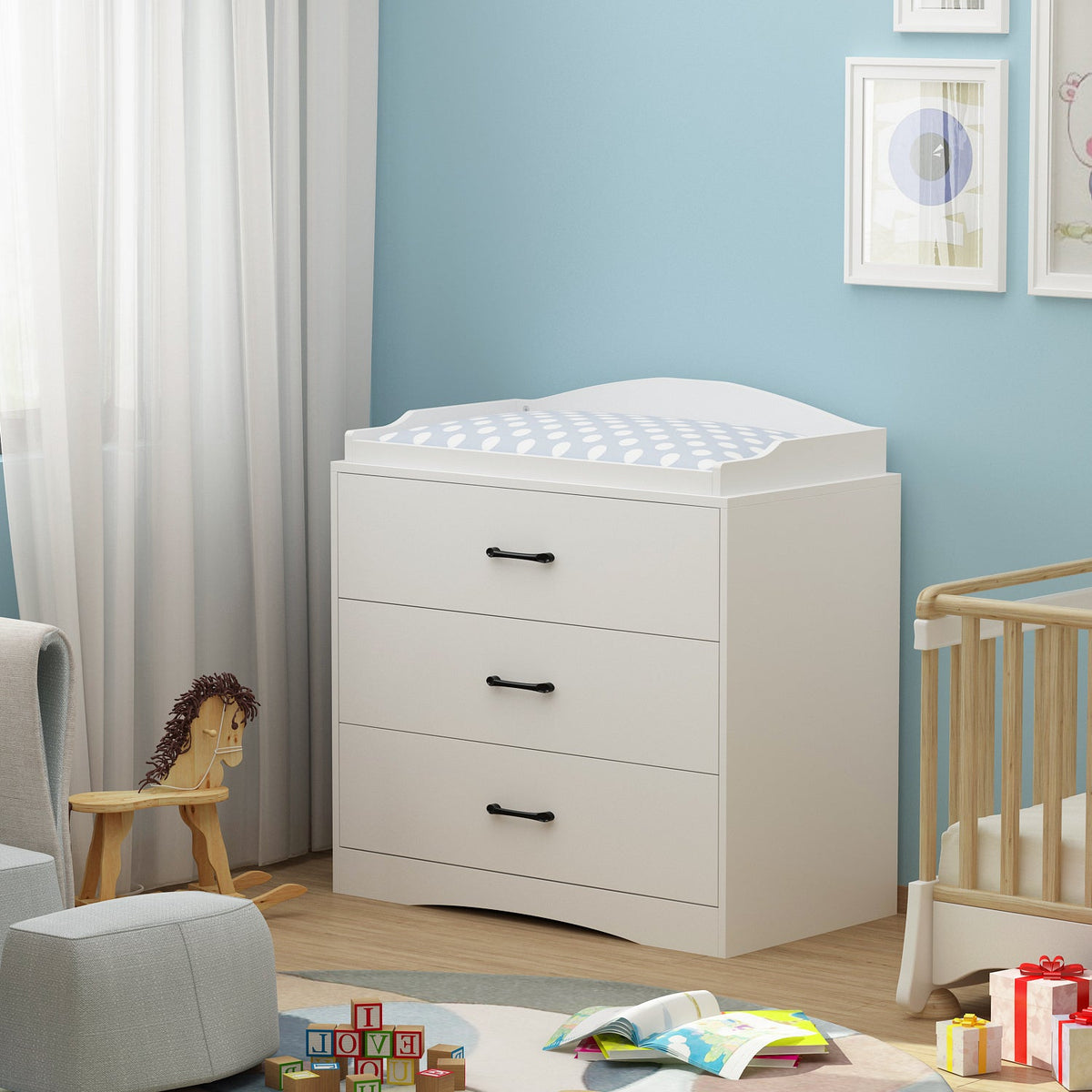
The American Academy of Pediatrics advises choosing a sturdy, stable changing table with a 2-inch guardrail around all four sides, and a concave top so the middle is slightly lower than the sides. Before you buy, check that:
- The table or dresser does not wobble when you push on the top.
- Rails or a changing topper frame the changing area on all sides, or you use a contoured pad that provides barriers.
- Drawers have stops so they don't pull out and fall. Five of our nine changing table dressers list drawer safety stops.
On our models that list a safety rail height, it is 2.8 to 3.1 inches.
2. Anchor the Dresser to Prevent Tip-Overs
A changing table dresser holds a baby on top and heavy drawers below, and toddlers love to climb open drawers. The CPSC adopted ASTM F2057-23 as a mandatory standard for dressers and other clothing storage units, and reports 234 tip-over deaths from January 2000 through April 2022, including 199 children. It also recommends anchoring dressers securely to the wall.
- All nine FUFU&GAGA changing table dressers include a tip-over restraint kit. Install it during assembly, before the first diaper change.
- Fasten into a wall stud where possible, or use anchors rated for your wall type. Our step-by-step guide on how to anchor furniture to the wall covers drywall, studs and masonry.
- Open only one drawer at a time, and close it before you turn back to your baby.
Some models also list third-party stability claims. For example, the 46.3" black changing table with 3 drawers and 2 cabinets lists Product Stability UL Verified, ASTM F2057-19 and CPSIA compliance, and the 35.4" white 3-drawer changing table lists UL stability verification, CPSIA compliance and built-in safety rails. Even so, anchoring is still required.

3. Make Sure the Changing Pad Fits and Is Secured
A pad that slides or leaves a gap at the edge undermines every other safety feature. Choose a contoured changing pad sized for the changing area, so it sits snugly inside the rails or changing topper with no gaps along the sides. Then fasten it the way its instructions describe. Replace the cover if it bunches or makes the pad shift, and check the fit again after every wash.
4. Use the Safety Strap, but Don't Depend on It
The AAP's advice is to buckle the safety strap but not depend on it alone to keep your child secure. The CPSC explained in its rule that if caregivers believe straps make a changing table safe, they may leave a child unattended, and a child left in a single waist strap is exposed to a potential strangulation hazard. The strap is a backup for the moment you reach for a wipe, not a babysitter.
5. Never Leave Your Baby Unattended
Never leave a child unattended on a changing table, even for a moment, even if the baby is strapped. Babies can roll or push off with their feet earlier than parents expect, and a newborn who has never rolled can still wriggle toward the edge.
- Keep one hand on your baby whenever you are not using both.
- If the doorbell or phone rings, pick your baby up and take them with you, or put them in the crib.
- Never use the changing table as a place to sleep. Move a drowsy baby to a crib or bassinet.
6. Keep Diaper Supplies Within Your Reach, Not Your Baby's
Turning or stepping away to grab something is exactly when a fall can happen. Set out everything before you lay your baby down: a fresh diaper, wipes, diaper cream, a clean outfit and a changing pad liner. Keep them within your reach but out of your child's reach. Store powders, creams, plastic bags and small objects where your baby can't grab them; the AAP warns that a child who shakes open a powder container can inhale particles.
A changing table dresser makes this easier, because the top drawer sits right under your hands. Our guide on how to organize a changing table shows a layout that keeps everything one step away.
7. Set the Right Height for You
A table that is too low makes you bend and lose your stable stance; one that is too high pushes the baby farther from your body. Aim for a changing surface at or slightly below your bent elbows. Our models range from 32.9 to 39 inches tall overall. Our changing table height guide explains how to measure.
8. Keep the Station Clean and Sanitary
Changing tables are sanitary when you clean them. Wipe the pad cover after every messy change, wash covers and liners regularly, and wash your hands after each change. Wipe the dresser itself with a damp cloth and mild soap, following each product's care instructions; avoid abrasive cleaners. Three of our models list antimicrobial surfaces, but routine cleaning still matters.
9. Know When to Stop Using the Changing Table
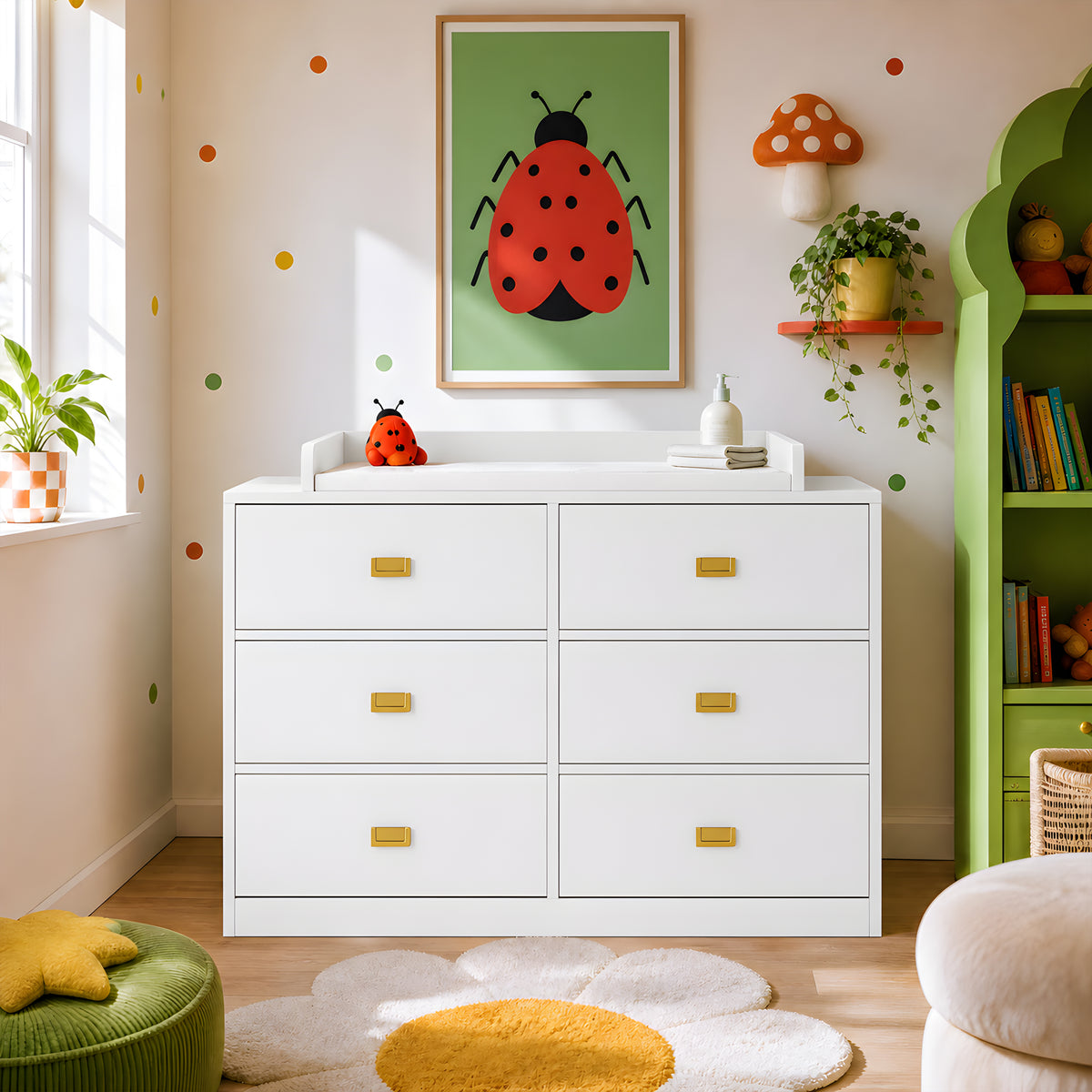
Stop when your baby reaches the age or weight limit the manufacturer recommends on the label. The federal standard describes changing tables as designed for children up to 30 lb, so that is a common limit. Many parents switch to floor changes sooner, once a baby becomes very strong, starts climbing, or fights every change. A dresser with a removable topper then becomes regular storage. Six of our nine models list a removable changing topper, including the 45.1" white/gray 6-drawer changing table dresser.
Changing Table Safety Checklist
| Check | What good looks like |
|---|---|
| Stability | No wobble; dresser anchored to the wall with the anti-tip kit |
| Barriers | Rails or topper on all four sides, or a contoured pad; guardrails at least 2" |
| Changing pad | Correct size, no gaps, fastened as instructed |
| Safety strap | Buckled every time, never a substitute for supervision |
| Supervision | One hand on baby; you stay within arm's reach |
| Supplies | Prepared before the change; hazards out of baby's reach |
| Limits | Stop at the label's age or weight limit |
Ready to set up a safer changing station? Compare anti-tip kits, rails, removable toppers and listed certifications across our changing table dressers, or read our changing table vs. dresser comparison if you are still deciding. FUFU&GAGA offers a replacement parts service if anything in your anti-tip kit goes missing.
FAQ
Are baby changing tables safe?
Yes, when they meet the federal standard and are used correctly. The standard targets falls, structural failures, instability, entrapment and suffocation, so the setup (barriers, a secured pad, an anchored dresser) and the habit of staying within arm's reach matter more than any single feature.
How do I keep my baby from falling off the changing table?
Prepare supplies first, buckle the strap, keep one hand on your baby, and never step away. Use a contoured pad that fits snugly inside the rails, and change your baby on the floor if you have to turn around.
Can I skip the strap if I'm keeping a hand on my baby?
Use both. The strap gives a little extra security while you reach for a wipe, and your hand and attention do the real work. Neither one alone is enough.
Are changing tables sanitary?
They are when you keep them clean. Use a wipeable pad cover or disposable liners, clean after messy changes, launder covers often, and wash your hands after every diaper change.


Dejar un comentario
Este sitio está protegido por hCaptcha y se aplican la Política de privacidad de hCaptcha y los Términos del servicio.