










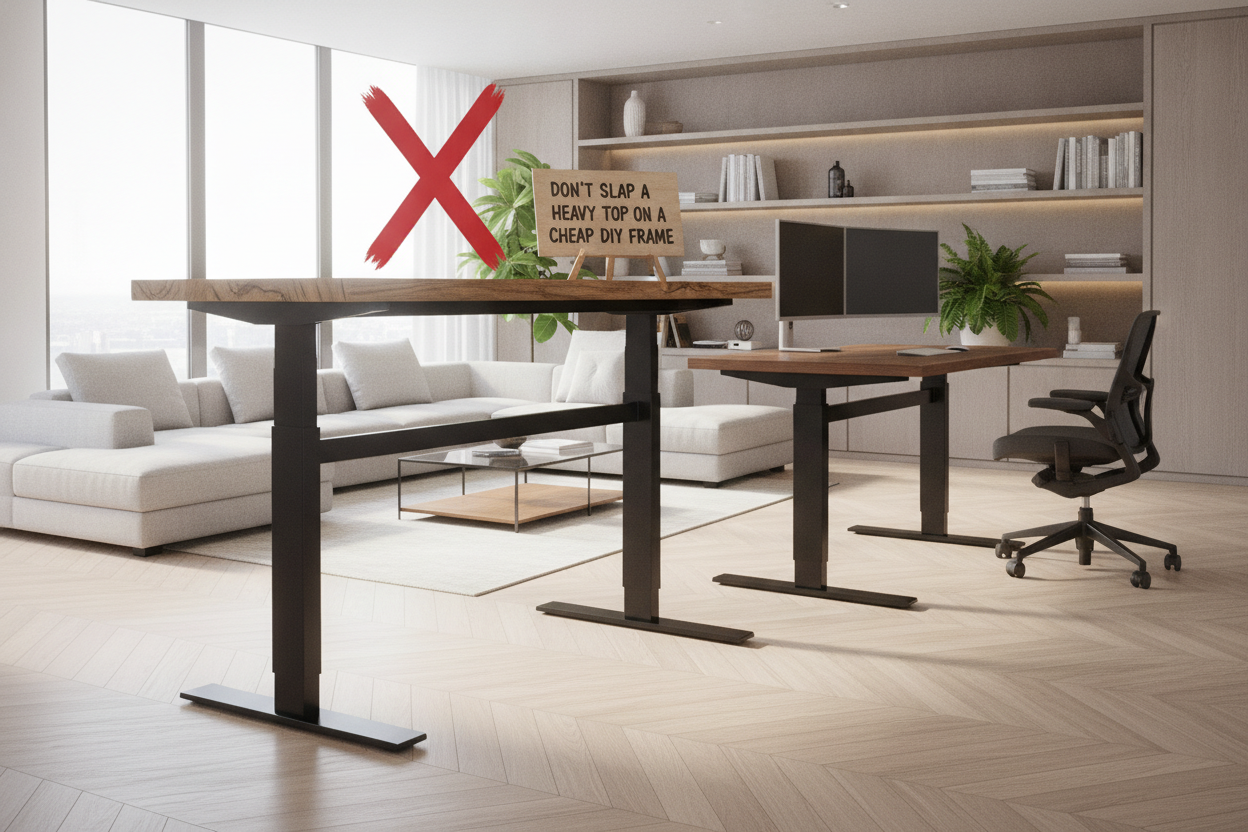
I spent three weeks sanding a solid maple slab until it was smooth as glass. I bought the cheapest diy sit stand desk frame I could find on a flash sale, thinking I had hacked the system. The moment I hit the 'up' button, the motor screamed like a dying blender and the whole thing tilted five degrees to the left.
If you have ever watched your $2,000 MacBook Pro wobble like a leaf in the wind because you typed a little too aggressively, you know the regret. Building your own desk is a rite of passage, but the physics of a moving heavy object do not care about your budget.
Quick Takeaways
- Cheap frames are designed for lightweight MDF tops, not heavy solid wood.
- Dual motors are non-negotiable for any top over 50 pounds.
- Three-stage legs provide better stability and height range than two-stage legs.
- Always factor in the weight of your gear, not just the wood slab.
The 'Cheap Base, Heavy Wood' Trap
Most of us start this journey because we are tired of a cramped, static writing computer desk that leaves our lower back screaming by 3 PM. The logic seems sound: buy a cheap lifting base online for $180 and pair it with a massive 80-pound butcher block from the hardware store. It looks great on Instagram, but it is a mechanical nightmare.
These budget frames usually have thin steel walls and single motors that are rated for 'total capacity' in a perfect world. In reality, once you add that heavy slab, the frame is already at 60% capacity before you even set down a monitor. You end up with a desk that groans every time you change positions.
Doing the Math on Your Desk's Real Weight
Weight capacity is the most lied-about spec in the furniture world. If a frame says it holds 150 pounds, that is usually static weight—meaning it can hold it while sitting still, not necessarily lift it smoothly every day for five years. You have to subtract the weight of the top first. A standard 60-inch acacia block weighs about 65 pounds.
Then add your dual-monitor arm (15 lbs), your tower PC (30 lbs), and that heavy mechanical keyboard. Suddenly, you are pushing the limits of a budget motor. People often ask if a custom build is actually cheaper than buying one, and the answer is usually 'no' if you want a frame that won't burn out in six months. High-quality steel and heavy-duty actuators cost money.
Why Your Standing Desk Frame DIY Needs Dual Motors
If you are planning a standing desk frame diy project with anything sturdier than a hollow-core door, get a dual-motor system. Single motors use a hex rod to drive the second leg. That rod is a major fail point; it slips, it squeaks, and it ensures one leg always moves slightly slower than the other.
Dual motors—one hidden in each leg—distribute the load evenly. This is vital when your desk setup is lopsided, like having a heavy PC on the right side. Dual motors can handle the uneven torque without the internal gears grinding themselves into metal shavings. It is the difference between a smooth glide and a jerky, terrifying ascent.
The Anti-Wobble Specs You Can't Ignore
Wobble is the enemy of productivity. To avoid it, look for 3-stage columns. These have three overlapping sections of steel instead of two, which allows the desk to go lower and higher while maintaining more overlap between the segments for rigidity. If the legs look like toothpicks, the desk will act like one.
Check the 'feet' of the frame, too. You want long, heavy steel feet with adjustable leveling pads. Some high-end frames include wedge gussets at the top where the leg meets the crossbar. This prevents the 'front-to-back' sway that makes your monitors shake while you type. If the frame doesn't have a solid crossbar or reinforced mounting plates, keep looking.
My Final Custom Build (And What I'd Do Differently)
My current setup uses a heavy-duty industrial frame paired with a 1.75-inch thick walnut top. It is rock solid, but I spent nearly $900 all-in. If I were doing it again on a tighter budget, I would skip the DIY headache entirely. Honestly, grabbing a reliable sit stand up desk with memory preset controller that comes as a complete kit is often more stable than a mismatched DIY pairing.
If you do go the DIY route, over-spec your frame. If you think you need 150 lbs of lift, buy a frame rated for 250. Your motors (and your floors) will thank you when you aren't recalibrating a tilted desk every Monday morning.
FAQ
Can I use a kitchen countertop for a standing desk?
Yes, but butcher blocks are incredibly heavy. Ensure your frame is rated for at least 250 lbs to account for the wood and your equipment. You will also need to pre-drill holes to avoid splitting the wood.
How do I stop my DIY desk from wobbling?
Make sure all bolts are tightened with a socket wrench, not just the included Allen key. Also, ensure the desk is perfectly level; even a half-inch slope makes the center of gravity wonky when the desk is extended.
Is a crossbar necessary for a standing desk?
For most budget or mid-range frames, yes. It adds lateral stability. Some high-end frames use thicker leg columns to achieve stability without a crossbar, but those are generally more expensive.



Dejar un comentario
Este sitio está protegido por hCaptcha y se aplican la Política de privacidad de hCaptcha y los Términos del servicio.