


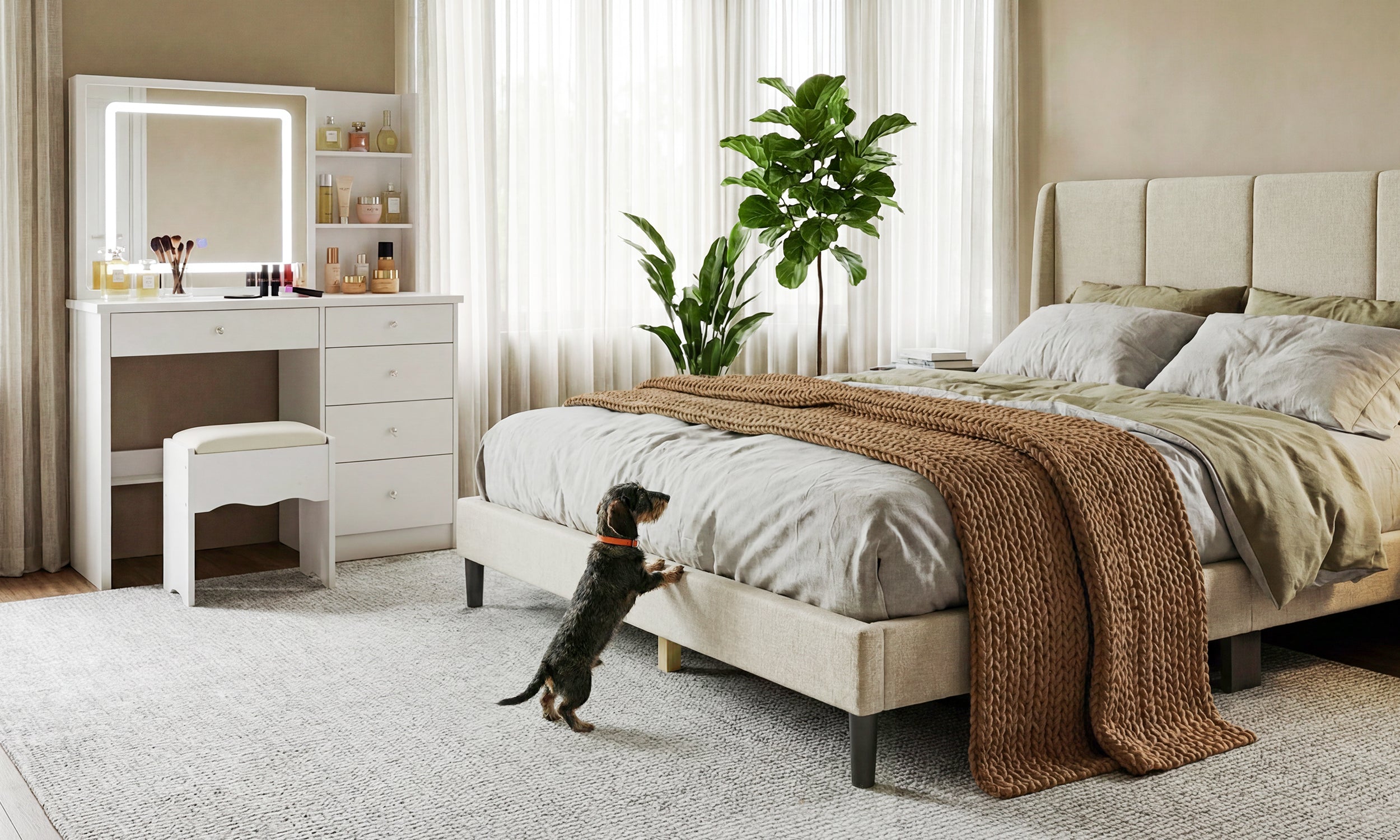


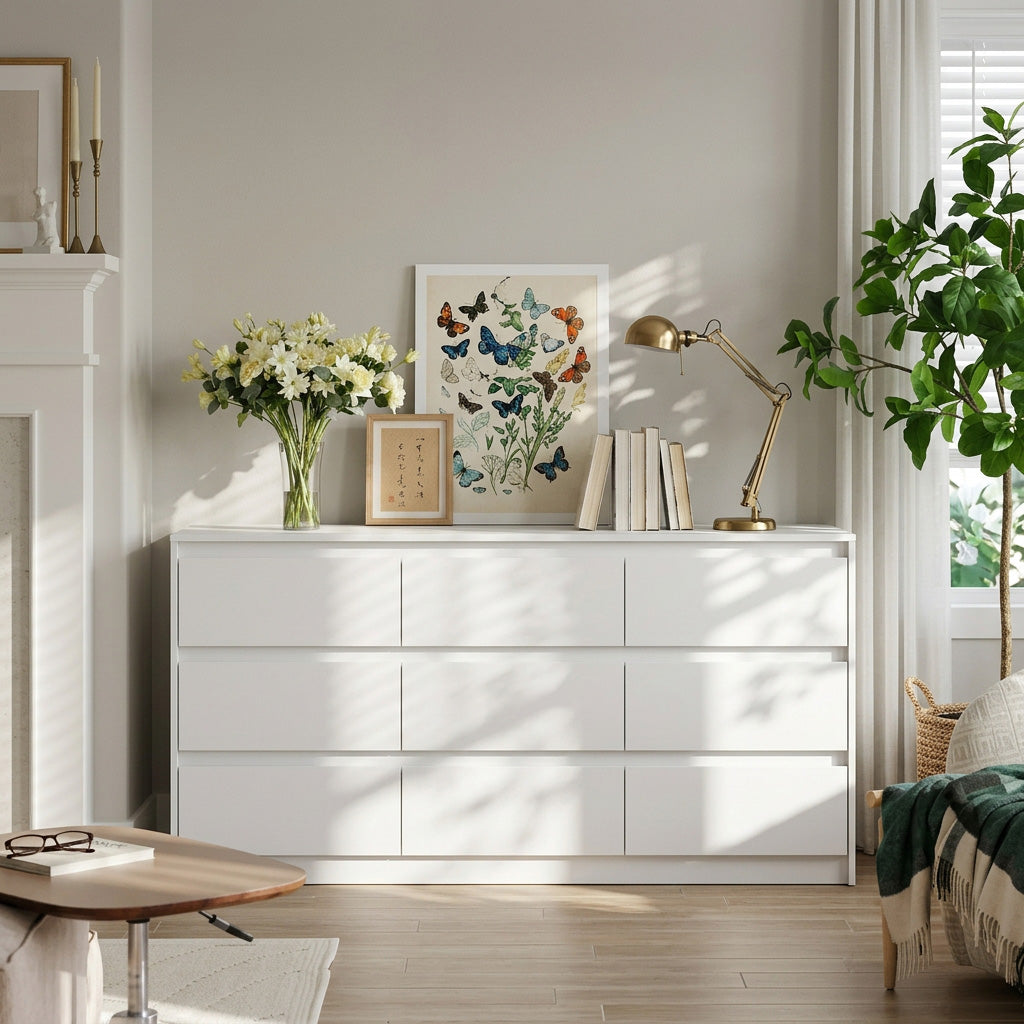
Dresser vs chest of drawers, in short: a dresser is low, wide and about waist high, with drawers in two or three columns and a large top surface. A chest of drawers is tall and narrow, with four to six drawers stacked in a single column, so it gives you storage without taking much floor space. Pick a dresser for a long wall and shared storage; pick a chest for small bedrooms, corners and kids' rooms.
In everyday US shopping the two names overlap, and many listings call one piece both. This guide explains the main difference, defines the related types (double dresser, tall chest, lowboy, gentleman's chest and more) and shows which one fits which room. You can compare both shapes in our dressers and chests collection.
Dresser vs Chest of Drawers: Quick Comparison
| Dresser | Chest of drawers | |
|---|---|---|
| Shape | Low and wide, horizontal design | Tall and narrow, vertical design |
| Typical height | About 28–36" (waist high) | About 40–60" (chest to shoulder height) |
| Typical width | About 45–72" | About 20–40" |
| Drawer layout | 6–9 drawers in two or three columns | 4–6 drawers stacked in one column |
| Top surface | Large: mirror, lamp, tray, sometimes a TV | Small: a lamp or a few décor pieces |
| Floor space | Needs a long open wall | Fits a corner or narrow wall |
| Best rooms | Primary bedrooms, larger rooms, guest rooms | Small bedrooms, kids rooms, nurseries, closets |
Sizes vary by brand, so treat these as typical ranges. In the FUFU&GAGA range, horizontal dressers are mostly 30–37" tall and 45–71" wide, and tall chests are about 40–47" tall and 23.6–31.5" wide. For exact numbers by type, see our standard dresser dimensions guide.
What Is a Dresser?
In American English, a dresser is a waist-high piece of bedroom furniture with drawers and room on top for a mirror (Wikipedia's chest of drawers entry notes that British English uses "dresser" for a kitchen piece with open shelves for tableware). A standard dresser spreads its drawers side by side, so each drawer is wide and fairly shallow. That layout suits folded clothes like t shirts, jeans and sweaters that you want to see at a glance.
The other strength is the top surface. A wide dresser gives you surface area for a mirror, a table lamp, a jewelry box and a tray for daily essentials, which makes it part of your daily routine as well as clothing storage.
Double dresser and triple dresser
A double dresser has two columns of drawers, usually six to eight in total, under one long top. A triple dresser adds a third column, typically nine drawers. The Modern 9-Drawer Triple Dresser is a good example: 63" wide, 31.5" tall and 15.7" deep, with nine drawers in three columns. If you share a bedroom, a double or triple dresser gives each person their own column.

Lowboy
A lowboy is an older term for a low chest or table with one or two rows of drawers on short legs, historically used as a dressing table or side table (source). Today the word is used loosely for any extra-low dresser. A modern equivalent is the 47.2" 9-drawer dresser with LED lights, which stands only 24.1" tall, low enough to sit under a window or a wall-mounted TV.
Combo dresser
A combo dresser (or combination dresser) mixes drawers with a cabinet door or open shelves. It works well in a guest room or living room where you need to hide bulkier items, not only clothes.
What Is a Chest of Drawers?
A chest of drawers is a cabinet with drawers stacked one above another. In the US, people use "chest of drawers," "chest," "tall chest" and "vertical dresser" for the tall, narrow version. Because the drawers stack in one column, a vertical chest is all about maximizing vertical space: you get five or six drawers on a small footprint. A 31.5" x 15.7" chest covers about 3.4 square feet of floor.
The drawers are narrower than a dresser's, so they suit smaller folded items: socks, underwear, t shirts, workout clothes. Taller pieces put the top drawer near chest height, which is easy access for adults but out of reach for small kids.

The 31.5" white 6-drawer tall chest is a typical example: 47.4" tall, 31.5" wide and 15.7" deep. The black 5-drawer vertical dresser has a similar footprint at 47.2" tall.
Tallboy, highboy and double chest
Historically, a highboy is a double chest of drawers (a chest-on-chest) whose lower section is usually wider than the upper one, while a tallboy in British usage can mean a chest of drawers with a wardrobe on top (source). In modern US stores, "tallboy," "highboy" and "tall chest" are all used for a tall, narrow chest of drawers.
Lingerie chest and bachelor's chest
A lingerie chest is a very narrow chest with many shallow drawers, often six or seven, for small garments and accessories. A bachelor's chest is a compact, low chest, typically with three drawers, that can double as a nightstand or hallway piece. The 31.5" 3-drawer chest with metal legs fits that role at 29.7" tall.
Gentleman's chest
A gentleman's chest is a tall chest with a pair of doors on the upper part, hiding shelves or small drawers, above full-width drawers. The concealed section was meant for accessories such as watches, ties and folded shirts. Few modern stores use the name; if you want the same mix of hidden compartments and drawers, look for combo dressers or chests with a cabinet section.
Key Differences Between a Dresser and a Chest of Drawers
1. Footprint and floor space
This is the main difference. A dresser needs a long wall: a 63" nine drawer dresser takes about 5 feet of wall plus open floor in front for the drawers. A chest of drawers covers a fraction of that width, which is why it is the go-to in small spaces.
2. Storage capacity and drawer shape
With multiple drawers spread across two or three columns, a dresser usually offers more total storage capacity and wider drawers for bulkier items. A chest offers fewer, narrower drawers but gives you better organization by category, one drawer per type of clothing.
3. Top surface and mirror use
A dresser's long top surface works as a styling and landing zone, with room for a mirror, lamp and tray. A chest's top is small and often above eye level for kids, so keep it to one or two objects. For ideas, see what to put on top of a dresser.
4. Height and stability
A tall, narrow chest has a small base for its height, so it can tip more easily when open drawers are pulled on or climbed. Dressers can tip too. Anchor both types to the wall; the CPSC's Anchor It! campaign recommends anchoring all furniture with drawers. Our guide on how to anchor furniture to the wall covers hardware and wall types.
Which One Fits Which Room?
| Room | Better choice | Why |
|---|---|---|
| Primary bedroom / master bedrooms | Double or triple dresser | Maximum storage, shared columns, space for a mirror |
| Small bedroom or studio | Tall chest | Uses vertical space, leaves floor open |
| Kids rooms and nurseries | Low dresser, anchored | Kids can reach the drawers; anchor it to the wall |
| Guest room | 6-drawer double dresser | Holds a suitcase's worth of clothes and doubles as a landing zone |
| Walk-in closet | Narrow chest or multi-drawer chest | Fits between hanging sections |
| Living room or entryway | Low, wide dresser | Works as a media console or sideboard with a finished back |
For a nursery, a dedicated changing table with safety rails is safer than a loose pad on a dresser top. In a dressing area, a makeup vanity may serve you better than a dresser with a mirror.
Can You Use a Dresser and a Chest in the Same Room?
Yes, and in larger rooms it is a common bedroom layout. Put the wide dresser on the long wall opposite the bed and the tall chest in a corner or next to the closet. Matching finishes keep the room calm; contrasting heights add visual interest. Make sure you leave enough room in front of both pieces for drawers to open, roughly 30–36" of clear floor.
How to Choose the Right Furniture for Your Bedroom
- Measure the wall. If you have 5 feet or more of open wall, a dresser fits. Under about 3 feet, choose a chest.
- Count your folded items. Lots of sweaters and jeans favor wide, deep drawers; lots of small items favor a chest.
- Check depth. A standard dresser depth is roughly 16–20"; many FUFU&GAGA models are 15.7" deep, which helps in tight rooms.
- Decide what the top is for. Mirror, TV stand, writing surface or display? Only a wide dresser handles all of them.
- Look at the hardware. Metal slides, drawer stops and a tip-over kit matter more than the name on the listing. See how to tell if a dresser is good quality.
Ready to compare sizes side by side? Browse the full FUFU&GAGA dressers and chests and filter by drawer count and width.
FAQ
What do Americans call a chest of drawers?
Americans use "chest of drawers," "chest," "dresser" and "bureau" almost interchangeably. In stores, "dresser" usually means the low, wide piece and "chest" or "tall chest" means the tall, narrow one.
What do British people call a dresser?
In British English, a dresser is usually a kitchen or dining piece with open shelves above a cupboard, used to display tableware. The American bedroom dresser is simply called a chest of drawers in the UK.
What is the main difference between a chest of drawers and a tallboy?
Today, mostly height. A tallboy is a taller version of a chest of drawers, often with more stacked drawers. Historically the term could also mean a chest of drawers with a wardrobe section on top.
Are dressers still used in bedrooms?
Yes. Dressers remain the main clothing storage piece in most US bedrooms, especially where closets are small. Many people also use them as a TV stand, media console or sideboard in other rooms.


Dejar un comentario
Este sitio está protegido por hCaptcha y se aplican la Política de privacidad de hCaptcha y los Términos del servicio.