










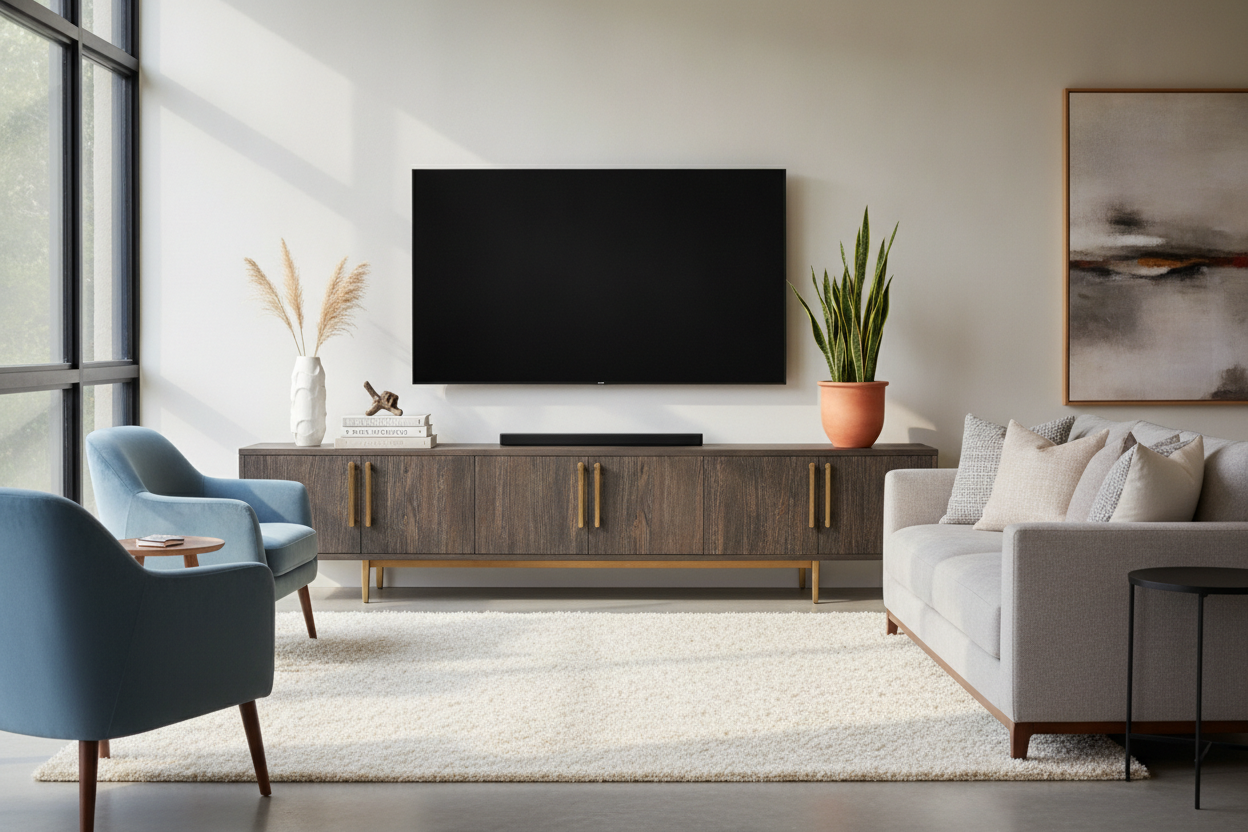
I spent three weeks scrolling through 800-pixel-wide thumbnails of hand-carved sideboards before I finally found 'the one.' It was a stunning piece of craftsmanship with bone inlay and brass feet. Then I put my 65-inch OLED on it. Suddenly, my living room didn't look like a boutique hotel; it looked like a Best Buy warehouse had crashed into a Parisian flea market.
We buy a beautiful accent tv stand because we want character, but the reality of a giant black plastic rectangle sitting on top of it often kills the vibe. It’s a visual tug-of-war where the tech is too loud and the furniture is trying too hard. If you don't balance the visual weight, your expensive media unit just looks like an afterthought.
Quick Takeaways
- Choose a unit at least 6-10 inches wider than your TV on both sides to avoid the 'top-heavy' look.
- Match the hardware on your console to other metal accents in the room, like floor lamps or coffee table legs.
- If the furniture has spindly legs, wall-mount the TV 4 inches above it to take the physical pressure off the piece.
- Never, ever let a single cable be visible; it ruins the 'furniture' illusion immediately.
The Problem With Putting Statement Furniture Under a Giant Tech Box
Modern TVs are getting bigger while our living rooms stay the same size. When you place a highly decorative accent entertainment center under a 75-inch screen, you're creating a massive block of high-contrast 'stuff' that dominates the wall. The eye doesn't know whether to look at the intricate wood grain or the latest Netflix hit.
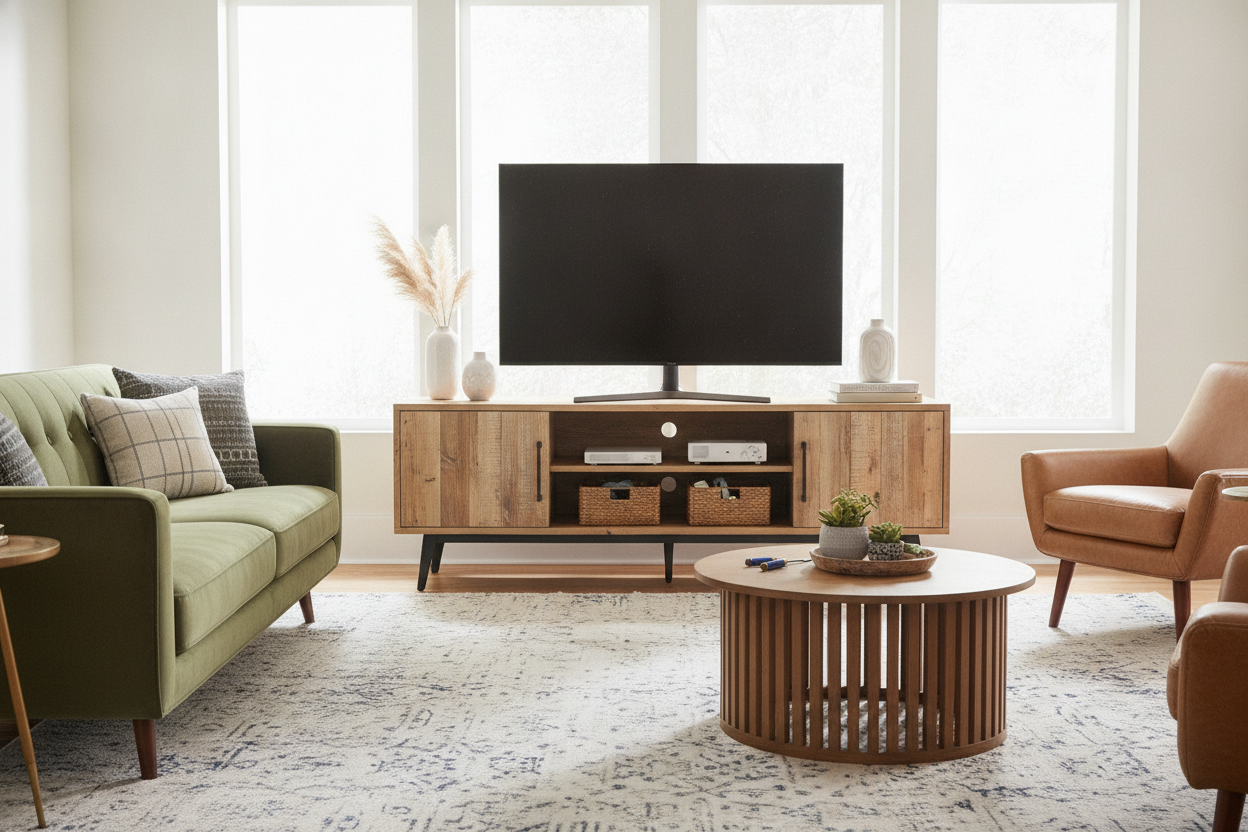
The mistake most people make is choosing a piece that is too small. If your TV overhangs the edges of your accent tv cabinet, the whole setup looks unstable and cheap. You need negative space on the surface of the stand to place a few non-tech items—a ceramic vase or a stack of books—to bridge the gap between 'appliance' and 'interior design.'
Rule 1: Anchor the Chaos With a Grounded TV Accent Cabinet
Visual weight is everything. If you have a massive screen, you need a base that looks like it could actually support a small car. I’ve seen too many people try to put a heavy TV on a mid-century piece with thin, toothpick legs. It creates an anxiety-inducing silhouette where the TV looks like it's about to crush the furniture.
I eventually realized that transitioning to a more substantial display cabinet TV stand was the only way to ground the room. A piece with a solid base or thicker plinth feels permanent. It stops the TV from 'floating' awkwardly and makes the media area feel like a destination rather than a temporary tech setup. Solid hardwoods or heavy-duty MDF with a high-quality veneer provide the density you need to balance the dark void of a turned-off screen.
Rule 2: Let Your Accent TV Console Dictate the Hardware
If your accent tv console features specific textures—think fluted wood, rattan inserts, or aged brass pulls—those elements need to be repeated elsewhere in the room. If the console is the only thing with brass in a room full of brushed nickel, it will stick out for the wrong reasons. I always look at the knobs first; they are the jewelry of the piece.
For example, styling a black cabinet with glass doors requires a bit of internal curation. You can't just shove your Xbox and a tangled mess of controllers behind glass. You need to use the shelves for decorative objects or neatly organized media. The black frame of the cabinet actually helps the TV blend in, as the screen becomes just another dark rectangle in a cohesive design scheme rather than a sore thumb.
Rule 3: You Must Ruthlessly Hide Every Single Cord
Nothing kills the 'accent' in an accent cabinet for tv faster than a dangling HDMI cord. Most high-end decorative pieces weren't actually designed with cord management in mind. I’ve had to take a 2-inch hole saw to the back of a $1,200 vintage sideboard just to keep the cables out of sight. It’s painful, but necessary.
If you aren't handy with a drill, look for a modern TV console cabinet that builds these features in. You want something that offers internal channels or at least a recessed back panel. Use zip ties or cable sleeves for the 2 inches of cord that run from the TV to the stand. If I can see a power strip, the styling has failed. Period.
When to Abandon Ship and Just Hide the Screen Completely
Sometimes, no matter how much you style it, the TV is just too big and the room is too small. If you're living in a space where the screen feels like it's screaming at you, it might be time to stop trying to style around it and start styling over it. This is the 'nuclear option' for design purists.
The ultimate move is an electric vertical lift TV cabinet. This allows you to have a gorgeous, clean-topped accent media console for 90% of the day. When you want to watch a movie, the TV emerges like a Bond gadget. It’s the only way to truly have a 'no-TV' look in a room that definitely has a TV. I installed one for a client who hated how their 55-inch screen ruined the fireplace view, and it completely changed how they used the room.
My Personal Experience: The 'Wobble' Lesson
I once bought a stunning mango wood accent media cabinet that had these beautiful, delicate iron legs. It looked like a piece of art. But every time my 15-pound cat jumped on the TV stand, the screen wobbled so violently I thought I was losing my security deposit. I learned the hard way that 'accent' shouldn't mean 'flimsy.' Now, I only buy units with at least a 150-lb weight capacity, even if my TV only weighs 40 lbs. That extra structural integrity prevents the 'sag' that ruins the lines of your furniture over time.
FAQ
How much wider should my accent stand be than the TV?
Ideally, your stand should be at least 6 to 10 inches wider than your TV on both sides. This provides visual balance and prevents the TV from looking like it's 'falling off' the piece.
Can I use a regular sideboard as a TV stand?
Yes, but check the height. Sideboards are often 30-36 inches tall, which might be too high for comfortable viewing if you aren't wall-mounting the TV. Aim for a total viewing height where your eyes are level with the middle of the screen.
How do I stop my TV stand from looking like a tech hub?
Use 'bridge' decor. Place a large, organic-shaped object (like a piece of driftwood or a rounded vase) on one side of the TV to break up the harsh horizontal and vertical lines of the screen.

Dejar un comentario
Este sitio está protegido por hCaptcha y se aplican la Política de privacidad de hCaptcha y los Términos del servicio.