










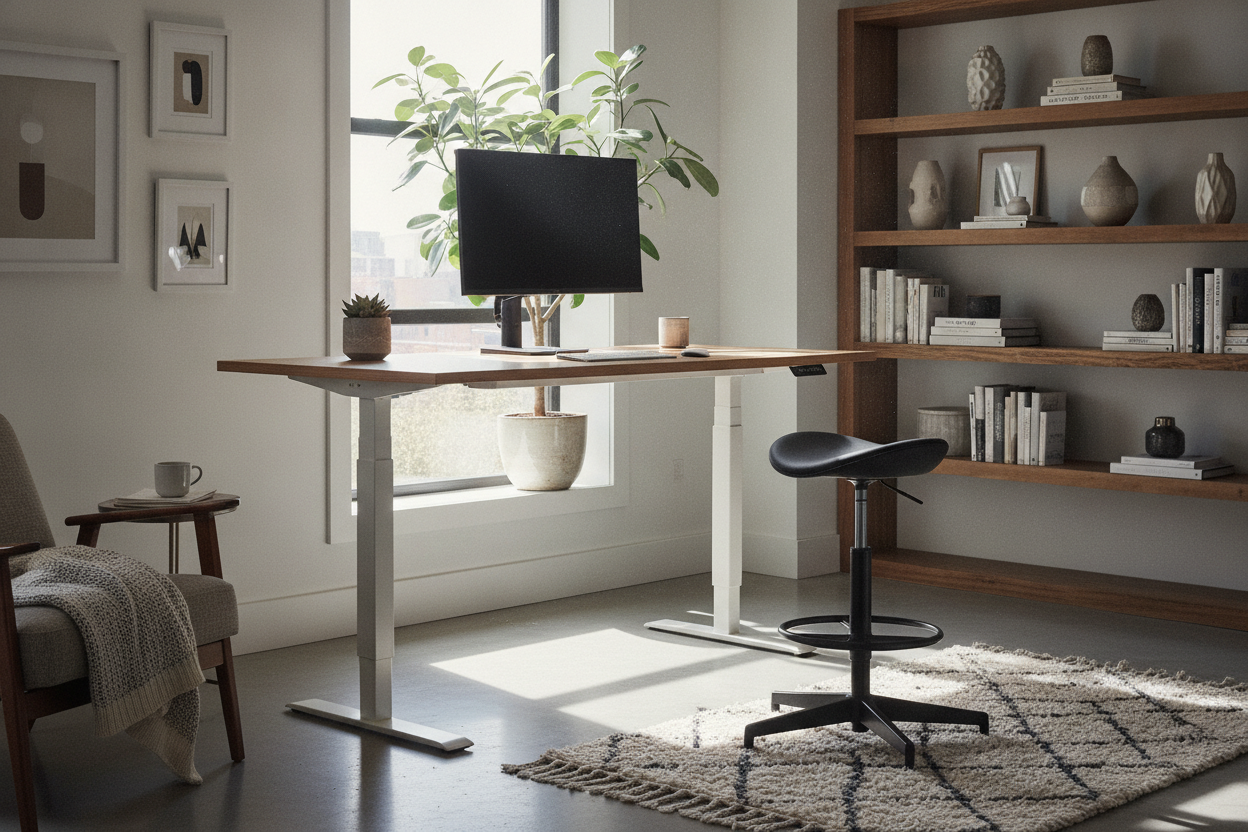
I fell for the hype. I spent weeks researching Why I Gutted My Cute Office for a TiMotion Standing Desk, thinking that standing would magically fix my posture and burn a thousand calories while I answered emails. By Wednesday of my first week, I wasn't a health icon—I was a person with throbbing heels and a lower back that felt like it had been through a car wash. Standing still for eight hours is just as punishing as sitting.
The solution wasn't to go back to my old task chair. The solution was the adjustable desk stool. It’s the middle ground that actually makes a standing desk functional. Without it, your expensive motorized desk is just a very tall, very heavy shelf where you store your coffee mug while you sit on the floor in defeat.
Quick Takeaways
- Standing 100% of the day is a recipe for plantar fasciitis and fatigue.
- An office stool for standing desk allows for 'perching,' which keeps your core active without crushing your heels.
- Look for a stool with a weighted, non-slip base that offers at least 10 inches of height adjustment.
- The goal is a 20/20/20 rotation: 20 minutes sitting, 20 minutes standing, 20 minutes perching.
The 'Stand All Day' Lie I Told Myself
I really thought I’d be that person who stands from 9 to 5, effortlessly productive. Reality hit me around hour four on day two. My shins ached, my knees felt stiff, and I found myself leaning awkwardly on one hip just to get some relief. By day three, I was back in a chair, feeling like I’d wasted my money. I realized that standing is an activity, not a static position.
When you stand still, blood pools in your feet. Your joints lock up. It’s exhausting. I needed a way to take the weight off without fully 'sitting down' and losing that upright momentum. That’s when I discovered that an office stool for standing desk isn't just an accessory—it's the missing piece of the ergonomic puzzle.
What Actually Is an Adjustable Desk Stool?
Forget the wooden bar stools from your kitchen island. A proper adjustable desk stool is an entirely different beast. These are designed with a heavy, rounded base that encourages 'active sitting.' They don't just go up and down; they tilt and pivot with your body weight.
The seat is usually smaller—often a saddle shape or a high-density foam puck—because you aren't supposed to park your entire weight on it for hours. It’s a support system. Most high-quality models use a pneumatic gas lift that handles about 250 to 300 pounds, providing a slight bounce that absorbs the impact on your spine when you sit down.
Perching vs. Sitting: The Ergonomic Difference
When you sit in a standard chair, your hips are at a 90-degree angle. This often leads to a rounded lower back and a compressed diaphragm. Perching is different. By adjusting your stool to about 75% of your standing height, you create a 135-degree hip angle. This open posture naturally aligns your spine and keeps your core engaged so you don't slouch into your monitor.
I found that perching on my stool felt like leaning against a fence. My feet were still on the ground, taking about 30% of my weight, while the stool took the rest. No more pins and needles in my toes, and no more 'heavy leg' feeling at the end of the day.
Why an Office Stool for Standing Desk Beats a Regular Chair
If you’ve ever tried to use a standard ergonomic chair with a standing desk, you know the struggle. You raise the desk to stand, then you have to wheel this 50-pound chair out of the way so you don't trip over the casters. It’s a clunky transition that makes you less likely to actually switch positions. I went through this transition myself when I Traded My Gaming Table for an Office Desk Adjustable Setup, and the chair was always the bottleneck.
A stool is lightweight and has a much smaller footprint. It tucks right under the desk when you’re standing fully, and it’s easy to pull out with one hand when your legs need a break. There are no armrests to get caught on the desk edge and no massive backrest cluttering up your visual space. It’s streamlined, which is exactly what a modern home office needs.
How I Finally Found My Ergonomic Sweet Spot
The trick isn't to pick one position and stay there. I found my groove using a rotation. I start my morning standing for 20 minutes to wake up. When my feet start to feel the floor, I pull in the stool and perch for 20 minutes. Then, I lower the whole setup and sit properly for 20 minutes to do deep-focus work. Repeat.
This constant movement keeps your metabolism from stalling and prevents those repetitive strain pains. I used to think I was lazy for needing to sit down, but using a stool made me realize that 'active rest' is the only way to survive a long shift without feeling like a zombie by 4 PM.
Don't Buy the Wrong Height: A Quick Warning
Before you hit buy, grab a tape measure. Some stools only go up to 28 or 30 inches, which is fine for a standard table but too short for a tall person at a standing desk. You need to ensure the stool can reach your hip height. If you don't plan on standing or perching at all, you might be better off sticking to a standard Writing Computer Desk where a traditional chair makes more sense.
Check the base material, too. Cheap plastic bases will slide on hardwood floors. I recommend a weighted steel base with a rubberized bottom. It stays put when you lean into it, which is the whole point. Trust me, the first time you lean back and the stool slides out from under you, you'll wish you spent the extra $40 on a heavy-duty model.
FAQ
Can I use a regular bar stool instead?
I wouldn't. Bar stools are usually 30 inches fixed and have zero 'give.' They aren't designed for leaning or movement, and the hard seats will make your tailbone ache within twenty minutes. You need the pneumatic tilt of a real office stool.
Does an adjustable stool hurt your back?
If you try to sit on it like a regular chair for four hours straight, yes, you'll feel it. It's meant for short bursts of support. It actually helped my back by forcing me to use my core muscles instead of leaning into a backrest.
Do I need a footrest with a stool?
Most standing desk stools have a built-in foot ring. Use it. Switching between having your feet flat on the floor and resting them on the ring helps keep your circulation moving.

Dejar un comentario
Este sitio está protegido por hCaptcha y se aplican la Política de privacidad de hCaptcha y los Términos del servicio.