










I spent three hours last night trying to squeeze two 27-inch monitors and a mechanical keyboard onto a desk that was clearly designed for a single iPad and a succulent. It was like trying to park a suburban SUV in a motorcycle spot. My monitors were hanging off the edges, and I had exactly zero square inches left for my coffee. I finally realized that finding a modern desk large enough for actual work—not just aesthetic scrolling—is a massive challenge in a market obsessed with minimalism.
- Depth matters as much as width; aim for at least 30 inches to keep your screens at a healthy distance.
- Solid wood or high-grade plywood beats MDF for long spans to prevent the dreaded 'center sag.'
- Integrated cable management is a requirement, not a luxury, for multi-monitor setups.
- A straight desk often provides better room flow than a bulky L-shaped unit.
The 'MacBook Only' Delusion in Contemporary Furniture
Most furniture brands seem to think 'modern' is synonymous with 'microscopic.' If you browse Instagram, every home office features a tiny 40-inch slab of wood with nothing but a 13-inch laptop on it. That is not a workspace; that is a staging area. For those of us who actually deal with spreadsheets, video editing, or gaming, we need a large office desk modern enough to look sharp but sturdy enough not to wobble during an intense typing session.
The problem is that many 'large' desks are just scaled-up versions of cheap writing tables. When you move from a basic writing computer desk to a heavy-duty setup, you realize that surface area isn't the only factor. You need a frame that won't vibrate every time your PC fan kicks in. I learned the hard way that a 60-inch desk made of 1-inch particle board will start to bow within six months under the weight of dual monitor arms.
What Actually Makes a Large Office Desk Modern?
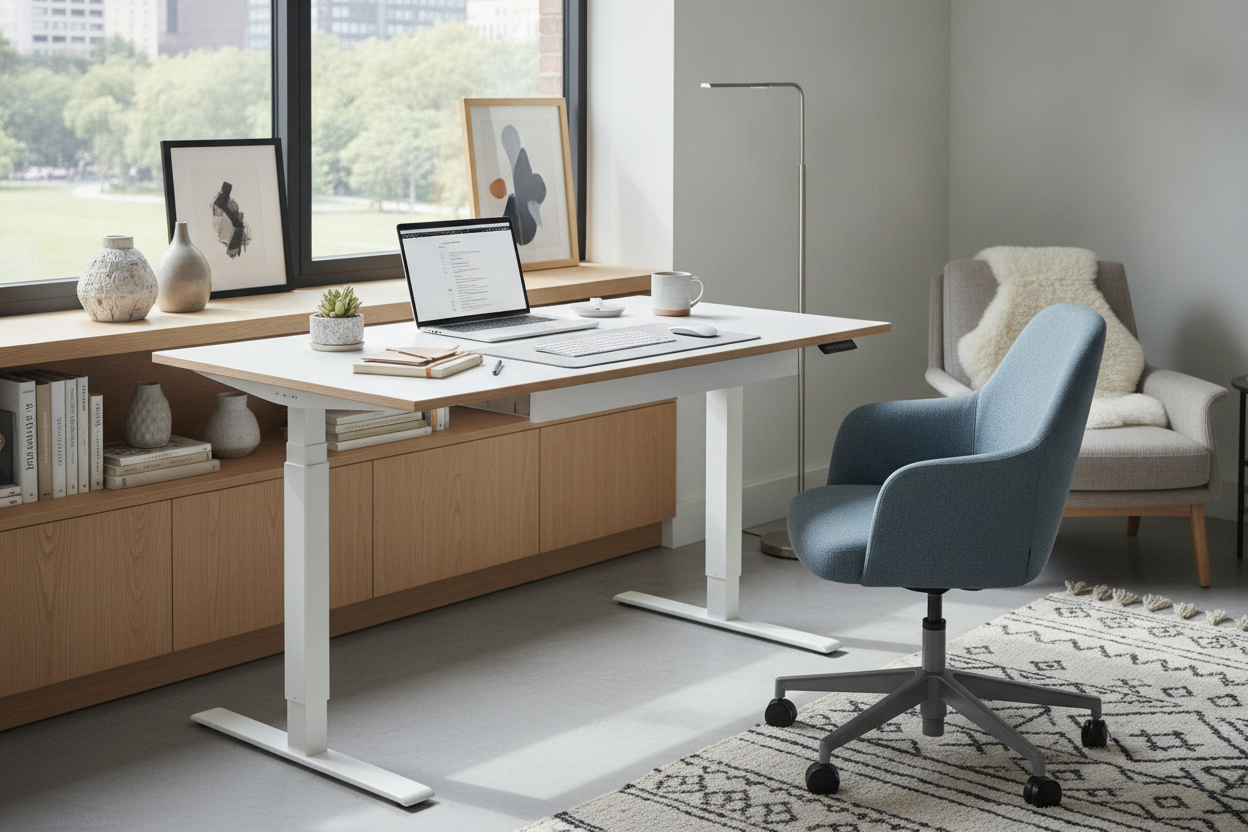
A modern long desk shouldn't remind you of a 1990s boardroom table. The 'modern' part comes down to the silhouette and the materials. I look for chamfered edges, which make a thick top look slimmer and more elegant. Tapered steel legs or a 'floating' top design can make a 72-inch piece of furniture feel light in a room rather than like a giant wooden block.
Cable routing is the other half of the equation. If you have three power bricks and six display cables hanging off the back, the 'modern' aesthetic is dead on arrival. The best modern large office desk designs include a built-in tray or a hidden channel to tuck those wires away. I prefer powder-coated metal legs in matte finishes—they don't show fingerprints and they provide a nice industrial contrast to warm wood tones.
My Hunt for a Large Modern Desk With Drawers
I have a visceral hatred for desktop clutter. I need a place for my SD cards, my spare charging cables, and the three notebooks I’ve started but never finished. Finding a large modern desk with drawers that doesn't look like a clunky filing cabinet is surprisingly difficult. Most designers ditch drawers to keep that 'airy' look, but then your desk just ends up covered in random junk.
I previously spent weeks looking for a desk with drawers modern enough to sit in my main living area without screaming 'office.' For a larger setup, I found that slim, under-mount drawers are the way to go. They provide just enough storage for the essentials without adding five inches of vertical bulk to the desk profile. If you can't find a desk with built-in storage, look for a matching mobile pedestal that can slide completely under the work surface.
Why I Didn't Go with an L-Shaped Setup
I debated a corner unit for a while. While a minimalist white home office corner desk is a fantastic solution for tight corners, it can feel a bit claustrophobic if you have the floor space for a straight run. A long, straight desk allows you to slide your chair from the 'focus zone' to a secondary task area without hitting your knees on a support leg. It feels more expansive and less like you're tucked into a cubicle.
Can a Long Bedroom Desk Actually Look Good?
Putting a massive workstation in your sleeping space is a design risk. You don't want to wake up and immediately feel the stress of your inbox. If you are forced to put a long bedroom desk in your sanctuary, material choice is everything. Avoid cold, sterile whites or dark 'executive' cherries. Instead, go with natural oak or walnut.
A long desk for bedroom use should be styled like a console table when not in use. I use a high-end brass task lamp and a ceramic tray for my pens to soften the tech-heavy vibe. By keeping the profile of the long desk for bedroom placement slim—think 28 inches deep instead of 32—you can maintain enough walkway space so the room doesn't feel like a corporate branch office.
The Final Verdict: My Upgraded Workstation
I eventually landed on a 74-inch solid walnut top paired with an industrial steel frame. It is massive, but because it has clean lines and no heavy pedestals, it doesn't swallow the room. I finally have space for my dual monitors, my studio speakers, and even a dedicated spot for my tablet. My productivity shot up simply because I stopped fighting for every inch of space. If you're on the fence about going big, just do it. You’ll never regret having too much desk real estate, but you’ll definitely regret having too little.
FAQ
How wide should a desk be for two 27-inch monitors?
You want at least 55 inches of width, but 60 to 72 inches is the sweet spot. This gives you room for the monitors to be angled slightly toward you without them overhanging the edges or crowding your speakers.
Does a long desk need a center support leg?
If the desk is over 60 inches and made of manufactured wood (MDF) or thin natural wood, yes. If it's high-quality solid wood or has a steel subframe running the length of the top, you can usually skip the middle leg and keep your legroom clear.
What is the best depth for a large modern desk?
Don't go shallower than 24 inches. For a large setup, 30 inches is ideal because it allows you to push your monitors back far enough to reduce eye strain while still having room for a keyboard and your forearms.


Dejar un comentario
Este sitio está protegido por hCaptcha y se aplican la Política de privacidad de hCaptcha y los Términos del servicio.