










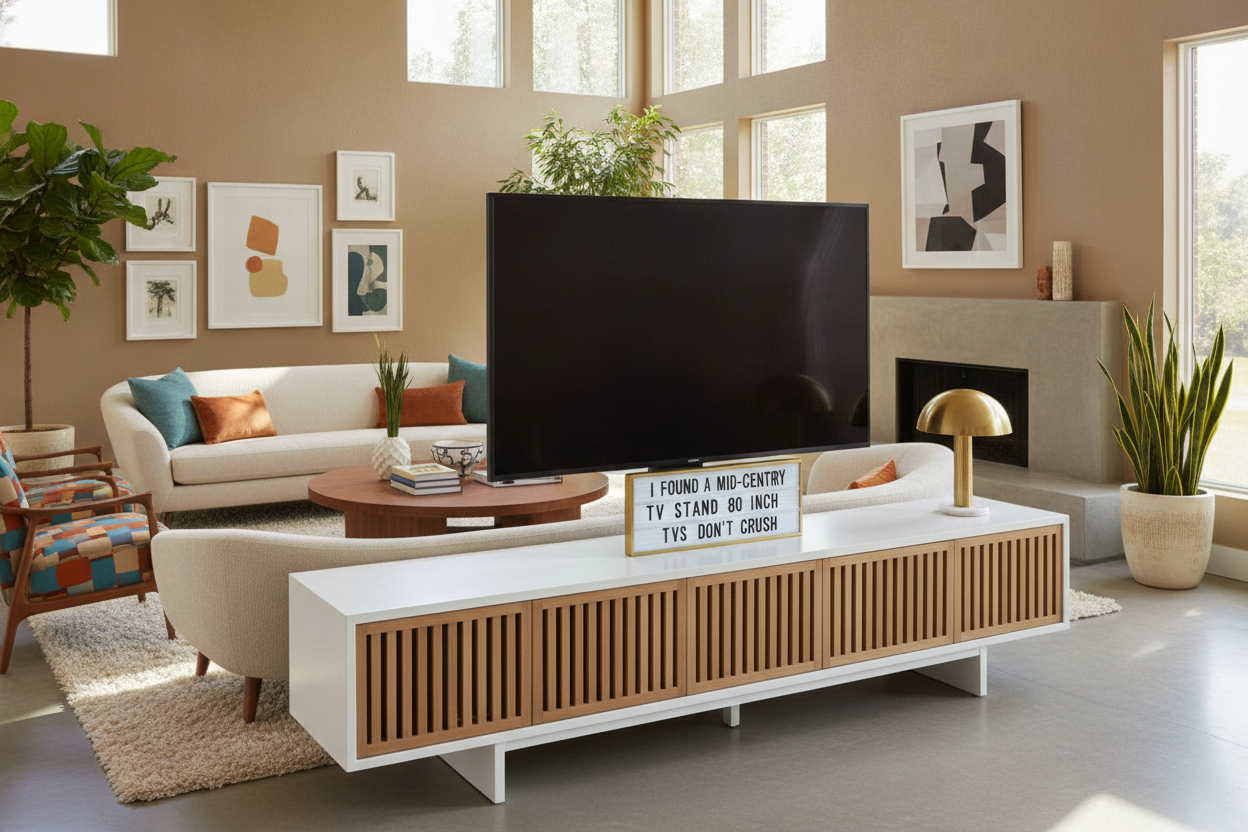
I remember staring at my new 80-inch TV sitting on the floor for three weeks because I was terrified it would snap the tapered legs off my vintage sideboard. It is the classic design dilemma: you want the 1950s aesthetic, but you have got a modern screen that weighs as much as a small child. Finding a mid century tv stand 80 inch TVs can actually live on without causing a structural disaster is a genuine challenge.
- Support is everything; you need at least five legs, including a center stabilizer.
- The console must be wider than the TV—aim for at least 84 to 90 inches.
- Avoid 'rustic' blends; they look like a design identity crisis.
- Solid wood or high-grade veneers only—skip the cheap particle board for screens this size.
The Delicate Peg Leg vs. The Giant Black Box
The physics of this setup are honestly brutal. Mid-century modern design is all about being 'light on its feet.' But when you put a massive black slab on top of thin, angled dowel legs, it can look top-heavy and anxious. It is like a bodybuilder standing on toothpicks.
To make it work, you have to find a piece that mimics that airy profile while hiding a heavy-duty frame. Most people underestimate the 'visual weight' of a large screen; it can swallow a slim console whole if you are not careful with the proportions.
Why You Can't Just Use a Real 1960s Credenza
I see people hunting Facebook Marketplace for 'authentic' 1960s credenzas every day. Stop. Those pieces were built for record players and heavy lamps, not the 100-pound footprint of a modern 80-inch screen. I have seen beautiful teak units bow in the middle because they lacked internal bracing.
I eventually gave up on the vintage hunt and went with a modern reproduction. I specifically Grindle solid wood TV stand because it actually has a reinforced center support leg. Without that fifth leg, the middle of your beautiful walnut unit will start to 'smile'—that is furniture-speak for sagging—within six months. You need modern engineering for modern tech.
Nailing the Proportions (Without Looking Clunky)
If your TV is roughly 70 inches wide, an 80-inch stand gives you about 5 inches of clearance on each side. That is the bare minimum. If you go any shorter, the TV looks like it is overflowing the edges, which feels cheap and accidental.
The goal is to maintain that off-the-floor look without the unit looking like a bulky dresser. Look for units that are at least 18 inches deep. Anything shallower feels unstable, and anything deeper starts to lose that sleek, mid-century silhouette we are chasing.
Let's Talk Finishes: Walnut, White, or Something Else?
Walnut is the gold standard for a reason—it is warm, hides dust, and has that rich grain that defines the era. But if your room already has wood floors and wood walls, a giant walnut box can make the space feel like a sauna. This is where alternative finishes come in to save your sanity.
When a tv stand 80 inch white finish actually works
I used to think a white media console 80 inches wide would look like a giant refrigerator in the middle of my living room. I was wrong. If you find a tv stand 80 inch white finish with those iconic tapered wooden legs, it actually pulls the focus away from the giant black screen and makes the room feel breathable.
It took me a long time to find a white TV stand for 80 inch TV that did not look like cheap office furniture. The trick is looking for matte finishes rather than high-gloss, which can look a bit too '2010 tech-bro' for a retro-inspired home.
Why a rustic 80 inch tv stand ruins the retro vibe
Please, for the love of design, avoid a rustic 80 inch tv stand. Putting a sleek, minimalist TV on a piece of 'distressed' barn wood with sliding barn doors is a visual car crash. Mid-century modern is about optimism, aerospace-inspired lines, and clean surfaces. Rustic is about texture and nostalgia. They do not play nice together; they just fight for attention.
The 3 Non-Negotiables for Your Final Choice
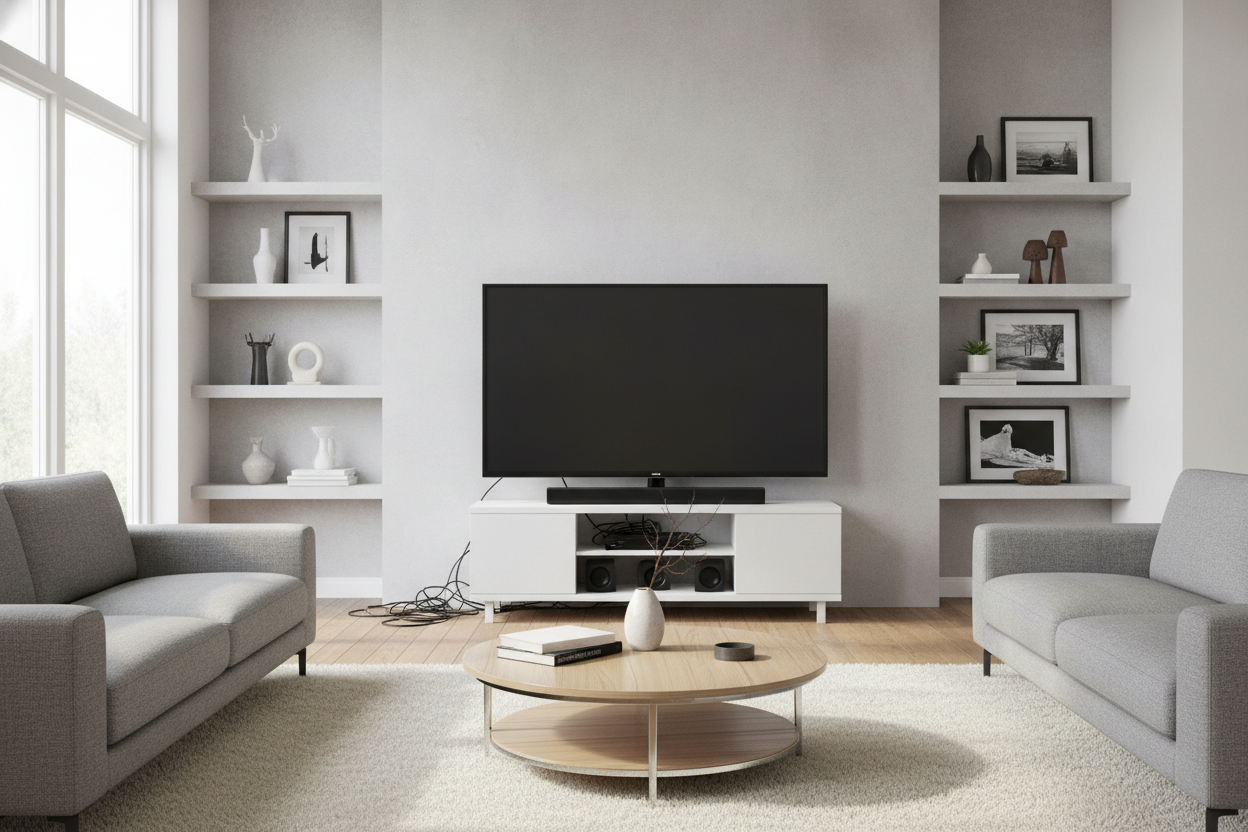
First, check the cable management. You do not want a high-end setup with a 'rat's nest' of black wires hanging out the back. Second, ensure there are at least five legs. If it only has four corner legs, walk away. Your TV is too heavy for that.
Third, look for slatted or mesh doors. Modern routers and consoles get hot, and they need to 'breathe.' Slatted doors allow for airflow and let your remote's IR signal pass through while keeping the ugly plastic boxes hidden from view. It is the only way to keep the aesthetic clean.
FAQ
How wide should a TV stand be for an 80-inch TV?
Your TV is likely about 70-72 inches wide. You want a stand that is at least 80 inches wide to provide a safe 4-5 inch buffer on each side. Anything smaller looks top-heavy.
Will a vintage sideboard hold a large TV?
Probably not without modification. Most vintage pieces lack the center support leg required to prevent long-term sagging under the weight of a massive modern screen.
Is solid wood better than MDF for a large TV?
Yes. While high-grade MDF is fine for small units, a 100-pound TV requires the structural integrity of solid wood or high-quality plywood to ensure the legs do not buckle over time.

Dejar un comentario
Este sitio está protegido por hCaptcha y se aplican la Política de privacidad de hCaptcha y los Términos del servicio.