










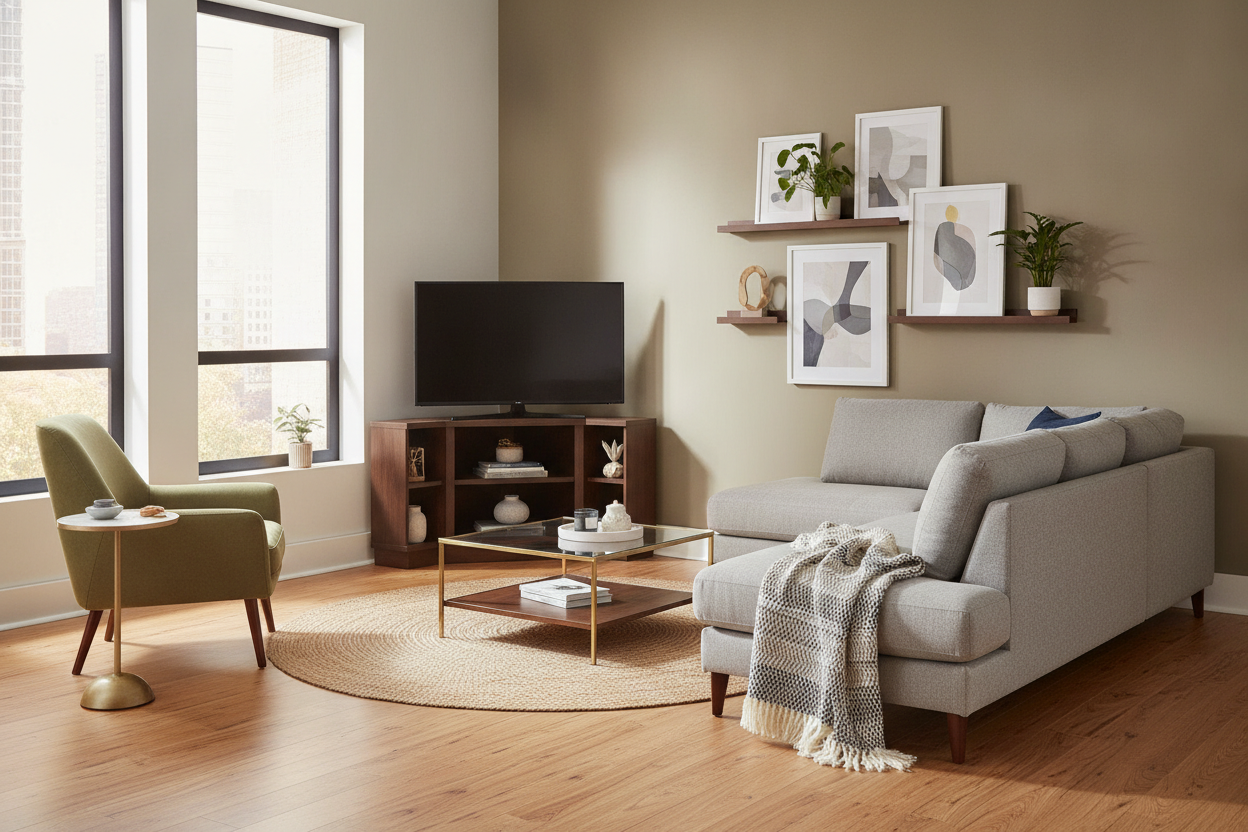
I spent three months staring at my living room, convinced I was just bad at interior design. My apartment is what real estate agents call 'charming' and what I call a drafty bowling alley. It is 10 feet wide and nearly 25 feet long. Every time I tried to set up a seating area, the TV became a giant black rectangle that blocked the natural flow of the room.
I tried every layout in the book. I put the sofa against the long wall, but then the TV had to go on the opposite wall, leaving me with a walkway that felt like squeezing through an airplane aisle. I finally realized that the traditional floor plan was my enemy. I needed to stop fighting the room and start using the corners. That is when I caved and started looking for an amazon tv corner stand.
- Space Saver: Corner units reclaim dead square footage that usually just collects dust.
- Better Angles: They naturally angle the screen toward the center of the room, reducing glare from windows.
- Weight Matters: Modern corner stands can easily support 50-60 lbs, which covers most 55-inch LEDs.
- Cable Chaos: Look for units with enclosed backs to hide the inevitable nest of HDMI cables.
The 'Bowling Alley' Living Room Dilemma
Living in a long, narrow space is a specific kind of architectural hell. When you place standard TV stands against the long wall of a 10-foot-wide room, you are immediately cutting your usable floor space down to about seven feet. Once you add a rug and a coffee table, you are basically hopping over furniture just to get to the kitchen. It makes the whole apartment feel like a cluttered hallway rather than a home.
I struggled with this for a year. I bought a slim console, thinking that would solve it, but the TV still felt like it was looming over the room. The focal point was all wrong. Because the TV was centered on the main wall, my sofa had to be directly opposite it, which meant my 'living room' was only six feet deep. The rest of the room was just empty, awkward space that I didn't know how to use. I felt like I was living in a furniture showroom that had been compressed by a hydraulic press.
The breaking point came when I realized I was avoiding having people over because there was nowhere for more than two people to sit without someone being blocked by the TV stand. I needed to move the screen out of the way, but in a narrow room, the only 'out of the way' is the corner.
Why I Resorted to Searching Amazon for a Corner Fix
I’ll be honest: Amazon wasn't my first choice. I spent weeks scrolling through high-end design sites and visiting local furniture boutiques. Here is the weird thing—modern furniture brands have completely abandoned the corner unit. If you want a $2,000 walnut sideboard, you have a million options. If you want a amazon corner tv stand that actually fits in a 90-degree angle, the 'design' world acts like you’re asking for a beanbag chair from 1994.
I realized that if I wanted utility, I had to go where the utility is. Amazon has a massive selection of these units because they cater to people actually living in small apartments, not just people with massive, square suburban living rooms. I spent hours digging through reviews, looking for photos of the back of the units and checking the thickness of the particle board. I wanted something that looked like actual furniture, not a temporary solution for a dorm room.
What surprised me was the variety. You can find mid-century designs, 'industrial' metal frames, and farmhouse styles. I wasn't just settling for a piece of plastic; I found a heavy, dark oak laminate unit that actually had some weight to it. The price was low enough that I figured if it was a disaster, I could just move it to the bedroom and not feel like I’d wasted a month's rent.
Can a Corner Unit Actually Hold a Real TV?
This was my biggest fear. We’ve all seen those flimsy stands that look like they might buckle if you sneeze too hard. I have a 55-inch OLED, and while it’s thin, it isn't light. I spent a lot of time searching specifically for a corner tv stand for 55 inch tv amazon that had a wide enough top surface. A lot of 'corner' stands are actually quite small, intended for 32-inch or 42-inch screens. If your TV is 50 inches wide and your stand is only 40 inches wide, the corners of your TV are going to hang off into space, which looks terrible and is a total tipping hazard.
I looked for a unit with a weight capacity of at least 75 pounds. Most modern 55-inch TVs weigh between 35 and 50 pounds, so you want that extra buffer. I also checked the depth. You need enough depth so the 'V' shape of the stand actually sits flush against your walls. If the stand is too shallow, it won't push back far enough into the corner, and you'll end up losing more floor space than you intended.
When it arrived, I was pleasantly surprised. The hardware was solid, and once I tightened everything down, it didn't wobble at all. I even did the 'shake test' (very scientific, I know) and the TV stayed planted. The 55-inch screen fits with about two inches to spare on either side, making it look custom-built for that corner.
The Best Part: Getting My Main Wall Back
Moving the TV was a revelation. By tucking the screen into the corner, I suddenly had twelve feet of uninterrupted wall space. This is the part people don't talk about enough: TVs are design vampires. They suck the life out of a wall because you can't really put anything else there. Now, I have a massive gallery wall with actual art, and my living room feels twice as big. Why I Gave Up My Main Wall for a 55 Inch Corner TV Stand became the mantra for my apartment's survival.
With the TV in the corner, I was able to rotate my sofa 90 degrees. Now, instead of staring at a wall, the sofa faces the window and the rest of the room. It opened up the 'flow' of the apartment. I can walk from the front door to the kitchen in a straight line without dodging a media console. It turned my apartment from a series of obstacles into an actual living space. The TV is still there when I want to watch a movie, but it’s no longer the boss of the room.
I also noticed that the viewing angles are actually better. Because the stand is angled at 45 degrees into the room, you can see the screen clearly from the kitchen and the dining area. It turned my tiny living room into a multi-functional space without making it feel crowded.
3 Things to Check Before You Hit 'Add to Cart'
First, measure your baseboards. I’m serious. If you have thick, old-school baseboards, a flush-mount corner stand might not sit perfectly against the wall. You might have a one-inch gap behind the stand, which can be annoying for stability. Look for units that have a slight 'overhang' on the top or legs that sit slightly inset.
Second, think about your peripherals. Most corner stands are smaller than a modern TV stand with cabinets and drawers. You aren't going to have room for a record player, a PS5, a soundbar, and a collection of physical media. I had to get a separate small shelf for my records because the corner stand only had enough room for the router and the gaming console. If you have a lot of gear, look for a model with adjustable interior shelves.
Third, check the cable management holes. Some of the cheaper Amazon models just have a solid back. If you don't want to be drilling your own holes through MDF, make sure the description explicitly mentions 'cable management' or 'media cutouts.' I made the mistake of buying a 'corner cabinet' once that was meant for blankets, and trying to snake a power strip through the back was a nightmare I never want to repeat.
FAQ
Will a 65-inch TV fit on a corner stand?
Usually, no. Most corner units are capped at 50 to 55 inches. A 65-inch screen is so wide that the edges will hit the walls before the stand can get deep enough into the corner. Always check the actual width of your TV, not just the diagonal screen size.
Is the assembly difficult?
It is standard flat-pack furniture. Expect about 45 minutes of work and a lot of cam-locks. If you hate building furniture, pay the extra $50 for the assembly service, but if you have a screwdriver and some patience, it is totally doable alone.
Does it look cheap?
It depends on the finish. Avoid the high-gloss whites if you want a 'premium' look—those tend to show every scratch. The textured wood laminates (like 'grey wash' or 'charcoal oak') actually look quite good and hold up well to daily wear and tear.

Dejar un comentario
Este sitio está protegido por hCaptcha y se aplican la Política de privacidad de hCaptcha y los Términos del servicio.