










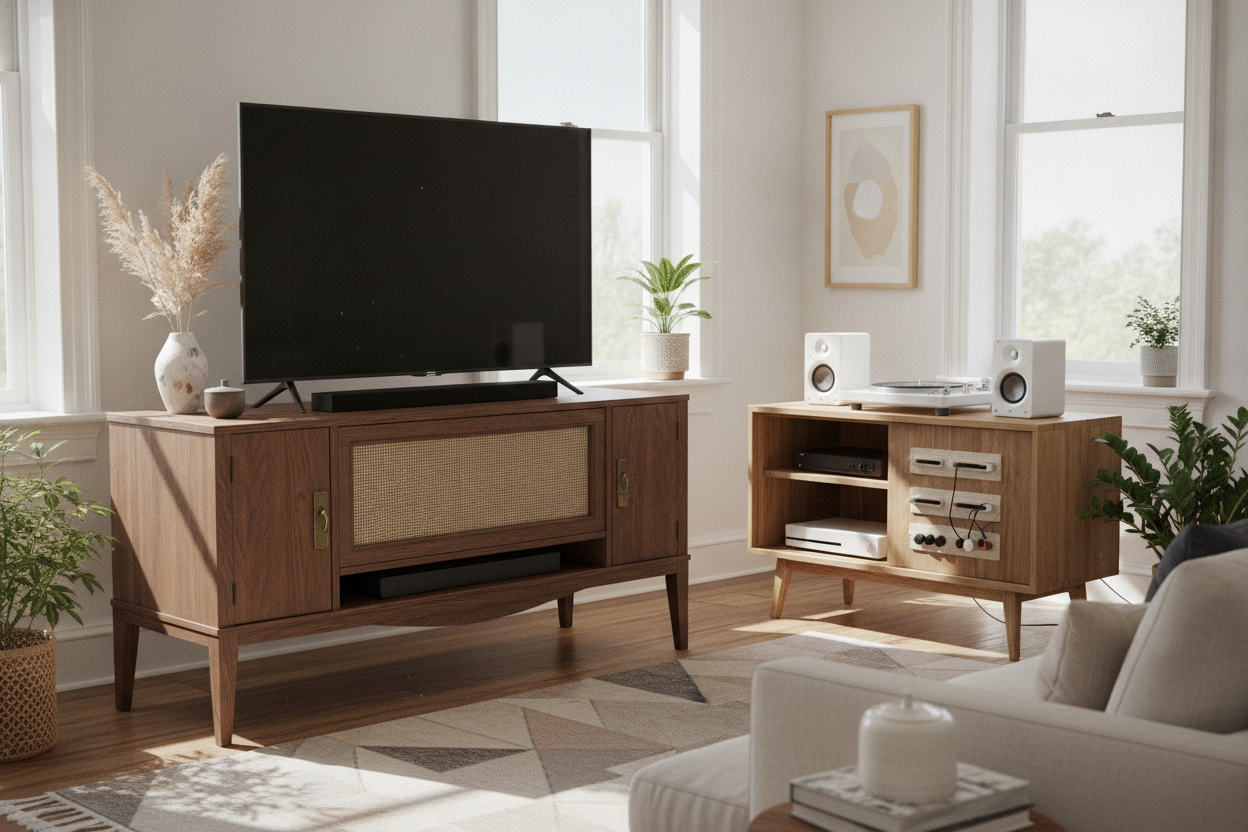
I remember staring at my living room two years ago and feeling like a total fraud. I had this gorgeous, walnut-veneer credenza from 1964, and right on top of it sat a massive, glowing router and a tangle of black plastic cables that looked like a digital octopus. I wanted the soul of vintage media consoles, but my tech was making the whole room look like a Best Buy clearance aisle.
Quick Takeaways
- Measure your deepest piece of gear (usually the AV receiver) and add 2 inches for cable clearance.
- Solid wood is your friend; cheap vintage veneer will chip like a cracker if you drill into it.
- Dining buffets are often deeper than 1960s 'media' cabinets, making them better for modern tech.
- Heat is the enemy—never close a console or PC inside a solid wood box without active ventilation.
The Allure (and Immediate Regret) of Older Furniture
There is something about an antique media cabinet that modern flat-pack furniture just can't touch. The weight of the wood, the smell of old oil, and the fact that it survived 60 years of dinner parties gives a room instant gravity. But the honeymoon phase ended the second I tried to shove my Denon receiver into a 15-inch deep sideboard. Modern electronics are chunky, and mid-century designers weren't planning for bulky HDMI cables and 4K players.
I spent three hours trying to angle my gear in, only to realize the doors wouldn't shut. It’s a classic mistake: falling for the aesthetic of a media console antique without checking if it can actually hold anything more modern than a stack of 8-track tapes. I almost gave up and went back to a wire rack.
Why I Didn't Just Build It Into the Drywall
For a minute, I considered the minimalist route. I debated whether I should just try a media cabinet in wall to save floor space and stop bruising my shins in my narrow living room. It’s a smart move for small apartments, but I’m a sucker for furniture with legs. I craved the character of a standalone antique media console that I could take with me when I eventually move. There’s a warmth in old teak that a recessed drywall box just can't replicate.
How to Hunt for an Antique Media Cabinet That Actually Fits
If you’re hunting on Facebook Marketplace or at estate sales, bring a tape measure. Do not eyeball it. Most vintage sideboards are 15 to 16 inches deep, which is a nightmare for modern receivers that often need 17 or 18 inches once you factor in the plugs sticking out the back. This is why I started looking at dining buffets instead of dedicated record cabinets. Buffets were built to hold oversized serving platters, giving you that crucial extra depth.
Check the back panel too. If it’s solid wood, you’re in luck. If it’s that flimsy, brittle particle board from the 70s, it might crumble the moment you try to modify it. I always look for pieces with adjustable shelving, because fixed shelves in an antique media cabinet are almost always at the wrong height for a PS5.
Wait, Will My Vacuum Still Fit Underneath?
One thing nobody tells you about vintage pieces is that they often sit low to the ground. If you have a robot vacuum, those delicate peg legs can be a trap. My Roomba spent three days getting wedged under my sideboard before I realized I should have looked for a piece with at least 4 inches of clearance. If you’re tired of rescuing your vacuum, you might want to get a TV cabinet on legs that offers enough height for the sensors to clear the base.
The Terrifying Moment You Drill Into an Antique Media Console
Drilling that first hole into a 1950s piece feels like a crime, but it’s the only way to kill the cable clutter. I used a 2-inch hole saw bit on my power drill. Pro tip: put a piece of masking tape over the spot before you drill. It keeps the wood from splintering and gives you a cleaner edge. I put my holes directly behind where the gear sits, so the cables disappear instantly into the wall or a power strip hidden on the floor.
Don't just hack a giant square out of the back. A few neatly placed circles look intentional and keep the structural integrity of the piece. I even found some plastic desk grommets to pop into the holes, which makes the whole DIY job look like it came from the factory that way.
Keeping Things Cool (Because Old Wood Isn't Vented)
The biggest mistake I made? Closing the doors on my Xbox while it was running. Within twenty minutes, the fans sounded like a jet engine and the wood was hot to the touch. Vintage cabinets were meant to hold linens or silver, not heat-generating processors. I ended up buying a pair of USB-powered 120mm fans. I mounted them to the back panel—one pulling cool air in, one pushing hot air out. They plug right into the back of the console, so they only turn on when the system is running. It saved my gear and my furniture from a slow, heat-warped death.
FAQ
Do vintage consoles block Wi-Fi signals?
If the cabinet is solid wood, you might see a slight dip in signal strength, but it’s usually negligible. If it’s a metal vintage locker or has wire mesh doors, your signal will definitely take a hit. I keep my router on the top shelf or hidden behind a picture frame for the best coverage.
How do I fix a scratch on an antique media cabinet?
Skip the 'as seen on TV' fix-it pens. Grab some Howard Restor-A-Finish in a shade that matches your wood. It dissolves the top layer of finish just enough to blend the scratch away without a full sanding job.
Can I put a 65-inch TV on a vintage sideboard?
Check the weight capacity. Many mid-century pieces use thin legs that weren't designed for 60-pound modern TVs. If the top starts to 'smile' or bow in the middle, you need to wall-mount the TV above the console instead.

Dejar un comentario
Este sitio está protegido por hCaptcha y se aplican la Política de privacidad de hCaptcha y los Términos del servicio.