










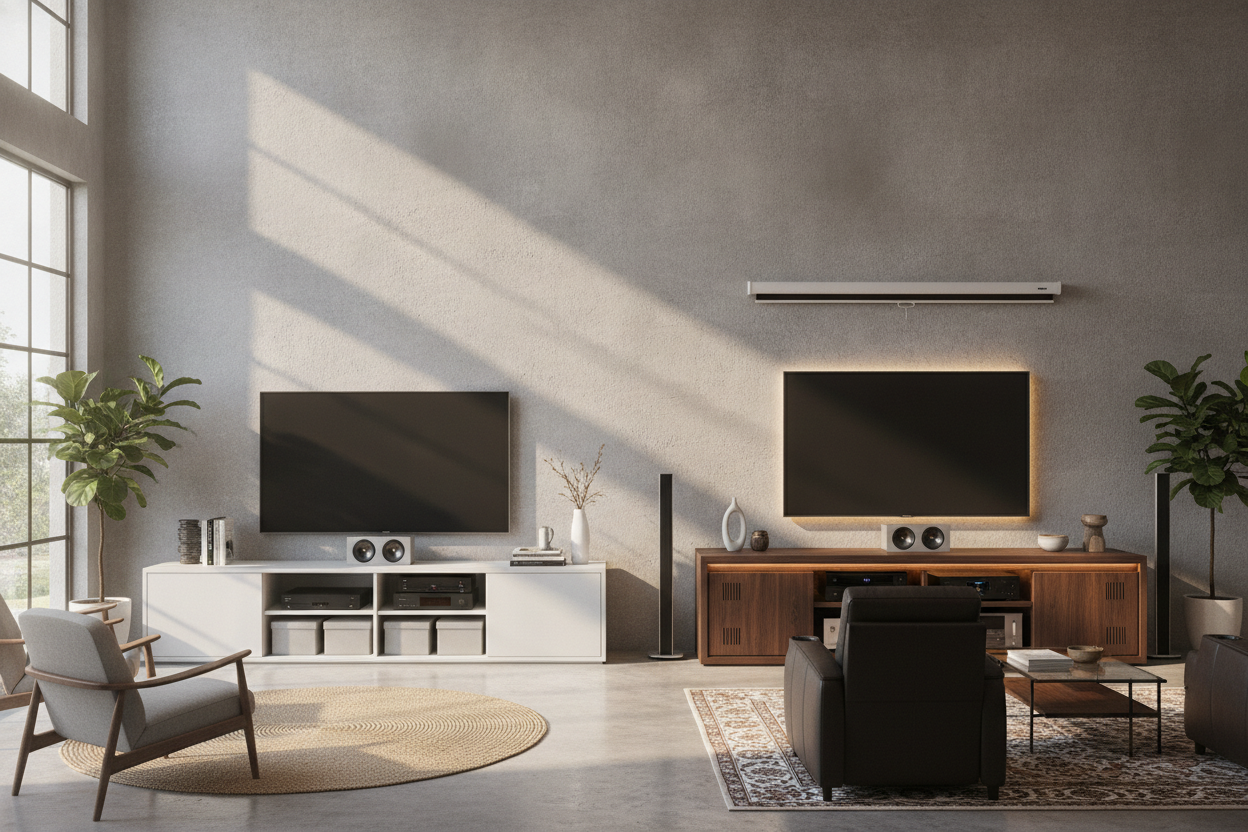
I remember staring at my living room setup at 2 AM, a single bead of sweat rolling down my face as I tried to shove a 45-pound Denon receiver into a cubby that was exactly one-eighth of an inch too narrow. My $150 flat-pack stand was literally groaning. The top shelf had a visible 1/2-inch dip, and the heat radiating from my Xbox was enough to sous-vide a steak. I’d spent years convincing myself that av consoles were just overpriced boxes for people with more money than sense. I was wrong.
Quick Takeaways
- Standard furniture is usually 16 inches deep; professional AV gear often requires 20-22 inches once you factor in cable bends.
- Particleboard sags under heavy amplifiers; true AV units use reinforced steel or solid hardwood.
- Heat is the silent killer of electronics; specialized consoles feature passive chimney-effect ventilation.
- The 'IKEA Hack' usually ends up costing more in tools, fans, and frustration than just buying the right piece first.
The Breaking Point (Why My Particleboard Hack Finally Failed)
We’ve all been there. You buy a sleek-looking sideboard, think it’ll look great under the TV, and then reality hits. For me, it was realizing my standard TV console is wasting space because I couldn't actually close the doors. The HDMI cables sticking out the back of the receiver added three inches of depth I hadn't accounted for. I ended up having to pull the whole unit six inches away from the wall, leaving a massive, dusty gap that looked like garbage.
Then came the heat. Standard furniture is designed to hold books or folded sweaters, not high-performance processors that run at 110 degrees. My cabinet became a literal oven. Every time I played a game for more than an hour, the internal fans on my console would scream like a jet engine taking off. I tried drilling holes in the back with a cheap hole saw, but the thin laminate just splintered and peeled. It looked like a beaver had tried to break into my media center. That was the moment I realized my 'budget' solution was actually a liability for my expensive tech.
What Actually Makes an AV Console Different?
A generic media stand is a box. An av console is a piece of infrastructure. The most immediate difference is the depth. Most big-box furniture tops out at 16 or 18 inches. A dedicated AV unit usually hits 20 to 22 inches. This isn't just for the 'look'—it’s because a high-end receiver is deep, and the heavy-duty cables plugged into the back don't like being bent at 90-degree angles. If you force them, you're looking at signal dropouts or damaged ports.
Then there's the hardware. Professional units use heavy-duty soft-close hinges that won't sag after six months of holding up heavy wooden doors. They often include integrated levelers, because no floor is actually flat, and a wobbly stand is a death sentence for a turntable or a high-end disc player. You're paying for the engineering that keeps the unit from racking or swaying when you're swapping out components.
The Weight Capacity Reality Check
Let's talk numbers. Your average flat-pack shelf is rated for maybe 25 to 30 pounds. A mid-range home theater power amp can easily hit 60 or 80 pounds. When you put that kind of weight on particleboard, it doesn't just break immediately; it 'creeps.' Over a few months, the shelf slowly bows until your expensive gear is sitting on a literal curve. A real AV console uses internal steel supports or thick, kiln-dried hardwood that won't flinch under a heavy load. I’ve seen $3,000 systems ruined because a $100 shelf finally gave up the ghost.
Built-In Ventilation and Cable Management
If you can't see the cables, they don't exist, right? Wrong. In a cheap cabinet, those cables become a 'rat's nest' that traps heat and makes troubleshooting impossible. When I finally upgraded, it cured my tangled cord anxiety completely. High-end consoles feature removable back panels and internal 'highways' for your wires. You can actually reach the back of your gear without pulling the whole unit out and scratching your floors.
More importantly, they have slotted bases and tops. This creates a natural airflow where cool air is pulled in from the bottom and hot air escapes out the top. Some even have mounting points for silent 120mm fans. This keeps your gear running at optimal temperatures, which literally extends the life of your electronics. You aren't just buying a cabinet; you're buying insurance for your tech.
The Hidden Costs of Modifying Cheap Furniture
I spent about $80 on 'upgrades' for my old IKEA Besta. I bought a set of cooling fans, a pack of cable ties, a new hole saw bit, and some L-brackets to stop the wobbling. Add in four hours of my Saturday spent sweating, measuring, and accidentally drilling through a structural cam-lock. In the end, it still looked like a modified IKEA cabinet. It didn't have the gravitas of a solid piece of furniture, and it certainly didn't have the resale value.
When you modify cheap furniture, you're fighting against the material. MDF and particleboard don't take kindly to being cut or stressed in ways the manufacturer didn't intend. By the time you buy the fans, the power supply for the fans, and the tools to install them, you’ve closed 30% of the price gap between the cheap stuff and the real stuff. And you still have a cabinet that feels like it’s made of compressed sawdust.
The Verdict: When to Splurge and When to Save
Look, if you just have a soundbar and a Nintendo Switch, keep your money. A basic target stand is fine. But if you own a dedicated receiver, a power amp, or a high-end gaming PC, the av console is the most important 'component' in your rack. It’s the difference between a system that looks like a cluttered mess and one that looks like a curated part of your home.
I personally recommend splurging if your total gear value exceeds $1,500. It sounds like a lot, but protecting that investment with proper airflow and structural support is just common sense. I went with a unit that has IR-friendly glass doors—meaning I can hide all the blinking lights but my remote still works. It’s the kind of small detail that makes me happy every single time I sit down to watch a movie.
FAQ
Can I just leave the back panel off a cheap cabinet for airflow?
You can, but be careful. On most budget furniture, that thin cardboard back panel is actually a structural component that prevents the unit from 'racking' or leaning sideways. If you remove it, the whole thing might collapse if someone bumps into it.
How much extra depth do I really need for cables?
Always add at least 3 inches to the depth of your deepest component. If your receiver is 17 inches deep, you need a cabinet that is at least 20 inches deep. This gives your HDMI and power cables room to breathe without being crushed against the back wall.
Do I really need active fans in my console?
Only if you're running high-wattage amps or a modern gaming console in a fully enclosed space. If the cabinet has good passive venting (slotted shelves and a vented top), you can usually skip the loud fans. If the doors are solid wood or glass with no gaps, fans are mandatory.

Dejar un comentario
Este sitio está protegido por hCaptcha y se aplican la Política de privacidad de hCaptcha y los Términos del servicio.