










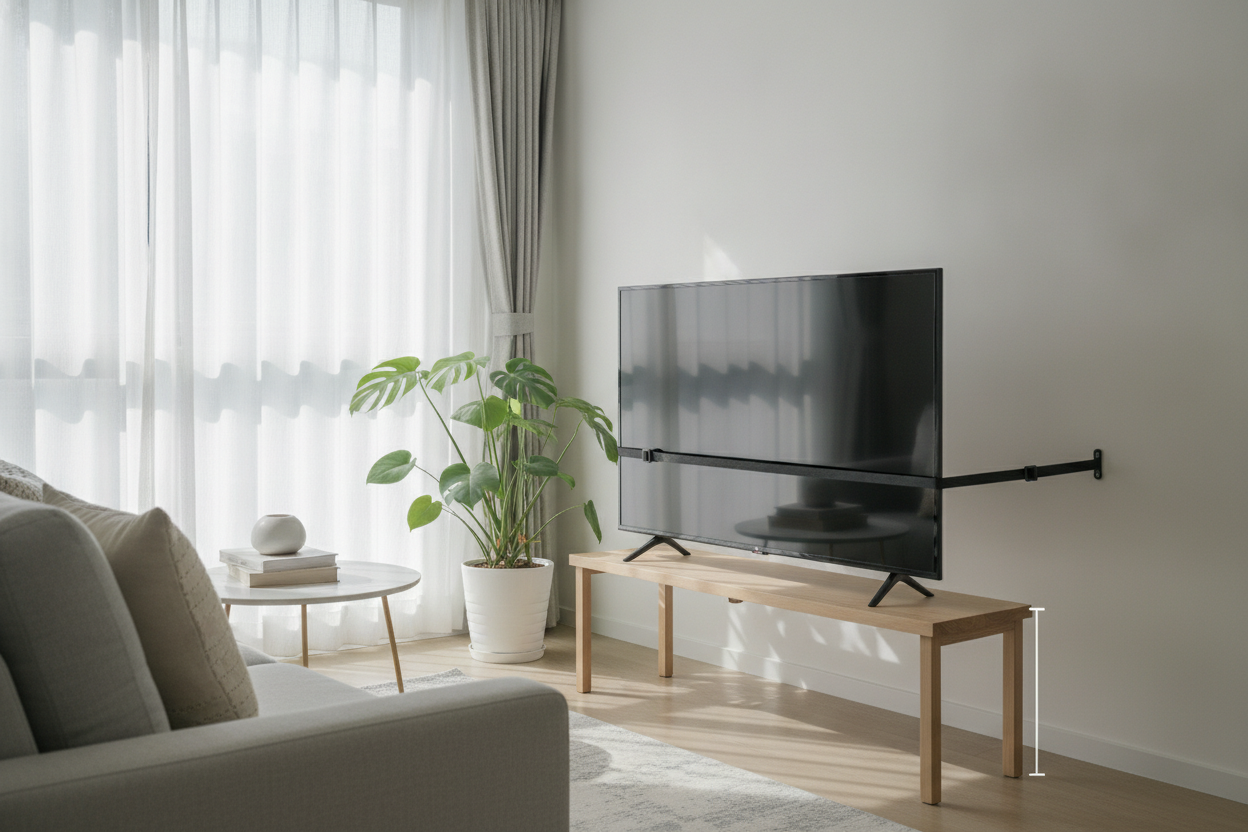
I once ordered what I thought was a sleek media console for my first studio apartment, only to have it arrive in a box the size of a pizza delivery. It turns out I didn't read the fine print on the depth. Staring at a 10 inch tv stand while holding a 50-inch flatscreen is a special kind of spatial anxiety. You’re basically asking a piece of furniture with the footprint of a cereal box to hold up a three-figure investment.
Quick Takeaways
- A 10-inch depth is 'ultra-shallow' and usually requires the TV to be wall-mounted above it.
- If the stand is only 10 inches wide, it is a pedestal for a small monitor, not a living room TV.
- Wall anchoring is mandatory for any furniture this slim to prevent tipping.
- Floating shelves are often a more stable alternative for tight hallways.
Wait, Do You Mean 10 Inches Deep, Wide, or Tall?
Before you hit 'buy,' we need to talk about which dimension we’re actually measuring. Most people searching for this are looking for depth—a shallow console that won't eat up the walkway in a narrow bedroom. A 10-inch deep stand is a specialized beast; it’s barely wide enough to hold a PlayStation, let alone the splayed legs of a modern TV.
Then there is the 10 inch wide tv stand. If you are looking for something 10 inches wide, you aren't looking for a console; you're looking for a pedestal or a plant stand. This only works for a tiny 19-inch kitchen TV or a digital photo frame. If you're looking for height, 10 inches puts the TV almost on the floor, which is great for a Japanese-inspired minimalist vibe but hell on your neck if you're sitting on a standard sofa.
The Physics of Balancing a Screen on a 10 Inch TV Stand
Modern TVs have moved away from heavy center bases to 'duck feet' style legs at the far edges of the frame. Here is the problem: those legs often have a footprint of 11 to 13 inches. If you try to perch them on a 10-inch surface, you're living on the edge—literally. The center of gravity is terrifyingly high, and a stiff breeze could send your OLED to the floor.
If you cannot drill into your walls to anchor the furniture or mount the screen, stop right here. A shallow stand is a tripod for disaster without a safety strap. For those in rentals where 'no holes' is the law of the land, you should probably browse standard depth TV stands instead. A 14-inch or 16-inch depth offers a massive jump in stability without actually hogging that much more floor space.
When a 10 Inch Wide TV Stand Actually Makes Sense
There are exactly three scenarios where an ultra-narrow footprint works. First: the 'Kitchen Corner.' You want a small screen for following recipes, and you have a weird 11-inch gap between the fridge and the pantry. A 10-inch wide pedestal fits perfectly there.
Second: the 'Security Hub.' If you have a small monitor dedicated to your doorbell camera, a tiny stand tucked in a closet or a hallway corner is ideal. But let’s be real—if you’re trying to build a 'home theater' in a cramped living room, you’ll eventually regret going this small. It’s better to measure twice and maybe upgrade to a 54 inch wide unit that actually spans the width of your TV and provides some visual balance.
Space-Saving Alternatives That Won't Eat Your Floor Plan
If your floor plan is so tight that 10 inches is your hard limit, consider going vertical. A floating shelf mounted at hip height gives you that 'stand' look without the legs cluttering the floor. It makes the room feel larger because you can see the floorboards all the way to the baseboard.
For the gadget-obsessed who hate seeing a black rectangle on the wall, there are more 'James Bond' options. You can actually find an electric vertical lift TV cabinet. These are deeper than 10 inches, but they allow you to hide the TV entirely when you're not using it, which solves the 'small room feels cluttered' problem better than a tiny stand ever could.
Personal Experience: The Lean-To Lesson
I tried to force a 10-inch console into my last apartment because I wanted a wide walkway. I didn't anchor it because I'm lazy. Three days in, I bumped the corner of the TV while vacuuming. The whole thing did a terrifying wobble that aged me five years. I ended up spending $20 on a set of anti-tip straps that same afternoon. If you go slim, you have to go secure. No exceptions.
FAQ
Can I put a 55-inch TV on a 10-inch deep stand?
Only if the TV is wall-mounted. Most 55-inch TV legs are too wide to sit safely on a 10-inch surface. If the TV is on its own legs, it will likely overhang and be extremely unstable.
Are 10-inch stands good for gaming consoles?
Barely. A PS5 is about 10.2 inches deep when standing vertically. It will fit, but there will be zero room for cables to plug into the back without the console sticking out over the edge.
How do I hide cables on such a small stand?
It’s tough. Since there’s no 'cabinet' to hide the mess, you’ll want to use adhesive cable channels that run down the back of the stand’s legs or use a decorative box on the bottom shelf to house the power strip.

Dejar un comentario
Este sitio está protegido por hCaptcha y se aplican la Política de privacidad de hCaptcha y los Términos del servicio.