










Core Structural Anatomy: Balancing Light Weight and Rigidity
Selecting a lightweight desk requires a careful look at how materials and geometry interact. When designing furniture meant for easy repositioning, manufacturers prioritize components that offer high structural integrity relative to their overall mass. A workstation does not need excessive bulk to withstand daily writing, computing, and task management, provided the load paths are correctly aligned.
Hollow-core composites, engineered wood tops with honeycombed interior cores, and slim-profile metal tubing represent the primary materials found in agile workstations. Engineered boards with high-density surface laminates deliver smooth, resilient work surfaces while keeping the core density manageable. Powder-coated tubular steel or extruded aluminum legs distribute downward force effectively without demanding the heavy solid castings common in traditional executive furniture.
By understanding how these elements fit together, you can identify models that feel solid under your arms while remaining effortless to lift and shift when reorganizing a room or vacuuming tight corners.
Dimensional Categories and Spatial Footprints
Lightweight desks generally fall into several dimensional profiles tailored to distinct spatial constraints and usage patterns:
- Compact Writing Perches: Narrow depths and modest widths make these ideal for alcoves, micro-apartments, or secondary work corners in bedrooms.
- Standard Task Desks: Balanced proportions provide room for a laptop, external monitor, and peripheral accessories while maintaining a low physical profile.
- Streamlined Utility Tables: Wider horizontal planes supported by open-frame undercarriages that serve dual roles as project crafting stations or temporary meeting desks.
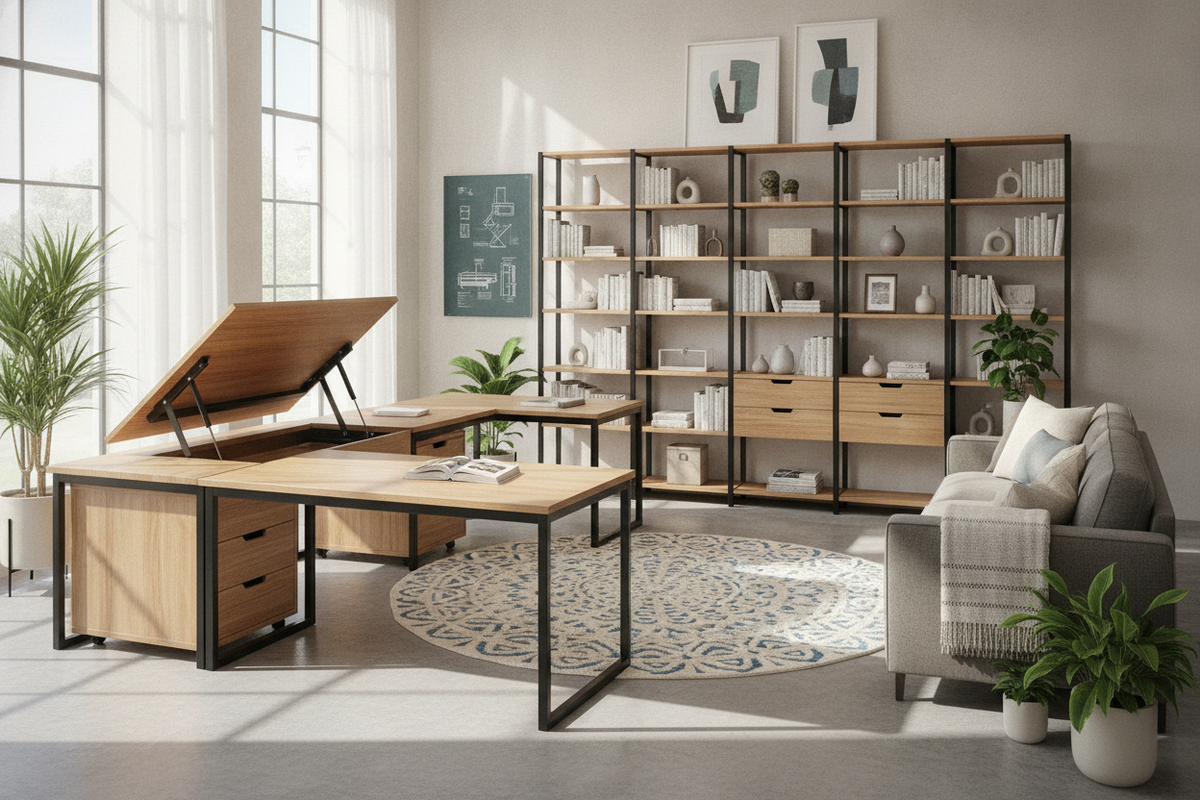
When planning desk placement, consider both the physical footprint and the clearance envelope required around the chair. Lightweight frames often excel in small rooms because their open base designs preserve visual openness and allow natural light to flow across the floor, preventing compact spaces from feeling cluttered.
Frame Engineering: Preventing Wobble in Low-Mass Desks
The central design challenge of any low-mass table is lateral stability. Without the sheer gravitational anchoring of heavy hardwood or cast iron, a lightweight desk relies on smart mechanical bracing to eliminate sway during typing or leaning.
Effective stabilization elements include:
- Rear Diagonal Bracing: Steel tension rods or cross-braces that connect opposing corners to disperse side-to-side force.
- Corner Gussets and Flanges: Triangular reinforcement plates welded or bolted at leg-to-apron junctions to resist angular flex.
- Perimeter Under-Frames: Continuous horizontal support rails that distribute downward load evenly across the entire surface.
- Adjustable Leveling Glides: Threaded feet that compensate for uneven floorboards, ensuring all contact points bear weight uniformly.
Checking for these structural reinforcements ensures your lightweight desk maintains a rock-solid posture throughout long work sessions.
Storage Architecture for Agile Workstations
Integrating storage into a mobile work environment requires balancing utility against excess weight. Permanent solid wood drawers can quickly double the weight of a desk, diminishing its portability and making relocation cumbersome.
Modern modular alternatives provide functional organization without the heavy footprint:
- Fabric and Canvas Drawers: Collapsible slide-in bins that hold office stationery while adding negligible mass.
- Suspended Wire Baskets: Open-mesh under-desk trays designed for power strips, cable routing, and external drives.
- Independent Mobile Carts: Detached storage units on castors that roll beside or beneath the workstation as needed.
For modular interior solutions and further organization strategies, check out this lightweight guide to coordinate your workspace with adaptable cabinetry.
Room Fit, Mobility, and Multi-Purpose Space Planning
In modern living spaces, rooms frequently serve multiple functions. A home office might double as a guest bedroom, creative studio, or living area alcove. A lightweight desk supports dynamic zoning because a single person can reposition it in moments without disassembling components or scratching delicate flooring.
To maximize flexibility, consider positioning the desk perpendicular to windows to reduce screen glare while keeping sightlines open. In shared spaces, pairing an airy desk frame with a clean cable-management spine creates a tidy silhouette from every angle, allowing the furniture to integrate naturally into existing living room or dining room decors.
Assembly, Disassembly, and Relocation Workflows
For renters, students, and frequent movers, the ease of assembling and packing down a desk is just as critical as its day-to-day ergonomics. Flat-pack lightweight desks feature simplified joinery systems that streamline setup.
To ensure longevity across multiple moves, keep these maintenance and relocation habits in mind:
- Hardware Organization: Keep connection bolts, hex keys, and spare glides grouped in labeled pouches during transport.
- Balanced Fastening: Thread all frame bolts loosely by hand before tightening them systematically in a diagonal pattern to prevent frame warping.
- Corner Protection: Use padded edge covers when navigating tight stairwells and doorways to protect thin veneer edging from impact.
- Periodic Tightening: Periodically inspect connector bolts and leveling glides to keep joints snug and wobble-free over time.
With thoughtful selection of materials, stable bracing configurations, and modular accessories, a lightweight desk offers an enduring, highly versatile foundation for productive modern living.

Dejar un comentario
Este sitio está protegido por hCaptcha y se aplican la Política de privacidad de hCaptcha y los Términos del servicio.