










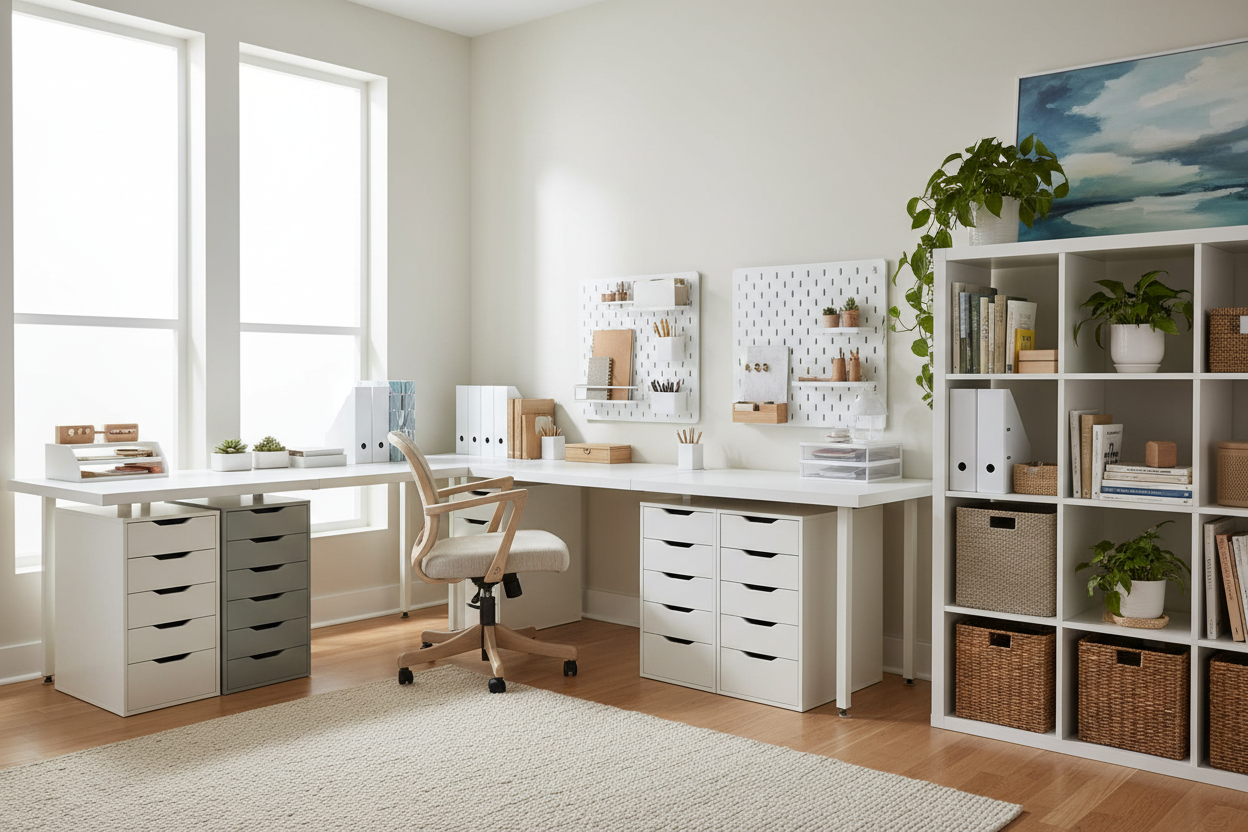
We have all stood in the middle of a home office, staring at a pile of paperwork and tangled cables, realizing that a simple table is not enough. The challenge isn't just finding a place to put things; it is finding a solution that feels curated rather than cluttered. As an interior designer, I often recommend ikea desk storage not because it is ubiquitous, but because its modular nature allows for a level of customization that rivals bespoke joinery—if you know how to select the right components.
Quick Decision Guide: Key Features to Look For
- Modular Compatibility: Ensure your chosen ikea desk units (like ALEX or KALLAX) align in height with your tabletop to create a seamless surface.
- Material Core: Distinguish between honeycomb paper filling (lightweight, less durable) and particleboard or solid wood veneer (heavy, long-lasting).
- Weight Capacity: Check the load limit of drawer bottoms; standard units are designed for stationery, not heavy equipment.
- Finish Texture: Matte finishes hide fingerprints better than high-gloss options, which is crucial for high-traffic workspaces.
Choosing the Right Material and Finish
When selecting ikea storage and desk combinations, the core material dictates the longevity of the piece. Many entry-level tabletops are constructed using a honeycomb paper structure. While cost-effective, these lack the acoustic dampening and tactile solidity of higher-end options.
Solid Wood vs. Veneer
For a more sophisticated, executive feel, I advise clients to bypass the standard white laminate tops in favor of kitchen countertops like the KARLBY or SALJAN. These offer a walnut or oak veneer that brings warmth and texture to the room. When paired with matte black or navy ikea storage with desk supports, the result is a high-contrast, architectural aesthetic that looks significantly more expensive than it is.
Space Planning and Layout
Visual balance is paramount in a workspace. A common error is creating a "leggy" look where the desk feels like it is floating aimlessly. To ground the space, use storage units as the actual legs of the desk.
The Anchor Method
Place a heavy drawer unit on one side and open shelving or trestle legs on the other. This asymmetry creates visual interest while keeping the heavier visual weight on the side where you need the most utility. If you are working with a long wall, utilizing two identical drawer units at either end creates a symmetrical, built-in appearance.
Elevating the Design: The "Built-In" Hack
To truly make these pieces sing, you must look beyond the instruction manual. Standard ikea desk units come with basic hardware that screams "flat-pack." Swapping out the standard drawer pulls for brushed brass, leather tabs, or matte black knurled handles instantly changes the character of the piece.
Furthermore, consider lighting. Installing LED strip lighting behind the desk or under floating shelves adds ambient glow, reducing eye strain and highlighting the texture of the wall behind your setup.
Lessons from My Own Projects
I learned a hard lesson about structural integrity early in my career while designing a workspace for a graphic designer. We used a 78-inch tabletop spanning across two drawer units without a central support leg, assuming the material was rigid enough.
Within six months, the desk began to bow visibly in the center—a phenomenon known as "sagging." It ruined the clean horizontal lines we had worked so hard to achieve. Now, whenever I design a setup spanning more than 55 inches, I insist on installing a hidden support leg (like the ADILS) in the back center. It’s invisible from the front but essential for maintaining that crisp, professional silhouette over time. Also, a small detail often overlooked: the back of these storage units is often unfinished. If your desk floats in the center of the room, you must plan to cover the back with a panel or position it against a wall.
Conclusion
Creating a workspace that inspires productivity doesn't require a five-figure budget. By strategically selecting materials and paying attention to the finer details of hardware and layout, you can transform standard components into a workspace that feels custom-made for your home. It is about making the furniture work for your specific workflow, not the other way around.
Frequently Asked Questions
Can I paint IKEA desk storage units to match my walls?
Yes, but preparation is key. Because most units have a laminate or melamine finish, you must use a shellac-based primer (like BIN) before applying your topcoat. Without this specific primer, standard paint will scratch off easily.
How do I stop the tabletop from sliding on the storage units?
If you are resting a tabletop on drawer units without screwing them in, use clear silicone bumper pads or anti-slip rug tape between the drawer unit and the tabletop. This provides friction without damaging the finish.
What is the best depth for a functional home office desk?
Aim for a depth of at least 24 inches (approx. 60cm). This allows enough distance between your eyes and the monitor, while providing ample room for a keyboard and paperwork without feeling cramped.

Dejar un comentario
Este sitio está protegido por hCaptcha y se aplican la Política de privacidad de hCaptcha y los Términos del servicio.