










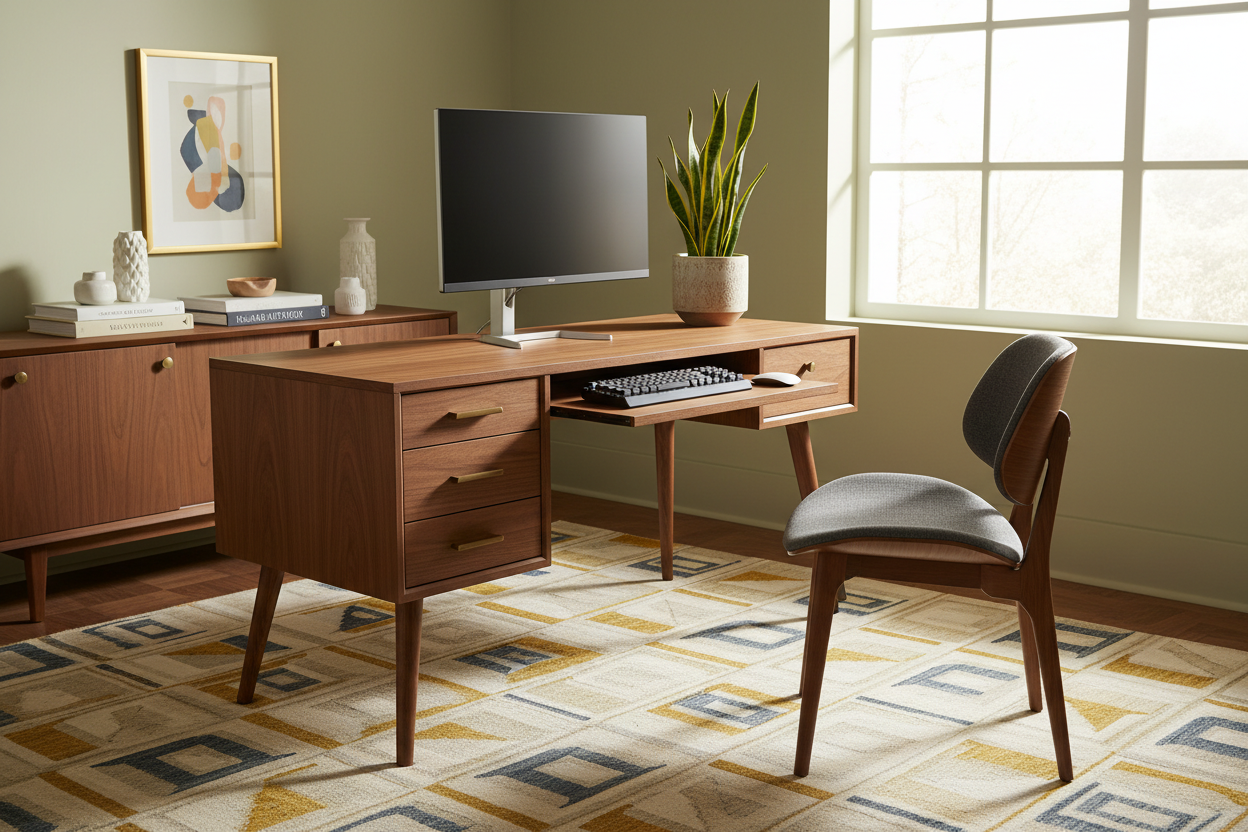
We often find ourselves caught in a tug-of-war between aesthetic purity and ergonomic necessity. You want the tapered legs and organic silhouettes of the 1950s, but you also need a workspace that doesn't leave your wrists straining after an hour of typing. The challenge lies in finding a mid century desk with keyboard tray that maintains clean architectural lines without looking clunky. In this guide, I will walk you through selecting a piece that honors the design era while accommodating modern technology.
Key Features to Look For
- Material Authenticity: Look for solid wood legs (walnut or acorn) paired with high-grade veneers to ensure stability without warping.
- Tray Mechanism: Prioritize steel ball-bearing glides over plastic tracks for silent, smooth operation.
- Apron Height: Ensure the desk apron (the vertical piece under the top) allows at least 24-26 inches of knee clearance when the tray is retracted.
- Cable Management: Check for discreet grommets or cutouts, as authentic vintage desks rarely account for power cords.
Balancing Silhouette with Utility
The hallmark of Mid Century Modern (MCM) design is visual lightness. A standard bulky keyboard drawer can ruin the floating effect of a desk top. When sourcing a mid century modern computer desk with keyboard tray, pay close attention to the profile of the drawer front. Ideally, the front of the tray should mimic a standard drawer face or blend seamlessly into the desk's apron when closed. This preserves the furniture's sculptural quality when you aren't working.
Material Selection: Solid Wood vs. Veneer
In my years designing home offices, I have found that material selection dictates longevity. While solid walnut is the gold standard for a luxury look, a high-quality wood veneer over MDF is often superior for the large flat surface of a desk. It resists seasonal expansion and contraction better than solid planks.
The Finish Factor
For a mid century modern desk with keyboard tray, the finish is not just about color; it is about tactile experience. Look for satin or matte lacquers rather than high-gloss polyurethanes. A satin finish highlights the grain patterns of teak or rosewood and feels more authentic to the period originals.
Ergonomics and The "Knee Squeeze"
The most significant oversight homeowners make with a mid century computer desk with keyboard tray is ignoring vertical clearance. MCM desks are notoriously low-profile. Adding a keyboard tray beneath the surface eats into your legroom. If you are taller than 5'10", you must verify that the distance from the floor to the bottom of the keyboard tray is sufficient. You do not want to sacrifice your posture for a beautiful piece of furniture.
Lessons from My Own Projects
I learned the hard way about the importance of "hardware fidelity" during a renovation for a writer in Seattle. We sourced a stunning, custom-built desk that looked perfect in the showroom. However, the manufacturer had used a friction-based slider for the keyboard tray rather than ball bearings to save money.
Within three months, the tray started sticking, and the vibration from typing caused a subtle rattling sound against the desk frame. It drove my client crazy. I had to personally go in and retrofit the piece with heavy-duty steel slides. Now, whenever I inspect a desk, I don't just look at the wood; I physically wiggle the tray side-to-side. If there is more than a millimeter of play, I walk away. It’s a small, unpolished detail that determines whether you will love or loathe the desk in the long run.
Conclusion
Finding the right desk is about respecting the past while living in the present. By focusing on sturdy hardware, appropriate knee clearance, and authentic finishes, you can secure a workspace that inspires creativity and supports your body. Don't settle for a desk that is merely a decoration; demand one that works as hard as you do.
Frequently Asked Questions
Can I add a keyboard tray to a vintage MCM desk?
Technically, yes, but proceed with caution. Vintage desks often have shallow aprons or center drawers that block aftermarket trays. You may need to remove the center drawer to mount the track, which can devalue an antique piece.
What is the ideal height for the keyboard tray?
For proper ergonomics, the tray should sit roughly 2 to 3 inches above your knees, allowing your elbows to rest at a 90-degree open angle. This is often lower than the standard 30-inch desk height.
How do I maintain the wood finish on the keyboard tray?
The tray sees high traffic and skin oil contact. Clean it weekly with a damp microfiber cloth and mild soap. Avoid silicone-based polishes, which can leave a sticky residue that interferes with your mouse tracking.


Dejar un comentario
Este sitio está protegido por hCaptcha y se aplican la Política de privacidad de hCaptcha y los Términos del servicio.