










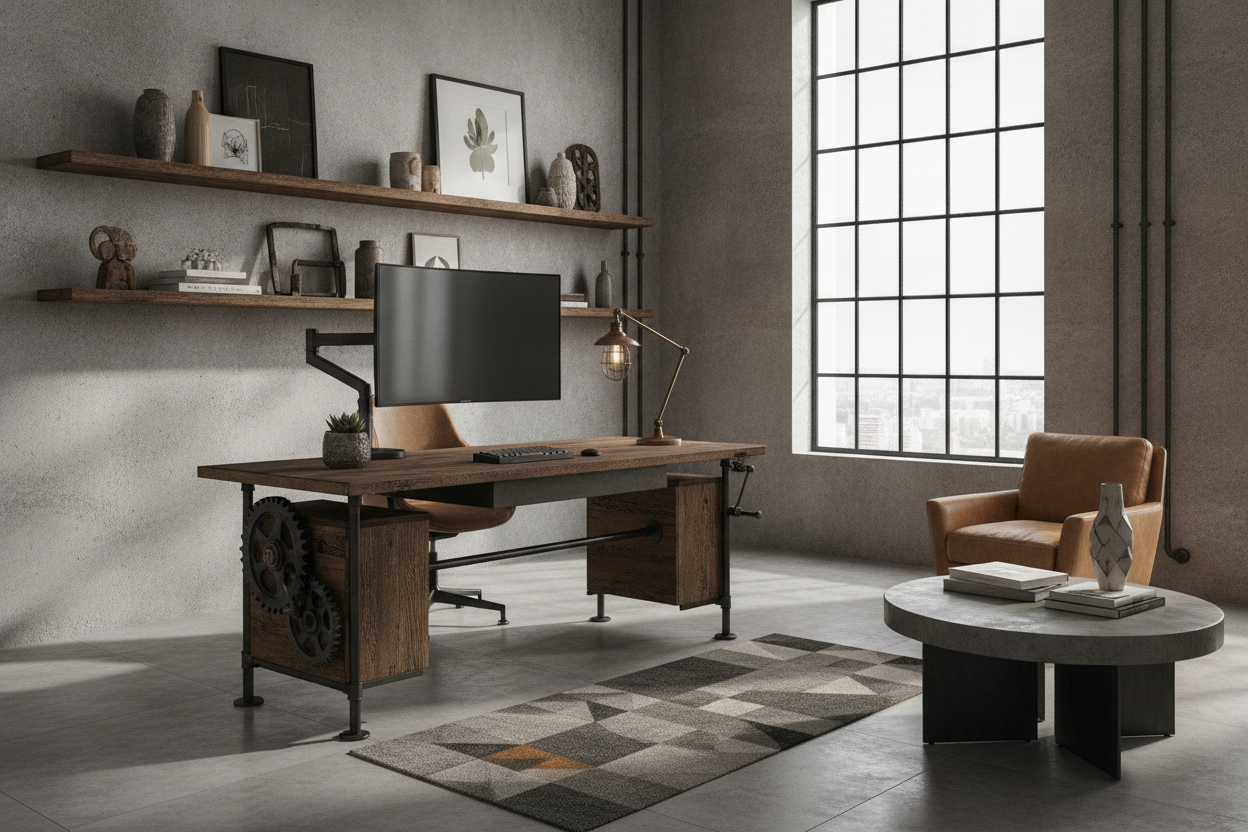
I’ve spent more hours than I’d like to admit staring at 47 open tabs of office furniture, trying to find a desk that doesn't look like it was salvaged from a mid-90s call center. Most modern office gear is too 'techy'—all white plastic and sleek curves that clash with my love for exposed brick and worn-in leather. I wanted something substantial, something that felt like it belonged in a converted warehouse loft, which led me down the rabbit hole of finding the perfect industrial adjustable standing desk.
- Prioritize heavy-duty steel frames over lightweight aluminum for stability.
- Look for desktop thicknesses of at least 1.25 inches to avoid the 'cheap veneer' look.
- Dual motors are non-negotiable if you’re using real wood or multiple monitors.
- Use textiles and warm lighting to soften the cold metal and wood aesthetic.
The Problem With Most 'Rustic' Office Furniture
If I see one more 'rustic' desk made of hollow square tubing and a piece of particle board with a wood-grain sticker, I’m going to lose it. Most big-box retailers have commoditized the industrial style standing desk to the point where it’s just a costume. They use these flimsy silver-painted legs and a top that feels like a hollow-core door. It’s the furniture equivalent of a fast-fashion t-shirt that falls apart after three washes.
Authentic industrial design is about honesty in materials. It’s about the weight of the thing. If you can lift your entire desk with one hand, it isn't industrial; it’s a prop. Real industrial pieces should have a bit of grit—visible welds, matte finishes, and a surface that actually has some tactile grain. When you buy the cheap imitation, you aren't getting a workspace; you're getting a vibrating platform that smells like off-gassing chemicals for three weeks. I’ve been there, and trust me, the 'savings' aren't worth the daily annoyance of a desktop that flexes when you lean on it.
What Actually Makes an Industrial Desk Look Authentic?
To get this look right without your office feeling like a steampunk movie set, you need to focus on the frame. Blackened steel is the gold standard. While white or silver frames look great in a minimalist Scandinavian setup, they feel too 'medical' for this vibe. I always recommend going with an adjustable standing desk black frame because it provides a heavy visual anchor that grounds the room. Matte finishes are your friend here—anything shiny will immediately look like plastic.
You also want to look at the joints. In a true industrial piece, the mechanical parts are part of the art. Look for frames with exposed bolts or heavy-duty crossbars. The desktop itself needs to be thick—I’m talking at least 1.25 inches. A thin top on a heavy frame looks like a guy who skipped leg day; it just doesn't work. The grain should be deep and textured, ideally with some natural knots or imperfections that tell you it didn't come out of a printer. If the 'wood' looks perfectly uniform, it's probably just contact paper.
The Weight Dilemma: Why Your Motors Matter
Here is where the physics of furniture gets real. If you source a beautiful, 80-pound slab of reclaimed oak or thick butcher block, you are already pushing the limits of cheap standing desk motors. Most budget frames are rated for about 150 pounds, but that includes the weight of the top itself. Once you add two 27-inch monitors, a laptop, a heavy mechanical keyboard, and maybe a desktop speakers, you’re redlining the motor every time you hit the 'up' button.
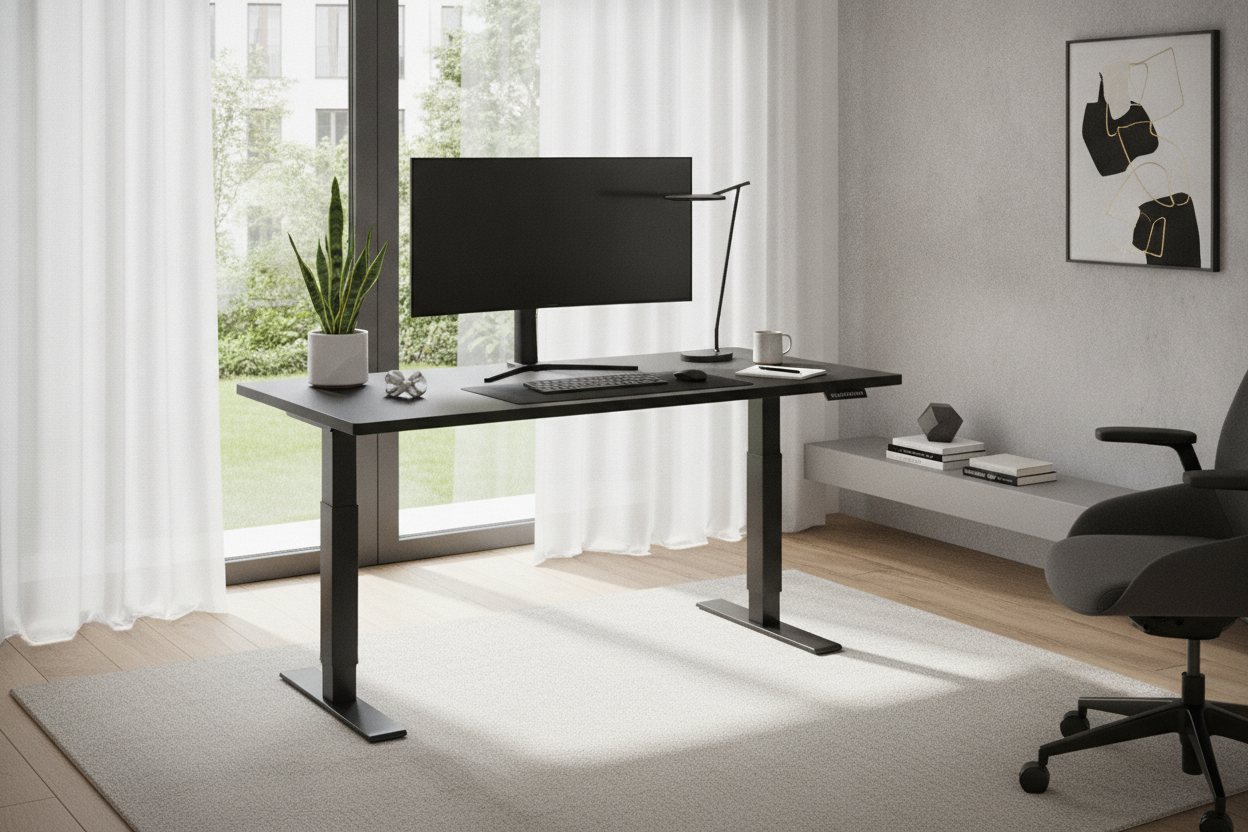
I’ve found that you need a frame specifically designed for heavy-duty loads. The 71 W Height Adjustable Standing Desk is a solid example of a foundation that doesn't groan when you put a real piece of wood on it. Dual motors are a must; they distribute the load more evenly and keep the desk from wobbling when it reaches its full height. Nobody wants a thousand-dollar setup that shakes when they type an email. If the motor sounds like a dying blender, you've made a mistake.
How I Styled Mine to Avoid the 'Mechanic's Garage' Vibe
The danger with industrial furniture is that it can feel cold and uninviting. To fix this, I treat the desk like a piece of architecture and use the rest of the room to add warmth. I put a vintage Persian rug with deep reds and blues under my desk. The intricate pattern balances the raw, hard lines of the steel legs perfectly. It also helps dampen the sound of the motors, which is a nice bonus.
Lighting is another big one. Skip the overhead fluorescent lights. I use an Edison-style desk lamp with a warm amber bulb and a few small spotlights for the walls. Then, add life. A large trailing Pothos or a snake plant sitting on the corner of the desk breaks up the brown and black color palette. It makes the space feel like a home office, not a factory floor. Finally, deal with your cables. Industrial desks are notoriously bad at hiding wires because they lack the bulky plastic panels of modern desks. I use leather cord wraps and magnetic cable channels to keep the 'messy' part of technology from ruining the clean lines of the steel.
Should You Just Build Your Own?
I’m a big fan of the hybrid approach. Buying a pre-made industrial desk is convenient, but if you want something truly unique, buy a high-quality motorized frame and source your own top. I once went to a local lumber yard and found a slab of live-edge walnut for $200. It took a weekend of sanding and oiling, but the result was a desk that looked like it cost three times what I actually spent.
The downside? It’s a lot of work. If you aren't handy with a drill and a sander, or if you don't have the space to get dusty, stick to a high-end pre-made option that offers a solid wood top as an upgrade. Your sanity is worth the extra hundred bucks. Just make sure the frame you buy has a wide enough range to accommodate whatever custom slab you find.
Personal Experience: My Wobble Disaster
I learned the hard way that you can't cheap out on the base. My first 'industrial' desk was a $180 special. It looked okay in photos, but at 42 inches high—my preferred standing height—it had a two-inch sway. Every time I hit the backspace key, my monitors would dance like they were at a concert. I eventually realized that 'industrial' is as much about structural integrity as it is about aesthetics. I ended up giving that desk away and buying a frame with twice the weight capacity. My coffee hasn't spilled since.
FAQ
How do I clean a reclaimed wood desktop?
Don't soak it. Use a slightly damp microfiber cloth and a gentle wood cleaner. If it’s raw or oiled wood, you’ll want to re-apply a food-safe wax or oil once a year to keep it from drying out and cracking in the winter.
Are industrial desks too loud?
The desk itself isn't loud, but cheap motors can be. High-quality dual motors usually hum at around 45-50 decibels, which is quieter than a refrigerator. If your motor is grinding or squealing, it's likely overloaded or poorly manufactured.
Can I add casters to an industrial standing desk?
Yes, and it actually looks great with the aesthetic. Just make sure they are heavy-duty locking casters. Also, remember that adding wheels will raise the minimum and maximum height of your desk by 2-3 inches, so adjust your chair accordingly.

Dejar un comentario
Este sitio está protegido por hCaptcha y se aplican la Política de privacidad de hCaptcha y los Términos del servicio.