





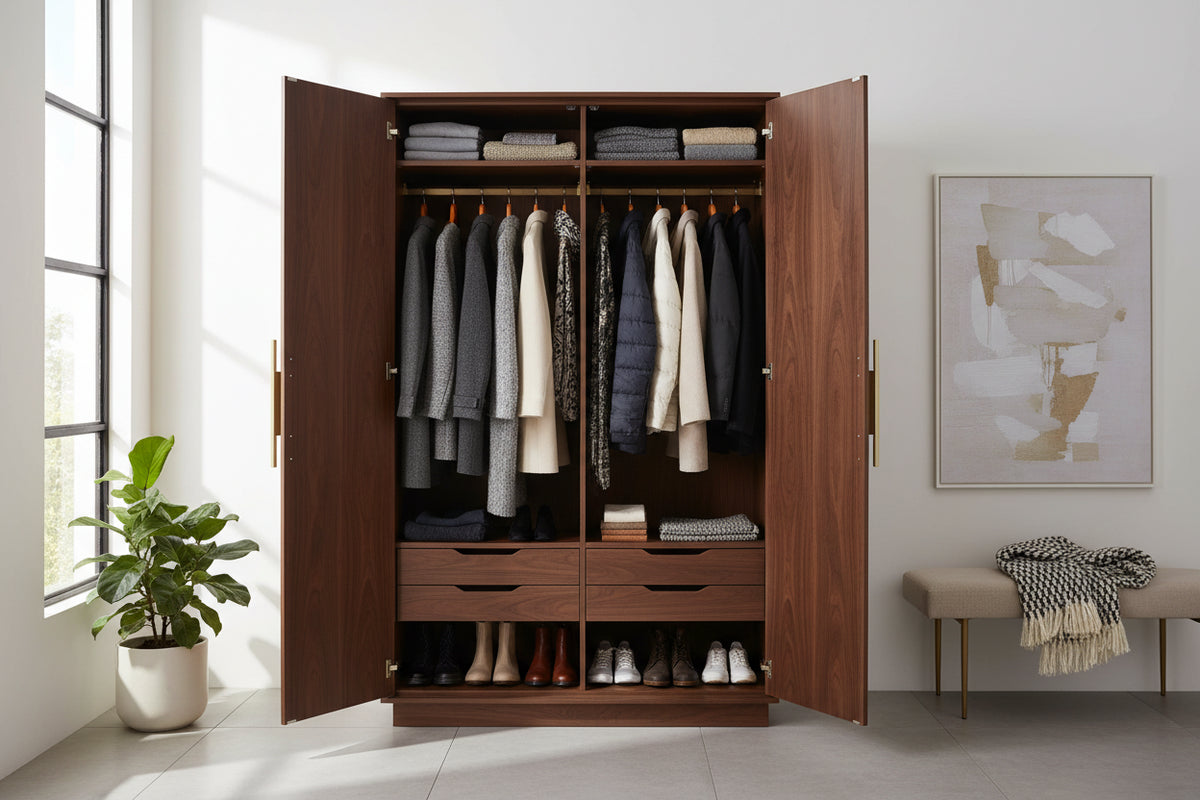
A coat armoire is a freestanding cabinet with a hanging rod behind doors, used as a coat closet where a home has none: in an entryway, a mudroom or a hallway. Two numbers decide whether your coats fit. The inside depth has to take a hanger (20 inches is the minimum and 24 inches is comfortable), and the clear hanging height under the rod has to be longer than your longest coat on its hanger.
Below: how to check both numbers, the arithmetic for each pick, shoes, wet coats, walkway space, hall tree vs armoire, and anchoring, with picks from the FUFU&GAGA entryway collection and our wardrobe range.
Key takeaways
- Depth: Dimensions.com gives 20 inches as the minimum closet depth for hangers and 24 inches as comfortable. Check the inside depth, not just the outside.
- Hanging height: measure your longest coat from hanger hook to hem and compare it with the clear drop under the rod in the product diagram.
- Long coats: the armoires below have hanging drops of 43.5 to 46.4 inches. That suits jackets and hip-length coats; knee-length and longer coats will rest on the shelf or rack below.
- Walkway: keep about 36 inches clear in front of the armoire.
- Safety: armoires are clothing storage units under 16 CFR part 1261. Anchor every one to the wall.
What is a coat armoire?
Dictionary.com defines an armoire as "a large wardrobe or movable cupboard, with doors and shelves." A coat armoire is the same piece put to work by the front door: a rod for coats, doors to hide them, and shelves or drawers for hats, gloves, bags and shoes. Stores also sell it as an armoire coat closet, a coat wardrobe or a coat cabinet. Most are bedroom wardrobes with the right measurements: the room name on a listing matters less than depth and hanging space.
If you are still deciding between the two furniture terms, our armoire vs wardrobe guide explains where they overlap and where they differ.
Number 1: interior depth for hangers
A coat on a hanger hangs side to side across the rod, so the cabinet must be at least as deep as the hanger is wide. Dimensions.com sets the minimum closet depth for hangers at 20 inches and the comfortable depth at 24 inches. Hunker says a closet meant for coats or other bulky hanging items may need to be as deep as 28 inches.
Freestanding armoires are shallower than that, and the inside is smaller again, because the back panel and the doors take part of the outside depth. Two examples from our product diagrams:
- A 23.6-inch-deep armoire measures 22.2 inches inside: 1.4 inches lost (23.6 - 22.2).
- A 19.3-inch-deep armoire measures 18.3 inches inside: 1 inch lost (19.3 - 18.3), which leaves it 1.7 inches under the 20-inch minimum (20 - 18.3).
In an armoire under 20 inches inside, wide coat hangers may sit at a slight angle or press on the closed doors. That is fine for jackets and slim coats; for puffers and thick wool coats, look for the deepest interior you can fit.
Number 2: clear hanging height under the rod
In a built-in closet, the rod height from the floor is what counts. Bob Vila recommends a single rod at 66 inches so long items hang without folding or brushing the floor, and Hunker places a long-hang rod at 68 inches and a double-hang pair at 42 and 84 inches. That double-hang pair leaves 42 inches between rods (84 - 42), the space a closet gives shirts and jackets.
An armoire is different. Most put the rod above shelves, drawers or a rack, so what matters is the clear drop from the rod down to whatever sits below it. Our coat closet dimensions guide summarizes typical garment lengths, measured from the rod to the hem in an Auburn University clothing storage study:
| Garment | Rod to hem | Fits a 43.5-in drop? | Fits a 46.4-in drop? |
|---|---|---|---|
| Jackets | 25 to 40 in | Yes | Yes |
| Short coats | 31 to 43 in | Yes, just | Yes |
| Men's overcoats | 48 to 54 in | No, folds on the shelf | No, 1.6 in or more short |
| Women's long coats | 48 to 55 in | No | No |
The study is decades old, so measure your own longest coat from the top of the hanger hook to the hem and compare it with the hanging height in the product diagram. If a listing says a unit suits long coats but shows no measured drop, ask for the diagram before ordering.
Which coat armoires hold long coats?
Honestly, few freestanding armoires do. Among the FUFU&GAGA wardrobes whose diagrams give a hanging height, the clear drop runs from 43.5 to 46.4 inches. That is a little more than a closet's 42-inch double-hang space and well short of the 66 to 68 inches a long-hang closet rod is mounted at. The deepest and longest of them, the 31.5-inch textured beige armoire, still sits 1.6 inches short of a 48-inch overcoat (48 - 46.4).
So plan the armoire for jackets, puffers, raincoats and hip-length coats, which make up most daily wear. If the household owns several knee-length or longer coats, keep those in a bedroom closet with a long-hang rod, or let them rest their hems on the shelf below the rod if a slight fold doesn't bother you.
How many coats fit? Rod width arithmetic
Our coat closet dimensions guide, using the same study, allows about 3 inches of rod per heavy coat and 2 inches per medium jacket or raincoat. So divide the inside rod width by 3 for winter coats:
- A 14.6-inch rod: about 5 heavy coats (14.6 / 3 = 4.9).
- A 30.2-inch rod: about 10 heavy coats (30.2 / 3 = 10.1).
- Two 30.2-inch rods: about 20 heavy coats (60.4 / 3 = 20.1).
Check the rod's weight rating too. A rod rated for 30 lb holds ten coats only if they average 3 lb or less, so weigh an armful of winter coats on a bathroom scale before you load it.
Coats and shoes in one armoire
Many people searching for an armoire for coats and shoes want both behind one set of doors. Two layouts work:
- Shelves below the rod: the Rena armoires below have shelf openings of 15.5 and 15.2 inches under the hanging section, which takes sneakers, flats and ankle boots. Measure your tallest boots against those heights.
- A shoe cabinet beside it: a slim shoe cabinet next to the armoire keeps muddy shoes away from coat hems and leaves the armoire's lower space for bags and hats. Our shoe cabinet buying guide covers pair counts and boot height.
Wet coats and ventilation
A closed cabinet keeps moisture in. The EPA's brief guide to mold, moisture and your home says to dry water-damaged areas and items within 24 to 48 hours to prevent mold growth, and to keep indoor humidity below 60 percent, ideally 30 to 50 percent. For a coat armoire, that means:
- Let a soaked raincoat or snowy parka dry on an open hook first, then hang it inside.
- Leave the doors open for a while after a wet day.
- Don't pack the rod tight; leave space for air between coats.
Entryway walkway and door swing
An armoire by the front door has to leave a way past it. The ADA's guide to accessible routes sets a 36-inch minimum clear width for walking surfaces, which may narrow to 32 inches at short points such as doorways. Homes don't have to meet it, but it is a sensible target. Add the armoire's depth to find the hall width you need:
- 19.3-inch armoire: 36 + 19.3 = 55.3 inches of hall width.
- 23.6-inch armoire: 36 + 23.6 = 59.6 inches.
Doors need room too. Each hinged door sweeps an arc as wide as the door. On a 63.3-inch armoire with four door columns, each door is about 15.8 inches wide (63.3 / 4), so you need roughly 16 inches of clear floor in front plus room to stand. Separate upper and lower doors help, and the front door must still open fully past them.
Hall tree vs coat armoire
A hall tree hangs coats on open hooks and usually adds a bench and shoe storage; an armoire hides coats behind doors.
| Coat armoire | Hall tree with cabinets | |
|---|---|---|
| How coats hang | On hangers on a rod | On hooks |
| Coats hidden? | Yes, behind doors | No, only what is in the side cabinets |
| Depth in our range | 15.7 to 23.6 in for the picks below | 15.8 in for the pick below |
| Seat for putting on shoes | No | Yes |
| Wet coats | Dry them first | Dry in the open on the hooks |
| Best for | A tidy entry with every coat out of sight | Daily coats, bags and a bench in one unit |
Our hall tree buying guide covers bench height, hook height and widths in detail.
Anchoring a coat armoire
A tall cabinet loaded with heavy coats can tip if a child climbs it or someone pulls hard on an open door. The CPSC's Anchor It campaign says anchoring all furniture with drawers, doors and shelves to the wall prevents tip-over injuries and deaths.
Armoires are clothing storage units under federal law. The CPSC's clothing storage unit rule (16 CFR part 1261) covers free-standing units at least 27 inches tall and 30 pounds with at least 3.2 cubic feet of enclosed storage, lists armoires among its examples, and applies to units manufactured after September 1, 2023. Covered units must pass three stability tests and come with an anti-tip device that meets ASTM F3096. Use that device: fix the armoire into a wall stud, or use anchors rated for your wall. Our anchoring guide shows the bracket-and-strap steps, which are the same for an armoire.
Coat armoire checklist
- Inside depth: 20 inches or more for hangers, or accept angled hangers below that.
- Hanging drop: longer than your longest daily coat on its hanger.
- Rod width: about 3 inches per heavy coat.
- Rod rating: total coat weight under the rated pounds.
- Hall width: armoire depth plus 36 inches.
- Door swing: about one door width of clear floor in front.
- Shoes: shelf height vs your tallest boots, or a shoe cabinet beside it.
- Wet coats: an open hook to dry them first.
- Anchoring: the anti-tip device in the box, and a stud to fix it to.
Our picks: coat armoires with measured hanging space
Each FUFU&GAGA pick below has a published diagram, so the depth and hanging figures are measured rather than guessed. Outside sizes come from the specs; inside depth, hanging drop and rod space come from each product's diagram.

31.5" Textured Beige Armoire with Pants Rack and Hanging Rod
The deepest pick and the one with the longest drop. It is 23.6 inches deep outside and 22.2 inches inside, so wide hangers sit square, between the 20-inch minimum and the 24-inch comfortable depth. The rod spans 30.2 inches (about 10 heavy coats: 30.2 / 3) and is rated for 33 lb; the clear drop above the pull-out pants rack is 46.4 inches. Below the rack is a 20.8-inch space for boots or bags. Size: 77.1" H x 31.5" W x 23.6" D. The specs list a tipover restraint as included.
Best for: puffers, parkas and hip-length coats that need depth.
Skip it if: you hang overcoats or long coats. The listing mentions long garments, but 46.4 inches is shorter than the 48 to 55 inches they need, so hems will rest on the pants rack. It is also the deepest pick, so it needs a hall at least 59.6 inches wide to keep 36 inches clear.
Rena 47.6" Luxe White Armoire with 6 Doors and 2 Hanging Rods
A mid-width coat armoire with two hanging sections side by side: one about 30.2 inches wide and a narrower one about 14.6 inches wide, per the diagram. Together that is 44.8 inches of rod space (30.2 + 14.6), or about 15 heavy coats (44.8 / 3). Both rods are removable and rated for 30 lb each. The main section's clear drop is 43.5 inches, with shelf openings of 15.5 and 15.2 inches below for shoes and bags. Six doors, split into upper and lower sets, keep each swing small. Size: 74.9" H x 47.6" W x 19.3" D, about 18.3 inches deep inside. A tipover restraint is included, per the specs.
Best for: a couple's or small family's jackets and short coats, plus shoes, on a 48-inch wall.
Skip it if: you hang bulky coats or long coats. At 18.3 inches inside it is under the 20-inch hanger minimum, and the 43.5-inch drop suits jackets and short coats only.

Rena 63.3" Luxe White Armoire with 6 Doors and 3 Drawers
The family-size pick. It has two 30.2-inch hanging sections, so 60.4 inches of rod, about 20 heavy coats (60.4 / 3), on two removable rods rated for 30 lb each. The diagram gives a 43.5-inch drop for the section above the shelves; the other hangs above three drawers, which suit gloves, hats and scarves. One hanging section has glass doors, so you can see which coat is where. It is a set of two units that stand side by side; anchor each one. Size: 74.9" H x 63.3" W x 19.3" D, about 18.3 inches deep inside. The specs list a tipover restraint as included.
Best for: a mudroom or wide entry wall that has to hold everyone's everyday coats.
Skip it if: you want every coat out of sight (one section has glass doors) or you hang thick winter coats, which may press on the doors at 18.3 inches inside.
Rena 15.7" Modern White Compact Wardrobe with Dual Doors
One of our most-ordered wardrobes, and the narrowest coat armoire here. At 15.7 inches wide it fits beside a door frame. Inside, the diagram shows a 14.6-inch-wide hanging section with a 43.5-inch drop, about 5 heavy coats (14.6 / 3), on a removable rod rated for 30 lb, with shelves below for shoes. Upper and lower doors keep the swing to about one narrow door. Size: 74.9" H x 15.7" W x 19.3" D, about 18.3 inches deep inside. A wall anchor is included, per the listing.
Best for: one or two people's jackets in a narrow gap by the door.
Skip it if: you need room for a family's coats, or for bulky or long coats; it is shallow inside and the drop is 43.5 inches.

63" Black Farmhouse 4-in-1 Hall Tree with Rattan Side Cabinets
The hall tree alternative, with closed storage. Wicker-look side cabinets hide bags, shoes and outerwear, four hooks in the center take the coats you wear every day (and let wet ones dry in the open), and the bench holds up to 220 lb with shoe storage below. At 15.8 inches deep it leaves more walkway than any armoire here. Size: 76.8" H x 63" W x 15.8" D. An anti-tipping device is included, per the listing.
Best for: a family entry that needs a seat, shoe space and a few hidden cabinets.
Skip it if: you want every coat behind a door or on a hanger; the center hooks are open.
Compare the picks
| Pick | W x D (in) | Inside depth | Hanging drop | Rod space | Heavy coats (rod / 3) | Best for |
|---|---|---|---|---|---|---|
| 31.5" textured beige | 31.5 x 23.6 | 22.2 in | 46.4 in | 30.2 in, 33 lb | About 10 | Bulky short coats |
| Rena 47.6" 6-door | 47.6 x 19.3 | 18.3 in | 43.5 in | 30.2 + 14.6 in | About 15 | Jackets plus shoes |
| Rena 63.3" 6-door | 63.3 x 19.3 | 18.3 in | 43.5 in | 2 x 30.2 in | About 20 | Family entry |
| Rena 15.7" compact | 15.7 x 19.3 | 18.3 in | 43.5 in | 14.6 in | About 5 | Narrow gaps |
| 63" black hall tree | 63 x 15.8 | n/a | Hooks | 4 hooks | 4 daily coats | Bench and shoes |
For a built-in style option, our entryway coat closet with doors guide covers placement and styling. For more widths and finishes, browse the armoires and wardrobes or the full entryway furniture collection.
FAQ
What is a freestanding coat closet called?
It is usually called an armoire or a wardrobe, and stores also sell it as a coat armoire, coat wardrobe or coat cabinet. Dictionary.com defines an armoire as a large wardrobe or movable cupboard with doors and shelves. A hall tree is different: it hangs coats on open hooks and often adds a bench.
How deep should an armoire for coats be?
At least 20 inches inside, the minimum closet depth for hangers per Dimensions.com, and ideally 24 inches. Hunker says closets for bulky coats may need up to 28 inches. Outside depth is about 1 to 1.5 inches more than the inside in our diagrams.
Where do you put coats without a coat closet?
Use a coat armoire by the door to hide them, a hall tree if you also need a bench and shoe storage, or wall hooks over a shoe cabinet in a very shallow hall. Keep one open hook where wet coats can dry before they go behind closed doors.
How do you store coats and shoes in one armoire?
Hang coats on the rod and use the shelves below for shoes, with a tray under wet boots. Measure your tallest boots against the shelf heights in the diagram. If the lower shelves are too short, stand a slim shoe cabinet next to the armoire instead.

Dejar un comentario
Este sitio está protegido por hCaptcha y se aplican la Política de privacidad de hCaptcha y los Términos del servicio.