










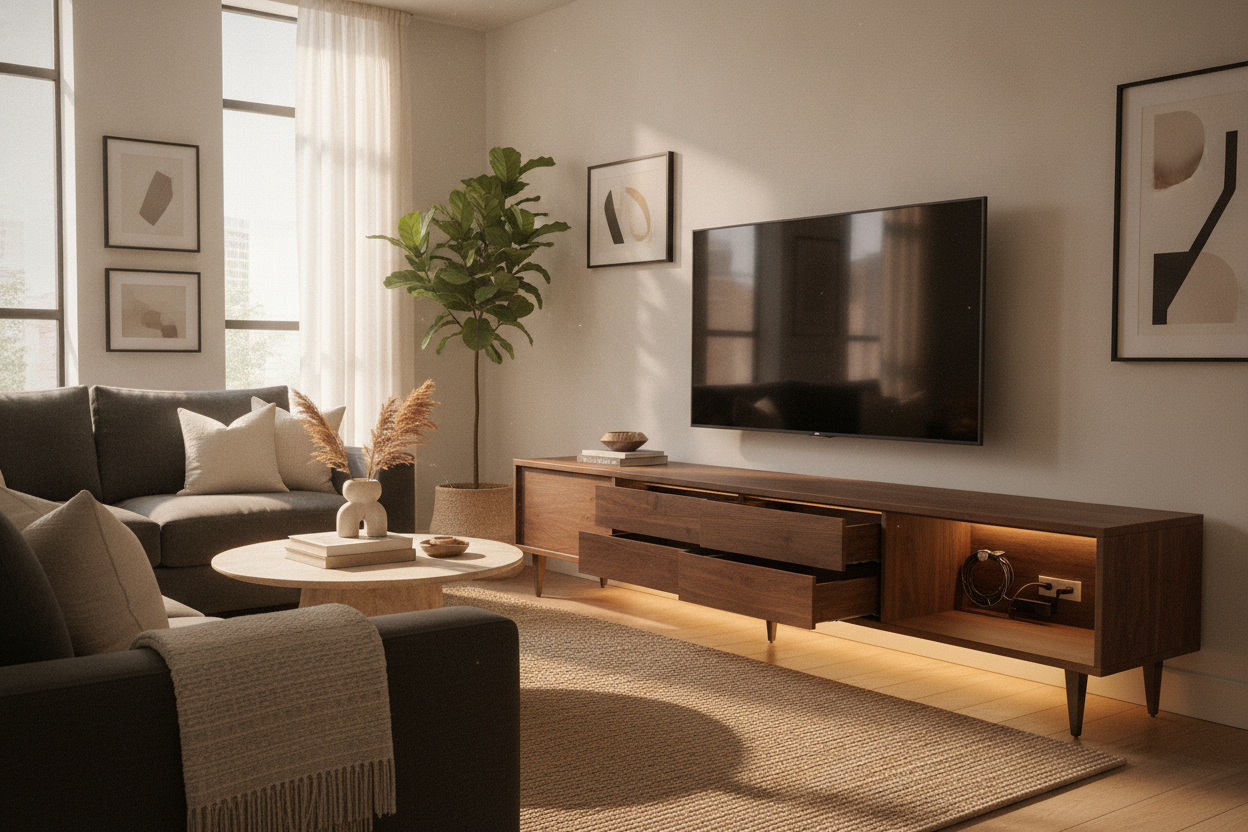
I remember the exact moment I realized my living room was a lie. I had just hauled a 65-inch OLED home, and as I set it down on my $89 'espresso' console, I heard a distinct, sickening crackle. The top shelf didn't just sag; it surrendered. Staring at 47 browser tabs of media furniture at 1 AM won't help you if you don't know what you're looking for. Finding a good quality tv stand isn't about the price tag; it’s about making sure your expensive tech doesn't end up face-down on the rug because of a few pieces of compressed sawdust and a prayer.
Quick Takeaways
- Weight limits are non-negotiable; always aim for a capacity at least 20 lbs higher than your TV weight.
- Real wood, high-grade MDF, or metal frames are the only materials that survive a move.
- Check the back panel: if it's stapled cardboard, the whole unit lacks structural integrity.
- The 'Wobble Test' never lies—if it shudders when you nudge it, it's a hard pass.
The Day My Particle Board Console Finally Snapped
It started with a subtle bow. You know the one—where the center of the stand dips just enough that your soundbar starts to look like it’s sliding into a canyon. I ignored it for months, telling myself that the 'engineered wood' was just settling. Then I upgraded my TV. The new screen was heavier, wider, and significantly more expensive. Within forty-eight hours, the veneer began to peel away from the edges like a bad sunburn, revealing the crumbly, grayish interior of low-density particle board.
The breaking point wasn't even the weight alone; it was a humid Tuesday. The moisture in the air softened the glue holding those wood chips together, and the whole thing just... gave up. I spent the evening propping up a three-thousand-dollar setup with stacks of old hardcover books. It was humiliating. That’s the problem with cheap media furniture: it’s designed to look good in a studio-lit photo, but it’s not built for the physics of a real home. If the core is basically paper and glue, it has an expiration date that usually hits right after the return window closes.
The 'Wobble Test' and Other Green Flags
When you're shopping in person, give the unit a firm shake from the side. A well-made piece won't budge. If it shimmies or the joints groan, the hardware is likely bottom-barrel. You want to see cam-locks that are made of actual metal, or better yet, traditional joinery. If you can spot a quality TV stand by looking at the corners, you'll notice that the best ones use reinforced blocks or dovetail joints rather than just a few thin nails and a smear of wood glue.
Another massive red flag is the back panel. Most budget stands use a piece of 1/8-inch thick cardboard that you're supposed to tack on with tiny nails. That cardboard isn't just for aesthetics; it's actually supposed to provide the lateral stability that keeps the stand from leaning. A high-end unit will have a finished back made of the same material as the rest of the frame, usually screwed into a recessed groove. This creates a rigid box that can handle the weight of a massive screen without folding like a house of cards. Always check the weight capacity in the fine print—if it says 50 lbs and your TV is 48 lbs, you're asking for trouble.
When to Scale Up Your Setup
Sometimes a low-profile console just isn't enough, especially if you're a gamer or a physical media collector. When you start adding consoles, receivers, and a center-channel speaker, you need to think about a quality entertainment center that offers more than just a flat surface. Scaling up means you're dealing with more vertical weight and a higher center of gravity, which makes structural integrity even more critical. A larger unit needs a dedicated center support leg—don't buy anything over 60 inches wide that only has four legs at the corners.
I've learned the hard way that 'more furniture' doesn't mean 'more stable.' A massive wall unit made of cheap materials is actually more dangerous than a small, sturdy stool. When you move into the realm of full-scale entertainment centers, look for ventilated back panels. High-end electronics generate heat, and if your stand is just a sealed box of MDF, you're basically slow-cooking your PlayStation. A quality unit will have built-in wire management and enough airflow to keep your gear from throttling.
Materials That Will Actually Survive Your Next Move
If you've ever moved apartments, you know the tragedy of the 'Ikea hangover'—that moment you realize your furniture is now a pile of loose screws and stripped holes. If you want a piece to last, you need to look at the bones. Solid wood (think oak, walnut, or acacia) is the gold standard because you can actually re-tighten the hardware without the wood disintegrating. If solid wood is out of the budget, high-grade MDF with a thick wood veneer is a solid runner-up. It's heavy, dense, and resists warping better than solid wood in high-humidity areas.
Take a look at something like a stylish black TV stand; usually, these modern designs use a mix of powder-coated metal frames and thick shelving. Metal is the 'cheat code' for durability. It doesn't sag, it doesn't peel, and it can hold three times the weight of wood at half the thickness. I personally moved a metal-framed console four times in five years, and it still looks exactly like the day I unboxed it. The finish matters too—look for 'thermally fused laminate' or real wood veneer rather than the paper-thin 'contact paper' style stickers found on the ultra-cheap stuff.
The Cost Per Year of Doing It Right
We need to talk about the 'Sam Vimes Boots Theory' of furniture. If you buy a $150 stand every two years because it sags or breaks during a move, you've spent $750 in a decade and still have a piece of junk. If you spend $600 once on a piece with kiln-dried hardwood and steel hardware, you're actually saving money in the long run. Plus, you're not contributing to the 'fast furniture' landfill problem. It’s worth asking if the unit is worth the floor space it occupies; if it's an eyesore that you're constantly worried about, the answer is no.
My current stand cost me about three times what my first one did, but the peace of mind is worth every penny. I don't panic when the cat jumps on top of the TV, and I don't have to use levelers to hide a sagging middle. Investing in a media console is really about protecting the tech you've already spent thousands on. Buy it once, buy it right, and you'll never have to listen to the sound of particle board snapping in the middle of the night again.
FAQ
Can my TV be wider than the stand?
Technically yes, if the feet fit, but it looks terrible and is a major tipping hazard. Aim for a stand that is at least 3-6 inches wider than the TV on both sides for visual balance and safety.
Is 'Engineered Wood' always bad?
Not at all. High-density fiberboard (HDF) or furniture-grade plywood is actually more stable than solid wood in some cases. The 'bad' stuff is low-density particle board that feels light and airy.
How do I know if a stand can handle my 75-inch TV?
Check the weight of your TV (without the stand) on the manufacturer's site, then look for the 'Max Weight Capacity' of the furniture. If it's not listed, don't buy it. Most 75-inch TVs need a stand rated for at least 100 lbs.

Dejar un comentario
Este sitio está protegido por hCaptcha y se aplican la Política de privacidad de hCaptcha y los Términos del servicio.