










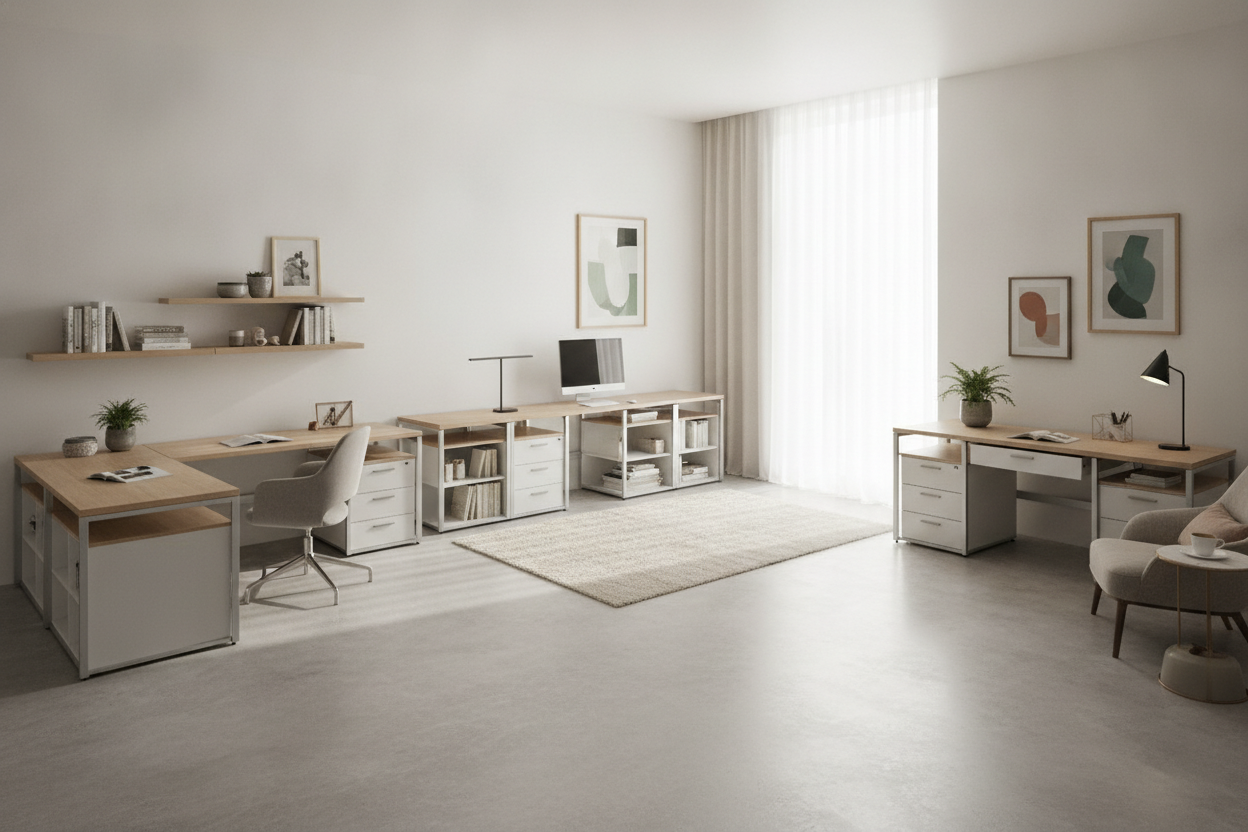
I once bought a solid oak executive desk that weighed about as much as a small car. It looked great in the corner of my 10x10 office until I realized the afternoon sun hit my monitor at exactly 2 PM every day and blinded me for three hours. Moving it was a three-person job that ended in a scratched floor and a lot of swearing. That is exactly why I have pivoted hard toward the modular desk with drawers for my current setup.
The beauty of modular furniture is that it does not demand a lifetime commitment. You are essentially buying a kit of parts—a work surface and independent storage pedestals—that can be rearranged as your life (or your floor plan) changes. If you are staring at 47 browser tabs of office furniture at 1 AM, let me save you some time: stop looking for the 'perfect' fixed desk and start looking for the components that let you change your mind.
- Modular pieces let you pivot when your workflow or your room layout changes.
- Independent storage units act as structural anchors without the bulk of a traditional desk.
- You can transition from a corner setup to a long wall station in about 20 minutes.
- Always measure your drawer clearance before committing to a tight corner configuration.
You Don't Have to Commit to One Layout Forever
The biggest fear I hear from people setting up a home office is the 'permanent footprint' problem. You buy a massive L-shaped unit, bolt it together, and suddenly that room can never be anything else. It is a heavy, expensive anchor. But a modular desk with drawers solves this by decoupling the storage from the surface. You are getting the heavy-duty organizational power of a built-in without the structural rigidity that makes most office furniture a nightmare to move.
I have seen so many people settle for a flimsy folding table because they are afraid of the bulk of real drawers. You do not have to settle for a 1.5 lb density particle board mess just to stay flexible. High-quality modular components—think kiln-dried wood or heavy-duty MDF with finished backs—give you that high-end built-in look while remaining completely mobile. It is the middle ground that actually works for people who move every few years or like to refresh their space every spring.
Layout 1: The Classic Corner Tuck
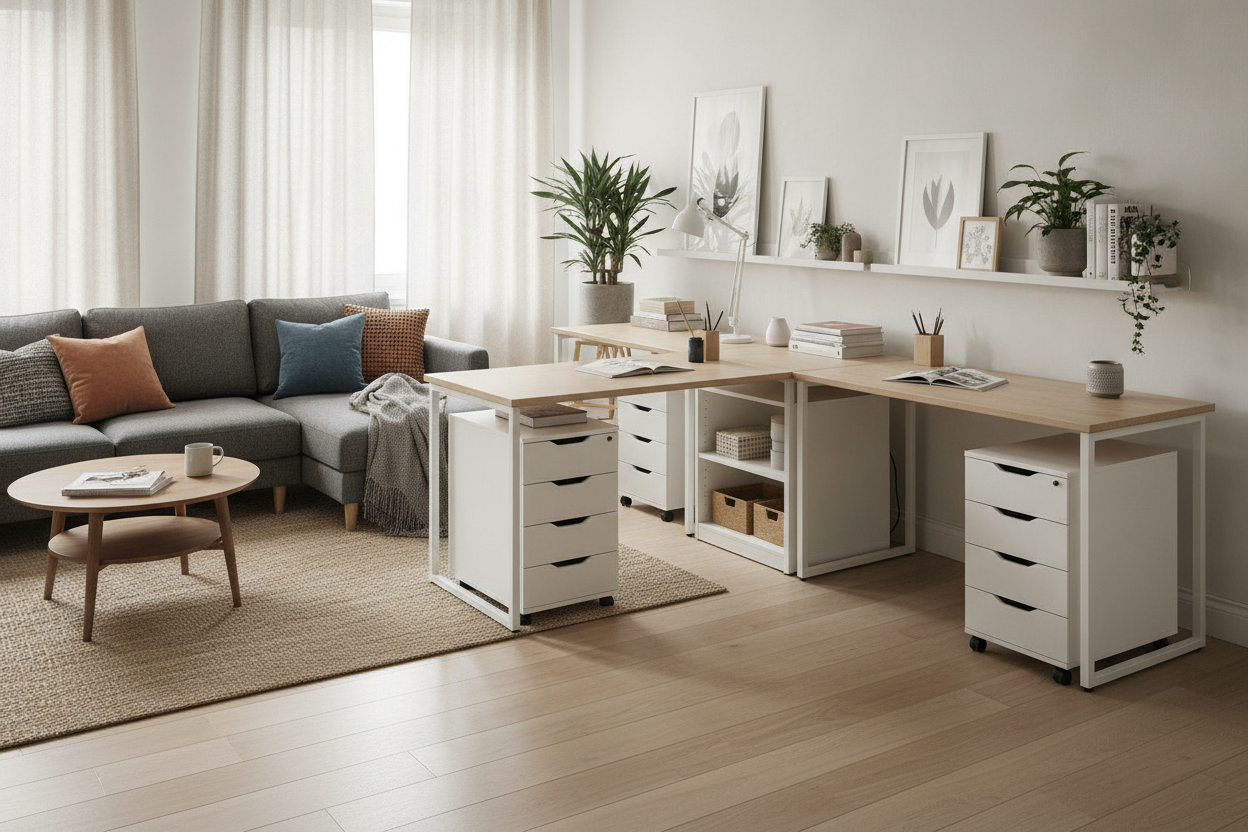
The corner tuck is the gold standard for anyone trying to squeeze an office into a bedroom or a multi-purpose guest room. In this configuration, you place your desk surface against one wall and tuck the modular desk drawers underneath one end, perpendicular to the main work area. This creates a compact 'cockpit' feel where everything is within arm's reach. It maximizes your floor space, leaving the center of the room open for things like a rug or a guest bed.
If you find that configuring individual modules feels like a math project you didn't sign up for, you can always opt for a pre-designed L shaped desk with 3 drawers and wood legs. It gives you that same efficient corner footprint without the guesswork. Just remember to check which side the drawers are on—with modular units, you can usually swap them from left to right in minutes, which is a lifesaver if you realize your power outlets are in a weird spot.
Layout 2: The Floating Room Centerpiece
If you have the luxury of a dedicated room, please stop shoving your desk against the wall like a grounded teenager. Pull it out into the center of the space. This is the 'Executive' layout. You position the desk so your back is to a wall or a window, and the front of the desk faces the door. In this setup, the storage modules act as physical anchors, providing the weight needed to keep the desk from sliding on hardwood floors.
This layout is also the best way to hide the 'cable spaghetti' that plagues every home office. You can run your wires down the back of the drawer units so they are invisible from the doorway. For this to look professional, you really need a contemporary desk with drawers that features a finished back. Most cheap furniture uses raw, ugly plywood on the back of the drawers because they assume it will be hidden against a wall. If you are floating the desk, that back panel becomes the most visible part of the furniture—so choose wisely.
Layout 3: The Long Wall Station
Narrow rooms are the bane of my existence, but the 'galley' office layout is a secret weapon. Instead of trying to turn a corner, you line the drawers and the desk surface up along one long wall. This creates a shallow but wide workspace that is perfect for dual-monitor setups or people who need a separate 'zone' for a printer or a tablet. It keeps the walkway of the room clear, which is essential for hallways or narrow spare rooms.
I find this setup is actually the most underrated way of maximizing small spaces because it uses the length of the room rather than the depth. When you have 60 to 72 inches of horizontal runway, you don't feel cramped, even if the desk is only 24 inches deep. It feels like a custom library build-in, but because it is modular, you can pull it apart and turn it back into a corner desk whenever you feel like it.
A Quick Warning About Moving Those Storage Units
I have learned this the hard way: do not try to 'slide' or 'scoot' a modular storage unit while it is full of twenty pounds of tax returns and old charging cables. I tried this with a laminate unit once and the cam-locks literally sheared off the side panel. It was a total loss. If you are shifting your layout, take five minutes to empty the drawers. Your back—and your floor—will thank you.
A lightweight writing computer desk is easy enough to toss around during a cleaning spree, but modular storage blocks are dense. They are designed to be stable, which means they are heavy. Treat them with some respect and they will last through a dozen different room configurations. My current modular setup has lived in three different apartments and has been a corner desk, a floating desk, and a sideboard. It still looks brand new because I don't try to move it while it's holding my entire life inside its drawers.
FAQ
Can I add more drawers to a modular desk later?
Usually, yes. As long as the desktop is a standard height (around 29-30 inches), most modular pedestals will fit underneath. Just make sure the finish matches if you are buying from the same manufacturer.
Do modular drawers slide around under the desk?
They can if they aren't weighted down. I recommend using small rubber friction pads or a bit of museum putty between the top of the drawer unit and the underside of the desk to keep everything locked in place without using screws.
Is it hard to assemble modular desk drawers?
The drawers are always the most time-consuming part because of the glides and alignment. Expect to spend about 45 minutes per drawer unit. The 'shell' of the desk usually goes together in ten.

Dejar un comentario
Este sitio está protegido por hCaptcha y se aplican la Política de privacidad de hCaptcha y los Términos del servicio.