










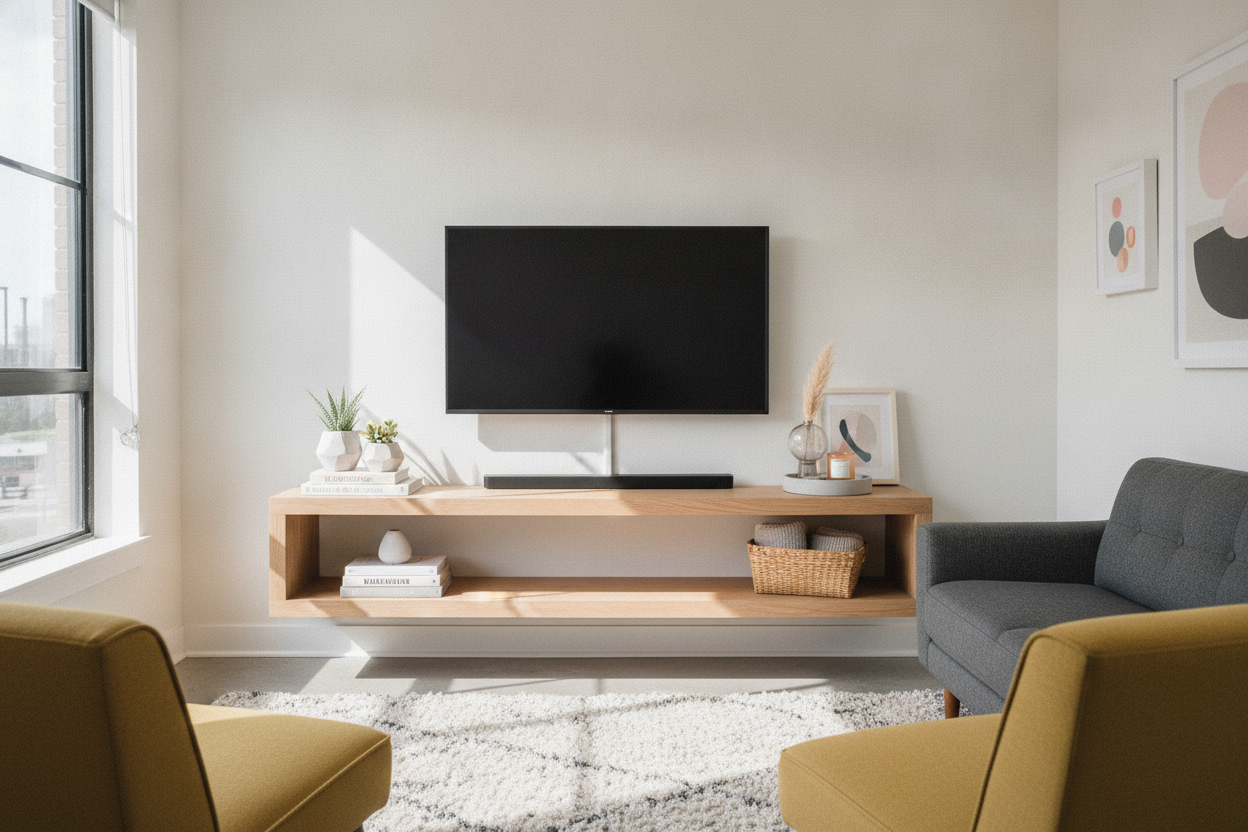
I once spent three hours measuring the perfect height for a wall mount, only to step back and realize my new unit looked like a stray Lego brick on a gallery wall. It is the classic small-space trap: you buy a small floating entertainment center to save floor space, but instead of looking 'minimalist,' it just looks lonely. It’s a common mistake in apartments where every square inch is a battleground.
The goal is to make your floating tv stand small enough to fit your wall but substantial enough to carry the room. You want it to look like a deliberate architectural choice, not a shelf you found in the 'as-is' section and threw up there in a panic. After mounting (and un-mounting) more of these than I care to admit, I have found three rules that actually work.
Quick Styling Takeaways
- Your TV should never be wider than your console; aim for a 6-inch buffer on each side.
- Fill the 'dead air' underneath with texture—think baskets or a low-profile pouf.
- Use asymmetrical decor to draw the eye away from the unit's small footprint.
- Hide the cables or the whole 'floating' illusion is ruined instantly.
The Scale Check: Don't Let Your TV Bully Your Console
The biggest mistake I see is a 55-inch TV perched over a 40-inch narrow floating tv stand. It looks top-heavy, precarious, and honestly, a bit cheap. In the design world, we call this the 'lollipop effect.' Your media unit needs to be the anchor, which means it must be wider than the screen it is supporting. Ideally, you want at least 5 to 10 inches of breathing room on either side of the TV.
If you are working with a small floating media console, and your TV is already huge, you have to trick the eye. You can do this by flanking the console with wall art or sconces to 'extend' the visual width of the unit. I have seen people try to center a massive screen over a tiny box, and it just makes the room feel cramped and unbalanced. If your console is 48 inches wide, your TV should really be no larger than 43 inches. Trust me, the math matters more than the screen size here.
Grounding the Empty Space Underneath
A small floating tv console can sometimes look like it’s drifting away into the ceiling if you don't 'ground' it. That gap between the bottom of the unit and the floor is a design opportunity, not just a place for dust bunnies to congregate. I usually tuck a pair of matching woven baskets or a chunky knit pouf underneath. It fills the void and provides a place to hide extra blankets or those controllers you only use when friends come over.
Lighting is another pro move for grounding. Some high-end units come with built-in kits, but you can achieve a similar vibe by adding a battery-powered LED strip to the underside. Much like the glow from a high gloss LED TV stand console, that pool of light on the floor creates a visual 'base' that makes the unit feel heavy and permanent. It stops the 'hovering box' look and turns the whole setup into a focal point.
Asymmetry is Your Best Friend
When you are dealing with a limited surface area, trying to go symmetrical usually backfires. It just highlights how little space you have. Instead, lean into the off-center look. I like to use a wall mounted media console entertainment center as a blank canvas. Put a tall, architectural plant like a Snake Plant or a trailing Pothos on one side, and a small stack of coffee table books on the other.
This asymmetry creates a visual flow that keeps the eye moving. If you put one candle on the left and one candle on the right, you’ve just created a tiny altar for your TV. Boring. By stacking items of different heights—a tall vase, a medium book, a small tray—you create a 'landscape' that makes the small floating media console feel much larger than its actual dimensions. It’s about distracting the viewer from the footprint and focusing them on the curation.
When You Should Probably Just Use Legs
I am a fan of the floating look, but it isn't always the right move. If your wall is made of crumbly old plaster or you are in a rental where the 'studs' are more of a suggestion than a reality, mounting a heavy unit is a recipe for a 3 AM disaster. I’ve seen floating tv stand small units rip right out of the drywall because someone underestimated the weight of their soundbar. It is heartbreaking and expensive.
If you find yourself second-guessing the structural integrity of your wall, or if your console is so small it looks like a kitchen cabinet, it might be time to pivot. Sometimes a slim unit with tapered legs provides that same 'airy' feel without the mounting headache. If you are on the fence, I highly recommend reading this breakdown on floating vs. freestanding small TV media stand before you start drilling holes you might regret later.
Personal Experience: My 'Floating' Fail
I once mounted a 36-inch floating shelf in my first studio apartment thinking I was a genius. I put my 42-inch TV on it, and within a week, the shelf started to tilt forward. Every time a bus drove by, the TV would wobble. I spent the whole month terrified my tech was going to end up in pieces. I eventually realized that just because a box says 'floating' doesn't mean it's magic. You need real anchors, real studs, and a console that actually fits the scale of your hardware. I ended up switching to a wider unit, and the room instantly felt ten times more expensive.
Frequently Asked Questions
How high should I mount my floating console?
The sweet spot is usually 24 to 30 inches off the ground. You want the center of your TV to be at eye level when you are sitting on your sofa. If you have to tilt your neck up, it’s too high.
Can a floating console hold a gaming console?
Usually, yes, but check the weight limit. Most small floating tv console units are rated for 30-50 lbs. A PS5 or Xbox Series X is heavy, so make sure your wall anchors are heavy-duty and you aren't exceeding the shelf's capacity.
How do I hide the cables?
If you can't run them behind the wall, use a paintable cord cover. It’s a plastic channel that sticks to the wall. Paint it the exact same color as your wall, and it virtually disappears. Never let the black 'spaghetti' cords just hang there.

Dejar un comentario
Este sitio está protegido por hCaptcha y se aplican la Política de privacidad de hCaptcha y los Términos del servicio.