










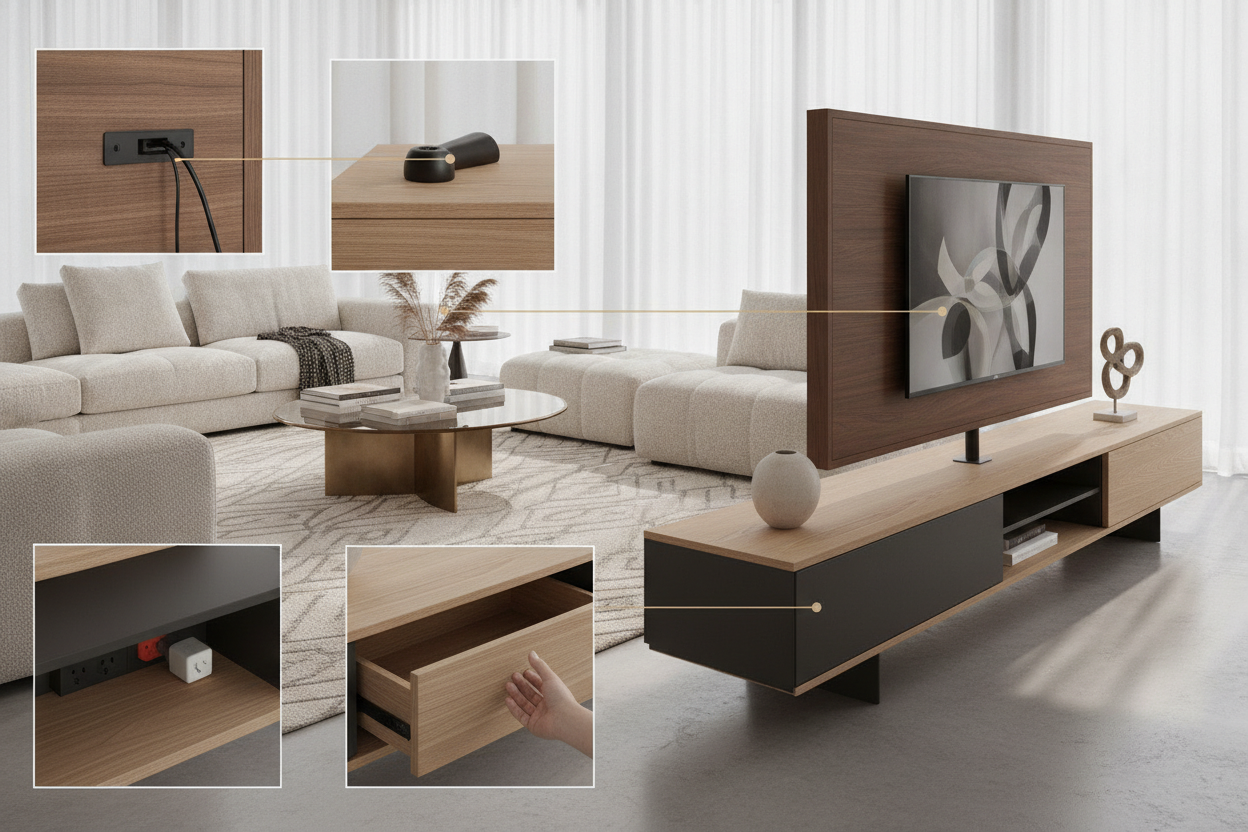
I once spent three hours measuring my wall, only to buy a media console that arrived looking like it belonged in a dollhouse. It was beautiful on the screen, but the images for tv stands I was scrolling through didn't account for the fact that my 65-inch television is a monster. We have all been there—tricked by a perfectly angled shot that hides the fact that the 'solid wood' is actually paper-thin veneer or that the 'spacious' shelves can barely fit a modern gaming console.
When you are deep in the research phase of shopping for new tv stands, you have to look past the professional styling. Those catalog photos are designed to sell a vibe, not a piece of functional furniture. After years of testing and returning furniture, I’ve developed a cynical eye for decoding every tv stand photo I see.
Quick Takeaways
- Never trust the scale of the TV in the photo; retailers often use small 32-inch screens to make the stand look bigger.
- Look for shadows and grain patterns in customer photos to find the true color of the wood.
- Check for 'sag' in the middle of the unit in any picture tv stand reviewers have posted.
- Verify the back panel material—cardboard vs. plywood—before you commit.
The Tiny Screen Trick Used in Television Stand Pictures
Retailers are experts at visual manipulation. When you browse television stand pictures, you will notice the TV sitting on top always looks perfectly proportioned. Here is the secret: they often use a 40-inch or even a 32-inch television for the shoot. This makes a standard 58-inch console look like a massive, commanding piece of furniture. If you bring that same unit home and try to plop a 75-inch OLED on it, the overhang will make your living room look cluttered and cheap.
I always look at the distance between the edge of the TV and the edge of the stand in these tv stands images. If the TV in the photo has six inches of breathing room on either side, check the specs. Often, you will find that 'large' console is only 50 inches wide. A 65-inch TV is roughly 57 inches wide. Do the math before you trust the visual. Don't let the t v stand images fool you into thinking a compact unit has the gravity of a sideboard.
Another thing to watch for is the height. A lot of tv stands pictures are shot from a low angle to make the piece look taller. In reality, many modern units sit only 18 to 22 inches off the ground. If you have a high sofa, you will be looking down at your screen, which is a one-way ticket to neck strain. Always cross-reference the photo with a tape measure against your wall.
Why I Only Trust Real Pictures of TV Stands Now
Studio lighting is the enemy of truth. Professional photographers use massive softboxes and 5000K daylight bulbs to make every wood grain pop. In your house, you probably have 2700K warm bulbs or a single window with north-facing light. That 'honey oak' you saw in the pictures of tv stands online will almost certainly look like 'muddy orange' once it hits your carpet.
This is why I spend more time looking at customer review photos than the actual product page. I want to see tv stands pics taken in a dimly lit apartment with a messy pile of cables in the corner. That is where the real color lives. If ten different customers post photos and the wood tone looks different in every single one, that is a red flag for cheap, inconsistent finishes. I’ve found that high-quality pieces with real wood veneers maintain their integrity across different lighting setups.
When you are browsing shopping for new tv stands, look for the 'real life' gallery. You want to see how the light hits the surface. Is it a plastic-y sheen or a soft, matte glow? If the manufacturer doesn't provide user-submitted tv stands images, I usually keep scrolling. I need to see that wood grain in a 'normal' house before I give them my credit card info.
What to Look For When Analyzing a TV Stand Photo
Beyond the color, you need to look at the 'visual weight.' A tv stand photo can make a piece look airy and light, but you need to see how it interacts with the floor. For example, a modern tv stand with cabinets might look sleek on a polished concrete floor in a studio, but put those thin tapered legs on a plush shag rug and the whole thing might look unstable or 'sink' into the room.
I look for the gaps. Check the tv stands pics for how the doors align. If you see even a 2mm gap or a slight tilt in the cabinet doors in the professional photo, imagine how bad it will be when you assemble it yourself on an uneven floor. Professional stylists spend hours leveling those pieces for the shot; if they couldn't get it perfect, you won't either. I also look for the thickness of the top slab. Anything less than an inch thick is likely to bow over time if you are placing a heavy TV on it.
Pay attention to the depth, too. Many tv stands pictures are shot straight-on, hiding how shallow the unit is. I once bought a gorgeous mid-century piece only to realize my AV receiver stuck out two inches from the front because the cabinet was only 14 inches deep. Always look for a side-profile picture tv stand to see the actual footprint. You want at least 16 to 18 inches of depth for most media components and stable TV legs.
Don't Forget to Hunt for Pics of TV Cabinet Interiors
The outside is for your guests; the inside is for your sanity. Most people forget to look for pics of tv cabinet interiors. I need to see the cable management situation. Are there pre-drilled holes in every compartment, or just one in the middle? If you have a PlayStation, a cable box, and a soundbar, one hole isn't going to cut it. You’ll end up with a 'cable waterfall' spilling out the sides.
Also, look at the hinges. In a high-quality tv stand photo, you can sometimes spot soft-close European hinges. If the interior shots show cheap, thin metal brackets, those doors are going to start sagging within six months. If you are planning to style a display cabinet tv stand, the interior finish matters even more. Glass doors are unforgiving; you want the inside of the cabinet to be finished just as well as the outside, not left as raw, ugly particle board.
Finally, check the shelving. Are the shelves adjustable? Look for the little peg holes in the pics of tv cabinet interiors. If the shelves are fixed, you are stuck with whatever height they chose, which usually means your center-channel speaker won't fit by a quarter of an inch. I’ve learned the hard way that fixed shelving is the ultimate deal-breaker for a functional media setup.
FAQ
What is the best height for a TV stand?
For most people, the center of the TV should be at eye level when seated. This usually means a stand height of 22 to 28 inches. If you have a massive 85-inch TV, you actually want a lower stand (around 15-18 inches) so you aren't looking up at the ceiling.
How much wider should the stand be than the TV?
I recommend at least 3 to 6 inches of space on each side. This prevents the 'top-heavy' look and keeps the TV from being bumped. If your TV is 60 inches wide, look for a stand that is at least 66 to 72 inches wide.
Can I put a TV on a stand that is narrower than the screen?
Technically yes, if the legs fit, but it looks terrible. It creates a visual imbalance that makes the room feel cramped. Plus, the overhang is a major safety hazard for kids or pets running by.
My Personal Experience with 'Studio Magic'
A few years ago, I fell in love with a 'walnut' console online. The images for tv stands showed this rich, chocolatey brown with a beautiful matte finish. When it arrived, it was essentially orange. The 'wood grain' was a repeating sticker pattern that looked like it was printed on a low-resolution inkjet printer. I didn't check the customer television stand pictures, and I paid the price in return shipping fees. Now, I am the person who zooms in 400% on a tv stand photo to check the corner joins. If the corners look like they are peeling in the photo, they will definitely peel in your living room.

Dejar un comentario
Este sitio está protegido por hCaptcha y se aplican la Política de privacidad de hCaptcha y los Términos del servicio.