










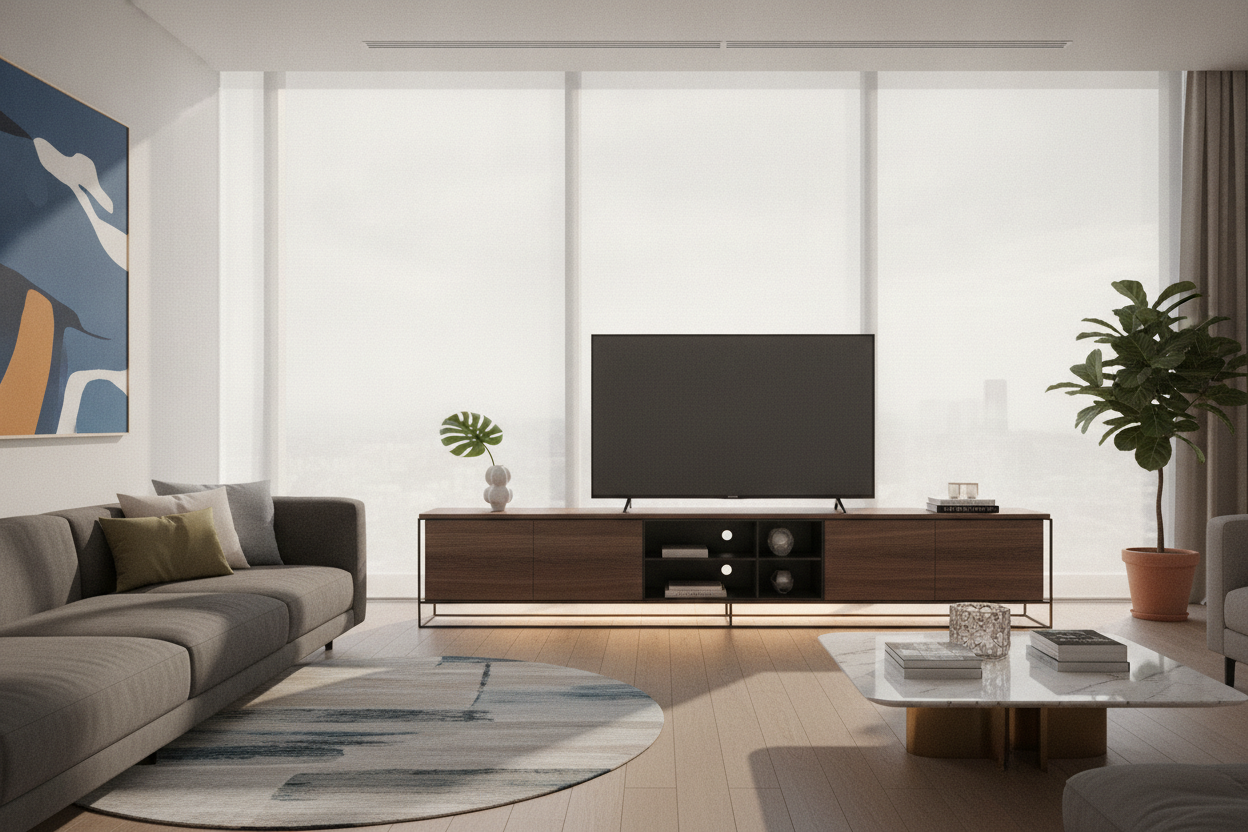
I have spent way too many nights staring at 40 open browser tabs of media consoles, trying to decide if a $300 particle board unit is a 'steal' or a future landfill resident. We have all been there—you buy something that looks cool in a studio-lit photo, but three months later, it feels like a relic of a trend you already hate. Finding the best contemporary tv stands isn't about chasing the look of the moment; it is about finding a piece that acts as a foundation for your room without shouting for attention.
- Natural wood grain beats high-gloss plastic every single time.
- Aim for a unit at least 6-10 inches wider than your TV to avoid a top-heavy look.
- Matte finishes hide fingerprints and dust better than shiny surfaces.
- Cable management is a structural requirement, not a luxury.
Why 'Contemporary' Doesn't Have to Mean 'Trendy'
The biggest trap in furniture shopping is confusing contemporary design with 'fast furniture' trends. Contemporary design, at its best, is just a reflection of how we live right now. It is about clean lines, functional storage, and materials that do not feel like they belong in a museum or a 1970s basement. The best modern tv stand is the one you do not notice because it fits the scale of your room so perfectly.
I have seen too many people buy those ultra-curved, neon-lit units that look like a gaming PC. They look dated before the delivery truck even leaves the driveway. Real longevity comes from simplicity. Think about a low-profile silhouette with a sturdy base. If the design relies on a 'gimmick' to look interesting, skip it. You want the craftsmanship and the proportions to do the heavy lifting, not a trendy color or a weird leg shape.
The Secret to Spotting the Best Modern TV Stand
When you are upgrading your living room console, you need to look at the 'visual weight.' A stand that is too leggy can look like it is floating awkwardly, while a solid block to the floor can feel too heavy in a small apartment. I usually look for a recessed plinth base or very short, tapered legs. It gives the piece enough lift to feel modern without making it look like it is about to tip over under the weight of a 65-inch screen.
Hardware is another dead giveaway of quality. If a unit has flimsy, shiny plastic handles, the rest of the build is likely just as cheap. Look for integrated finger pulls or solid metal hardware with a brushed or matte finish. These small details are what separate a 'forever' piece from something that will rattle every time you close a drawer.
Embrace Warm Woods to Soften the Tech
Let's be honest: a giant black rectangle of a TV is not exactly 'cozy.' It is a cold, hard piece of tech. To balance that out, I always steer people toward organic textures. I have found that warm wood tones can fix a cold room faster than any rug or throw pillow. Whether it is a rich walnut or a light, airy oak, the natural grain provides a visual 'break' from the glass and plastic of your electronics.
I am a stickler for real wood veneers over solid cores. Avoid the cheap paper laminates that peel at the corners after a year. A high-quality veneer over kiln-dried wood or high-density fiberboard is actually more stable for electronics because it won't warp with the heat generated by your cable box or console. It looks expensive because it is real material, and it ages with a patina that plastic just can't replicate.
When in Doubt, Go Matte Black
If wood grain isn't your vibe, matte black is the ultimate 'cheat code' for a high-end look. Unlike chrome or brass, which go in and out of style every three years, a matte black finish feels architectural and grounded. It acts as a shadow in the room, making the unit feel smaller than it actually is. This is especially helpful if you are trying to fit a large stylish black entertainment center into a room that is already a bit crowded.
The key here is the 'matte' part. High-gloss black is a nightmare—it shows every single speck of dust and every fingerprint from the kids. A matte finish absorbs light rather than reflecting it, which helps the furniture blend into the wall. It is a sophisticated move that makes even a mid-range piece look like a custom built-in.
Texture Is Your Best Friend for Hiding Cords
We all have too many wires. Between the soundbar, the Switch, and the router, the back of a TV stand can quickly look like a plate of black spaghetti. This is where texture comes in. A media unit with slatted doors is my absolute favorite solution. The slats provide a beautiful rhythmic texture on the front of the piece, but they also serve a functional purpose: they allow infrared signals from your remotes to pass through and keep your electronics ventilated.
I once made the mistake of buying a solid-door cabinet with no ventilation. My Xbox sounded like a jet engine within twenty minutes of playing because the heat had nowhere to go. Slatted or mesh fronts solve that problem while keeping the visual 'noise' of your gear hidden. It keeps the room looking clean and intentional, even if there is a chaotic mess of HDMI cables hiding right behind the door.
Personal Experience: The 'Dental Office' Disaster
A few years ago, I bought a high-gloss white TV stand because I thought it would make my small living room feel 'bright.' It was a disaster. It looked like a piece of equipment from a dental office. Every time the sun hit it, the glare off the top surface was blinding while I was trying to watch a movie. I ended up selling it on Marketplace for half what I paid and replaced it with a textured wood unit. The lesson? Texture and matte finishes are much more 'livable' than anything shiny.
Frequently Asked Questions
How wide should my TV stand be?
Your stand should be at least 6 to 10 inches wider than the actual width of your TV screen. If the TV hangs over the edges, the whole room will feel top-heavy and unstable. Always measure the TV's total width, not just the diagonal screen size.
Does my TV stand need a cable hole?
Yes, absolutely. Do not buy a unit and 'plan to drill a hole later.' You want factory-finished cable management ports that are positioned high enough to reach your devices without straining the cables.
Is a floating TV stand a good idea?
Floating stands look incredible for a minimalist look, but they require professional mounting into studs. If you are a renter or not handy with a drill, stick to a floor-based unit with a recessed base to get a similar 'light' feel without the drywall damage.

Dejar un comentario
Este sitio está protegido por hCaptcha y se aplican la Política de privacidad de hCaptcha y los Términos del servicio.