




Integrating a multifunctional desk and coffee table into a contemporary living space offers an efficient answer to the spatial challenges of hybrid living. When square footage must accommodate relaxation, entertaining, and focused daily productivity, convertible furnishings eliminate the visual clutter of redundant furniture. Understanding the engineering, kinetic movements, and spatial requirements of a coffee table converts to desk design allows homeowners and apartment dwellers to create an adaptable, elegant living environment.
Kinematic Conversion Mechanisms: Mechanical Dynamics and Structural Articulation
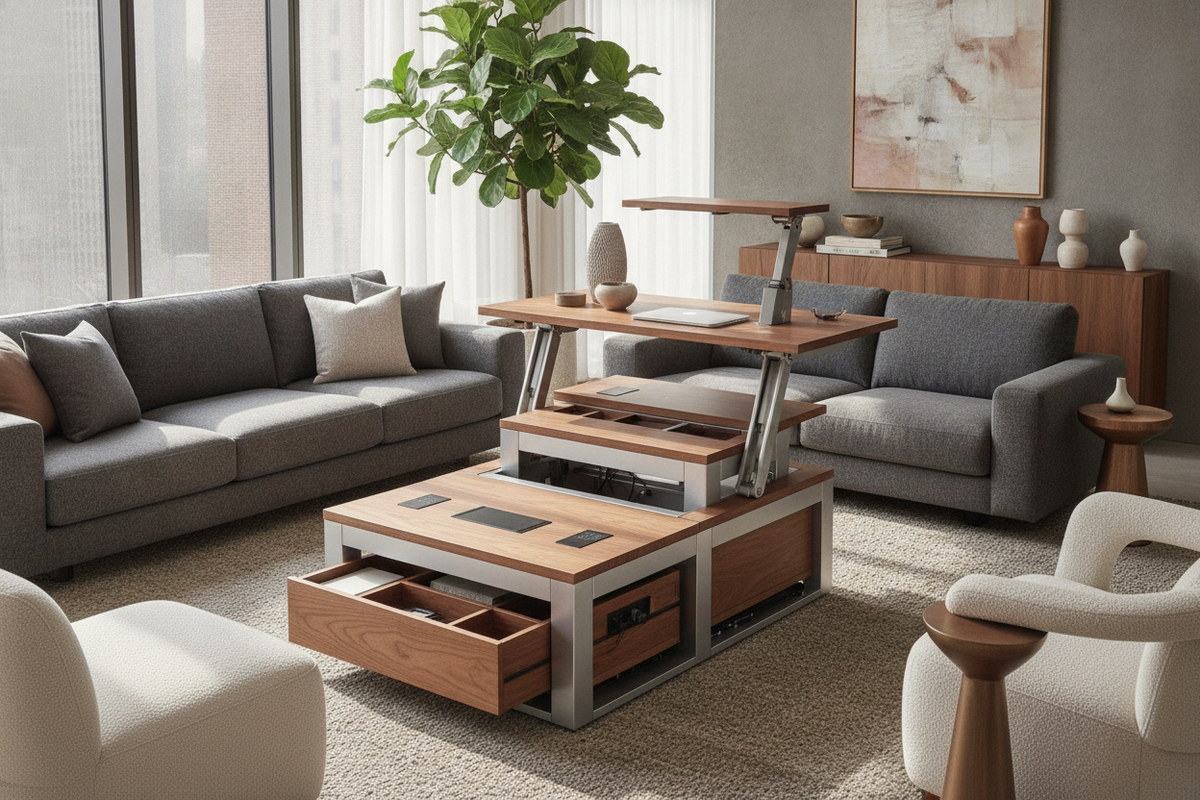
The operational core of any convertible workstation is its lift mechanism. Different mechanical systems determine how smoothly a tabletop transitions from standard lounge height to an elevated work posture:
- Spring-Loaded Scissor Hinges: Traditional mechanical hinges rely on coiled steel tension springs. While durable and mechanically direct, they require deliberate manual guidance during both lifting and lowering phases to prevent abrupt snapping.
- Hydraulic Gas-Strut Dampers: Modern convertible systems frequently implement pneumatic or hydraulic gas pistons. These dampers deliver a soft-closing motion, reducing mechanical shock and keeping tabletop items stable during movement.
- Dual-Axis Articulating Arms: High-performance configurations use synchronized multi-joint brackets that move the work surface forward toward the seated user while elevating it, minimizing the need to lean forward uncomfortably.
- Rotational and Split-Surface Platforms: Certain multi-leaf designs feature split surfaces where one side lifts while another section rotates or remains static, allowing simultaneous lounge and work functions.
When evaluating whether a lift-top mechanism meets intense daily work requirements or if a standalone workstation is preferable, exploring an expansive computer desk collection helps clarify spatial trade-offs between dedicated and hybrid workstations.
Spatial Clearance Envelopes and Dimensional Planning Tiers
A successful coffee table desk combo installation requires careful planning of two distinct physical envelopes: the static perimeter and the dynamic transition path. When closed, a coffee table should maintain adequate breathing room between the sofa edge and adjacent entertainment units. However, when deployed, the forward extension alters the room's traffic pathways.
Consider these primary planning categories when evaluating floor space:
- Compact Studio Footprints: Designed for micro-apartments, these units feature vertical-biased lift trajectories that minimize forward overhang, preserving narrow walkways while still offering an ergonomic reach.
- Standard Living Room Envelopes: Centered around modular sectionals, these tables provide balanced extension ratios, bringing the surface comfortably over the sofa cushion perimeter without crowding legroom.
- Expansive Multi-Leaf Workstations: Larger configurations fold out into extended surfaces, requiring open perimeter clearance on multiple sides to accommodate dual-seat collaboration or broader creative projects.
For compact floor plans where living space is tight, reviewing a computer desk that guide for shared zones provides useful zoning tactics that prevent multipurpose rooms from feeling congested.
Concealed Storage Layouts and Interior Compartmentalization
A primary architectural benefit of a coffee table with computer desk functionality is its capacity for interior concealment. Hybrid furniture must hide the hallmarks of a workstation when the workday ends, returning the room to a clean aesthetic.
Effective interior arrangements typically feature:
- Deep Internal Wells: Located directly beneath the primary lifting leaf, these cavities readily house laptops, power adapters, notebooks, and input devices.
- Lateral Slide-Out Drawers: Independent from the lift mechanism, side-mounted soft-close drawers allow quick access to remote controls, chargers, and writing supplies without disturbing the main tabletop surface.
- Split Underside Compartments: Segmented structural dividers prevent cables and accessories from shifting during table adjustments while adding internal rigidity to the chassis.
- Open Base Shelving: Lower slatted or solid shelves provide an accessible platform for display books, decorative storage bins, or media consoles.
Pairing low-profile hidden desk wells with vertical wall solutions detailed in our desk that guide ensures a clutter-free perimeter across the entire living room envelope.
Ergonomic Alignment: Sofa Height Compatibility and Work Surface Clearance
A common challenge with a coffee table that turns into a desk is achieving comfortable posture during extended typing or reading sessions. Standard coffee tables sit below knee height, whereas standard desk heights are calibrated for task chairs. When elevated, the convertible table surface must align appropriately with the sofa seat height.
To establish comfortable ergonomic relationships:
- Seat Cushion Compression: Soft sofa cushions compress under weight, lowering the user's resting elbow angle. The elevated table height should account for this deflection to maintain a neutral arm position.
- Under-Table Thigh Clearance: The structural apron and internal storage box must leave sufficient vertical room above the seated lap, preventing awkward leg placement.
- Forward Reach Geometry: An articulating arm that brings the top forward eliminates the tendency to slouch or perch on the edge of the couch cushion.
If ergonomic adjustments demand a fixed seated posture with dedicated legroom depth, a dedicated desk computer product offers full-frame stability designed specifically for intensive task postures.
Material Selection, Cantilever Load Stability, and Surface Engineering
Because an extended coffee table computer desk relies on a cantilevered surface, the choice of materials and framing components directly influences stability, wobble resistance, and longevity.
Key material and structural considerations include:
- Substrate Core Density: High-grade engineered composite boards or solid hardwood frames provide the structural mass necessary to anchor the base, preventing tipping when weight is applied to the extended top.
- Reinforced Steel Scissor Brackets: Powder-coated steel linkages resist lateral flexing and withstand repeated daily articulation.
- Corner Gussets and Bracing: Rigid structural joints in the lower cabinet body keep the entire frame square, ensuring smooth alignment of the closing seams over time.
- Protective Surface Finishes: Melamine, high-pressure laminates, or polyurethane-sealed wood veneers protect against heat from electronics, water rings from beverages, and abrasion from daily use.
For users managing heavy dual-monitor rigs that exceed cantilever lift capacities, a stable L-shaped computer desk product serves as a resilient alternative for permanent multi-screen setups.
Comprehensive Selection Framework and Assembly Maintenance Guidelines
Choosing the ideal coffee table desk convertible requires balancing spatial constraints, design preferences, and mechanical upkeep. Following a systematic evaluation process ensures long-term satisfaction:
- Assess Daily Conversion Frequency: For frequent daily transitions, prioritize gas-strut lift systems that open and close smoothly with minimal effort.
- Measure Clearances Accurately: Verify both the closed perimeter and the full swing arc of the lifted top relative to rugs, sofas, and surrounding walking paths.
- Plan Cable Pathways: Select models with integrated wire routing notches or interior pass-through grommets if you plan to keep charging devices plugged in while working.
- Maintain Hardware Tension: Periodically inspect hinge fasteners, tighten mounting screws, and ensure that lifting linkages remain clear of debris to preserve smooth kinematic movement.
By harmonizing mechanical efficiency, functional storage, and balanced proportions, a convertible coffee table that converts to desk creates an adaptable environment that supports productive workdays and restful evenings alike.


Dejar un comentario
Este sitio está protegido por hCaptcha y se aplican la Política de privacidad de hCaptcha y los Términos del servicio.