










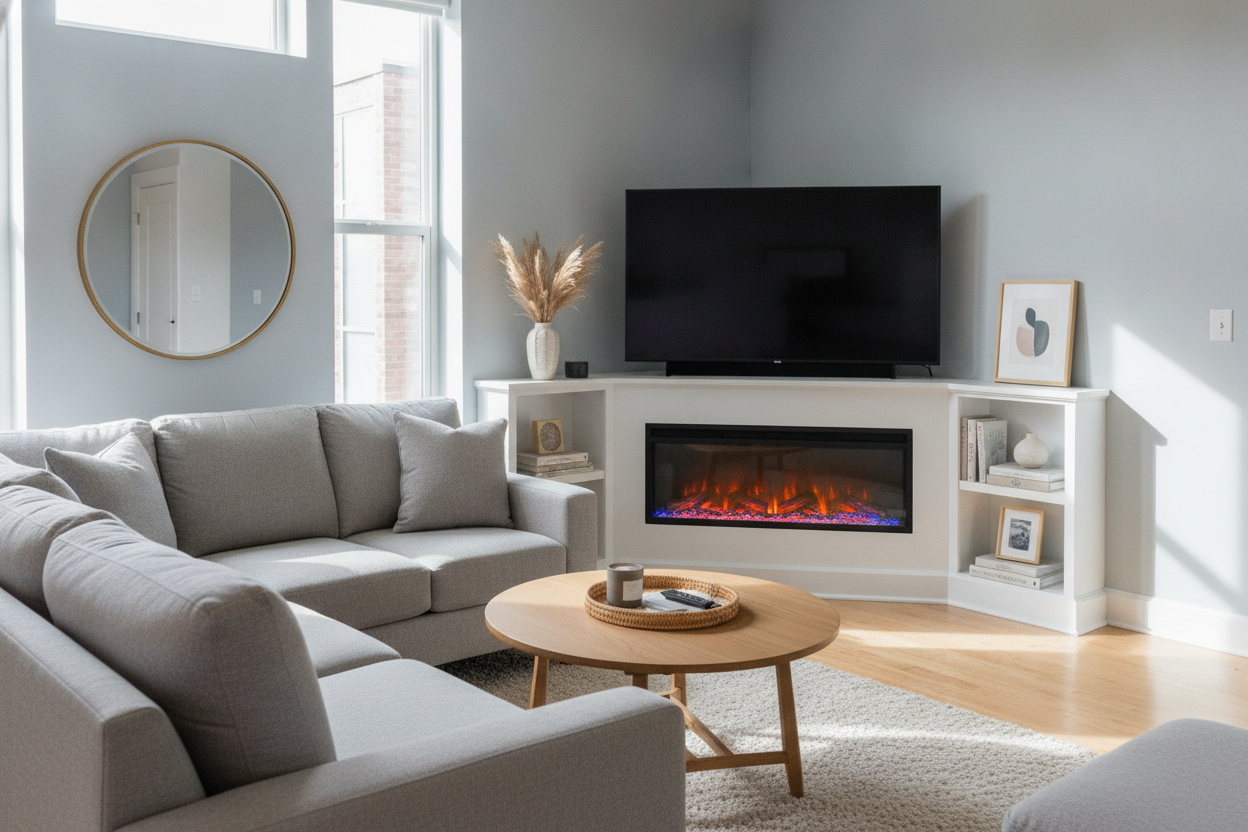
I spent three weeks staring at my living room walls like they were a puzzle with missing pieces. Every single wall in my 1940s rental has a radiator, a window, or a door that swings right into the path of a potential console. I was about to give up and just mount the TV on the ceiling until I realized I was ignoring the 90-degree angle right in front of me: the corner.
Finding a corner fireplace and tv stand wasn't just a design choice; it was a survival tactic for a room that refused to cooperate. My partner wanted a cozy hearth vibe, I wanted a place for my 55-inch OLED, and the room wanted us to stop blocking the natural light. This unit managed to check every box without making the space feel like a cluttered storage unit.
- Clears up wall space for windows and art.
- Adds a focal point to rooms with awkward layouts.
- Provides supplemental heat (usually up to 400-1,000 sq ft).
- Hides the 'cable spaghetti' in the triangular space behind the unit.
The 'Zero Blank Walls' Living Room Curse
If you live in an older home or a modern open-concept condo, you know the struggle. You have plenty of floor space, but zero usable wall space. I spent hours shopping for traditional TV stands, only to realize that a standard 60-inch flat-wall console would either block my only radiator or cover half of a beautiful bay window.
It's a frustrating reality when your home’s architecture fights your furniture. Most media centers are designed for massive, blank drywall surfaces. When those don't exist, you end up with a TV perched precariously on a too-small side table or, worse, mounted way too high over a real fireplace, giving everyone in the house a permanent neck ache.
Why the Corner Fireplace and TV Stand Is a Layout Cheat Code
Shifting your setup to a 45-degree angle is like finding a hidden room in your house. It utilizes the 'dead zone' where dust bunnies usually go to retire. By placing a corner entertainment center with fireplace in that niche, you suddenly open up the rest of the room for a more conversational seating arrangement.
I opted for a corner tv stand with electric fireplace because it softened the tech-heavy look of the room. Instead of a giant black rectangle being the only thing you see, the flickering LED 'flames' draw the eye down. If you're worried about it looking too chunky, choosing a rustic corner fireplace TV stand with some wood grain texture helps it feel like a built-in architectural feature rather than a plastic box.
But Doesn't Angled Furniture Look Like a Waiting Room?
This was my biggest fear. Angled furniture can sometimes feel accidental, like you just pushed things out of the way to vacuum. To avoid the 'doctor's office' aesthetic, you have to be intentional with your floor plan. You can't just shove the stand in a corner and leave the sofa flat against the opposite wall.
The trick is anchoring. I used a large, round jute rug to bridge the gap between the angled corner tv cabinet with fireplace and my sectional. It breaks up the harsh diagonal lines and makes the corner feel like a destination. Also, don't forget the 'wedge' behind the stand—I used that hidden space to tuck away a massive power strip and all my router cables. Out of sight, out of mind.
How to Measure for a Corner Unit (Without Crying)
Measuring for a corner tv stand with fireplace heater is different than measuring for a standard dresser. You aren't just looking at width; you're looking at how far the unit will come out along each wall. If you buy a unit that is 50 inches wide, it might only extend 35 inches along your wall. Always check the 'wall depth' measurement before you click buy.
I once helped a friend assemble a massive console with electric fireplace heater that was meant for a flat wall, and we tried to 'angle' it in a corner. It was a disaster. The back corners hit the walls too early, leaving a massive, ugly gap behind it. Specialized corner units have clipped back corners specifically to sit flush, which is a non-negotiable for a clean look.
The Screen-to-Base Ratio Rule
Here is my hill to die on: your TV should never be wider than the stand it sits on. For a corner fireplace tv stand for 55 inch tv, the stand's top surface needs to be at least 50-55 inches wide. If the screen overhangs the edges of the console, it looks top-heavy and precarious. For a corner tv stand with fireplace for 75 inch tv, you’re going to need a serious, wide-base unit to keep the proportions from looking like a lollipop.
The Cozy Payoff We Didn't Expect
The real win wasn't just the layout—it was the vibe. I didn't think I'd actually care about the 'fire,' but on rainy Tuesday nights, having that amber glow in the corner of my eye is genuinely soothing. It turned a previously useless, dark corner into the most inviting spot in the apartment.
I've seen similar transformations with a corner fireplace TV stand 55 inch setup, where it actually makes a small room feel larger because it draws the eye to the furthest point of the room. My only regret? I waited two years to stop fighting my walls and just embrace the corner. It’s the smartest furniture move I’ve made in this house.
FAQ
Can I put a real TV on top of an electric fireplace?
Yes, because electric units vent their heat out the front or bottom, not the top. The surface stays cool to the touch, so your electronics won't melt. Just don't try this with a real wood-burning stove.
Is the 'flame' realistic?
It depends on what you pay. Modern LED flames are pretty convincing from a distance, but they won't fool you up close. Think of it as 'mood lighting' rather than a movie prop.
Do these units come assembled?
Almost never. Expect a heavy box and about two hours of your life spent with an Allen wrench. It's a two-person job, mostly because the fireplace insert itself is usually quite heavy.

Dejar un comentario
Este sitio está protegido por hCaptcha y se aplican la Política de privacidad de hCaptcha y los Términos del servicio.