










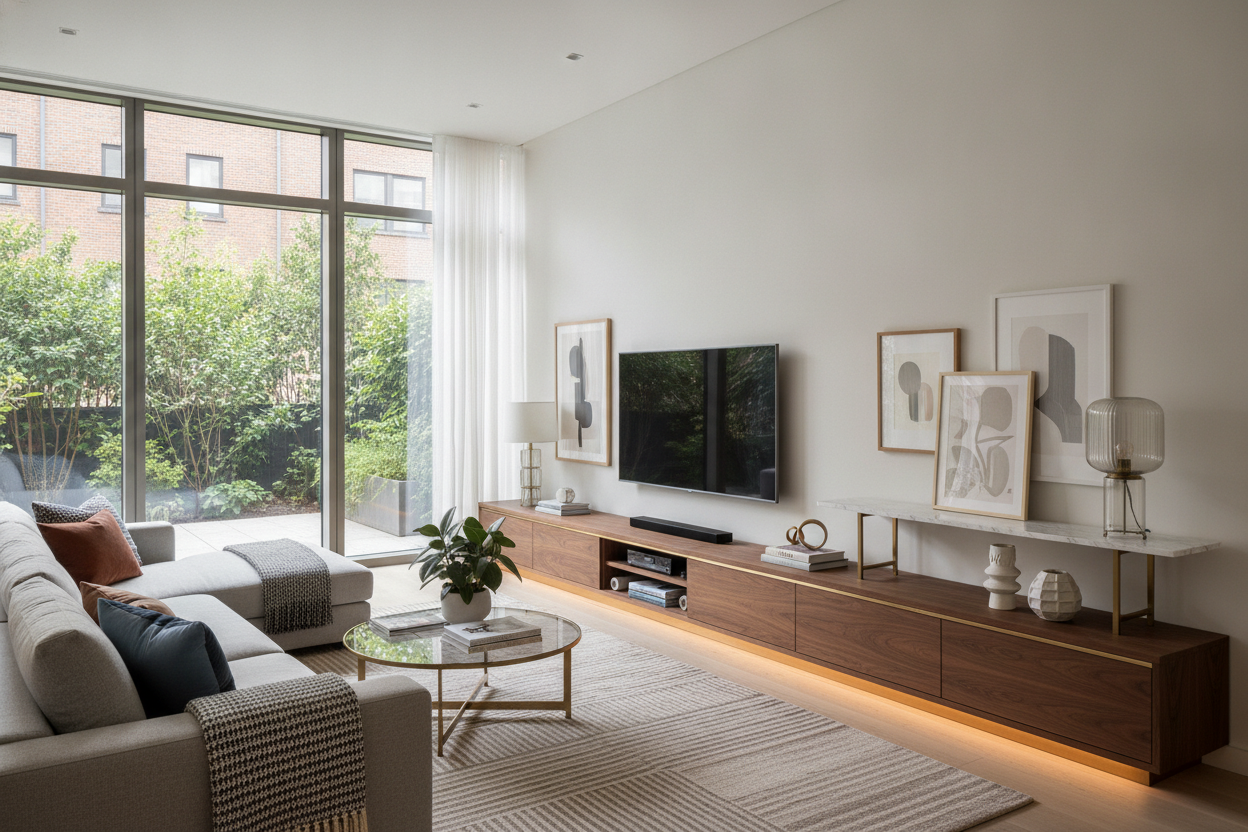
I remember staring at my 65-inch OLED—a piece of tech that cost me two months of freelance checks—sitting on a $40 fiberboard shelf that bowed in the middle. It looked ridiculous. Like wearing a tuxedo with flip-flops. I finally caved and bought a real modern furniture tv console, and I am never going back to the flat-pack struggle.
- Solid materials like kiln-dried oak or walnut prevent that mid-shelf sag over time.
- Proper cable management is the difference between a sleek room and a tech-cluttered mess.
- Scale matters: your console should be at least 6 to 10 inches wider than your TV.
- Quality hardware like soft-close hinges feels like a luxury you will appreciate every single day.
The Moment I Realized My TV Stand Was Ruining the Room
For years, I lived by the 'good enough' rule. If it held the TV and did not collapse during a mild earthquake, it stayed. But as I started actually caring about my interior design, that flimsy unit became an eyesore. It was too small, too low, and made of that weird hollow-core material that feels like thick cardboard. It lacked the visual weight a contemporary tv entertainment center needs to anchor a living room.
A proper modern furniture tv console does more than just hold a screen; it balances the 'black hole' effect of a large television. When you have a massive screen, you need a substantial piece of furniture underneath to ground it. Otherwise, the TV just looks like it is floating awkwardly on the wall. Switching to a solid unit changed the entire vibe of my apartment from 'grad student' to 'person who has their life together.'
What Makes a Contemporary Entertainment Unit Look 'Adult'?
The difference between a dorm-room stand and an actual adult entertainment center contemporary designers would approve of comes down to three things: materials, joinery, and depth. I used to buy the cheap stuff because I thought 'wood is wood.' It is not. Most budget stands use 0.5-inch particle board that chips if you look at it wrong. A quality unit uses at least 0.75-inch thick panels, often with beautiful real-wood veneers or solid timber.
Look at the legs. Are they spindly plastic or tapered solid wood with leveling feet? Leveling feet are a godsend if you live in an old building with slanted floors like I do. Also, check the hinges. If the doors slam shut with a loud 'thwack,' it is cheap. If they glide shut silently, you have found a winner. It is these small, tactile moments that make your home feel expensive without necessarily costing a fortune.
The Storage Reality: Finally Hiding the Tech Mess
My biggest regret with my old open-shelf unit was the 'wire waterfall.' No matter how many zip ties I used, the back of the TV looked like a disaster zone. Upgrading to a stylish black entertainment center with a closed back and pre-drilled cable ports was a revelation. I finally tucked the router, the gaming consoles, and the tangled mess of HDMI cables behind a sleek door.
When choosing an entertainment cabinet modern enough for today's tech, make sure it has ventilation. I once fried a DVR because I shoved it into a cabinet with zero airflow. Look for units with slatted doors or mesh panels. They allow your remote signals to pass through and keep your electronics from melting while you binge-watch your favorite series.
Why Flexibility is the Ultimate Flex in Open Layouts
If you live in an apartment or an open-concept house, you know the pain of 'the awkward wall.' Sometimes a standard 60-inch unit is too small, but an 80-inch one blocks the hallway. This is where an adjustable modern furniture tv console saves the day. I am a huge fan of modular or telescoping designs that let you slide the unit wider or narrower depending on your space.
I once moved from a spacious loft to a tiny pre-war apartment. My fixed-width console was two inches too wide for the only available wall. I had to sell it on Craigslist for a fraction of what I paid. Now, I only buy pieces that offer some level of flexibility. It is the smartest move for anyone who might move in the next three years.
How to Start Your Search Without Getting Overwhelmed
Before you start scrolling through endless pages of media cabinets, grab a tape measure. Measure your TV's actual width—not the screen size, which is diagonal. Then, find a console that is at least 20% wider. This creates a 'golden ratio' that is pleasing to the eye. If your TV is 55 inches wide, look for a console that is at least 66 inches long.
Lastly, consider the height. Your eyes should be level with the middle of the screen when you are sitting on your sofa. Most people buy units that are too high, leading to 'TV-too-high' syndrome and a sore neck. Stick to a height between 18 and 24 inches for the most comfortable viewing experience.
FAQ
How much should I spend on a quality console?
For a unit that will last a decade, expect to spend between $600 and $1,200. Anything under $300 is likely made of thin MDF and will start to sag or peel within two years of heavy use.
Can I put a TV on a console that is smaller than the screen?
Technically yes, if the stand fits, but it looks terrible. It creates a top-heavy visual that makes the room feel cramped and unstable. Always go wider than the TV.
What is the best material for durability?
Kiln-dried hardwood or high-density furniture-grade plywood with a thick veneer. Avoid anything described as 'paper foil finish'—that is basically just a sticker over compressed sawdust.

Dejar un comentario
Este sitio está protegido por hCaptcha y se aplican la Política de privacidad de hCaptcha y los Términos del servicio.