










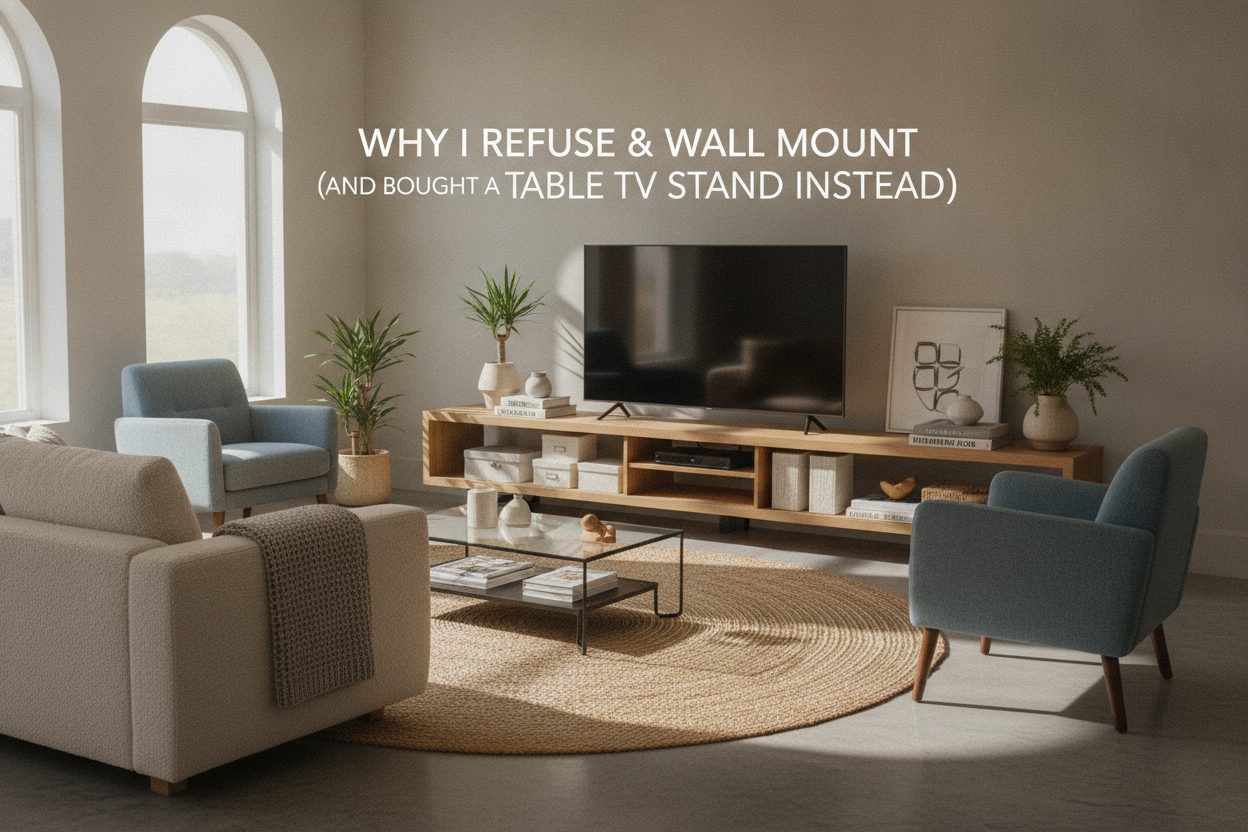
I spent three hours staring at a jagged hole in my drywall that was supposed to be a stud. My 65-inch TV was leaning precariously against the sofa, looking more like a liability than an entertainment center. That was the moment I realized I was done with the drill, the plaster dust, and the renter’s anxiety, and I bought a table tv stand instead.
- Save your security deposit by avoiding wall damage.
- Central pedestals fit on narrow furniture that factory legs can't reach.
- Cable management is built directly into the center pillar.
- Swivel functions are much easier to find and adjust than with wall mounts.
The Day I Surrendered to the Drywall
My apartment has 'creative' framing. I used a stud finder, I tapped the walls, I even tried the magnet trick—nothing. After turning my living room wall into a piece of Swiss cheese, I realized that wall-mounting is a high-stress, low-reward endeavor for anyone who doesn't own their home or a professional-grade Bosch drill.
The realization hit me while I was vacuuming up white dust for the third time: why am I fighting the architecture of the building? I just wanted to watch a movie, not perform a structural engineering feat. I needed a solution that stayed off the wall but looked more intentional than the flimsy plastic bits that come in the box.
What Actually Is a Table TV Stand? (And Why It Wins)
When you unbox a new screen, it usually comes with 'duck feet'—those thin plastic legs that sit at the far edges of the frame. They are functionally useless if your furniture isn't exactly as wide as the TV. A dedicated pedestal mount is a heavy, steel-and-glass base that screws into the VESA holes on the back of your screen, just like a wall mount does, but it sits on your furniture.
I tell everyone I know to replace those cheap factory legs immediately. Those legs feel like they're made of recycled milk jugs and offer zero height adjustment. A real pedestal stand gives you back about 6 to 8 inches of vertical space, which is exactly where your soundbar or gaming console needs to live.
You Actually Get to Keep Your Nice Furniture
The biggest aesthetic win is the footprint. If you have a 65-inch TV, those wide factory legs might require a 60-inch wide console. That limits your style choices significantly. Because a pedestal stand has a centralized base, you can safely place a massive screen on a much narrower, more stylish piece of furniture.
I was able to keep my favorite mid-century modern TV stand even after I upgraded my screen size. The central base sits firmly in the middle of the wood top, leaving plenty of room for a lamp or a couple of books on the sides, rather than having plastic legs hanging off the edge of the world.
How I Set Up My TV Stand on Table Display
Setting up a tv stand on table configuration took me about twenty minutes. The heavy lifting is the only hard part. Once the VESA brackets are screwed into the back of the TV, you just hook the whole thing onto the center pillar of the stand. It’s significantly less terrifying than trying to line up a 50-pound glass panel with a metal bracket on a wall.
The best part? The cable management. I found a heavy duty stand for TV on table that has a hollow center or clips along the back. I routed my HDMI cables and power cords through the pillar, so they disappear behind the console. It looks cleaner than any wall mount I’ve ever seen where the owner forgot to hide the 'cable waterfall' hanging down the middle of the wall.
The One Time I Might Consider Wall Mounting Again
I’m a convert, but I’m not delusional. If I lived in a high-traffic hallway where people were constantly bumping into the furniture, or if I had a toddler who viewed the TV as a climbing gym, I’d probably suck it up and bolt the thing to a stud for safety. But for a standard living room setup? The tabletop route is faster, cleaner, and much kinder to your walls.
FAQ
Will a table stand hold a 75-inch TV?
Yes, but check the weight capacity and the VESA pattern. Most heavy-duty pedestals are rated for 80-100 lbs, which covers almost all modern 75-inch LED screens.
Do these stands swivel?
Most of them do. Unlike a wall mount where a swivel arm can look bulky, a pedestal stand usually has a hidden swivel joint that lets you turn the screen 30 degrees in either direction without moving the base.
Will the base scratch my furniture?
Most come with rubber feet, but I always add a few extra felt pads to the bottom of the glass base just to be safe, especially on softer woods like pine or walnut veneers.

Dejar un comentario
Este sitio está protegido por hCaptcha y se aplican la Política de privacidad de hCaptcha y los Términos del servicio.