










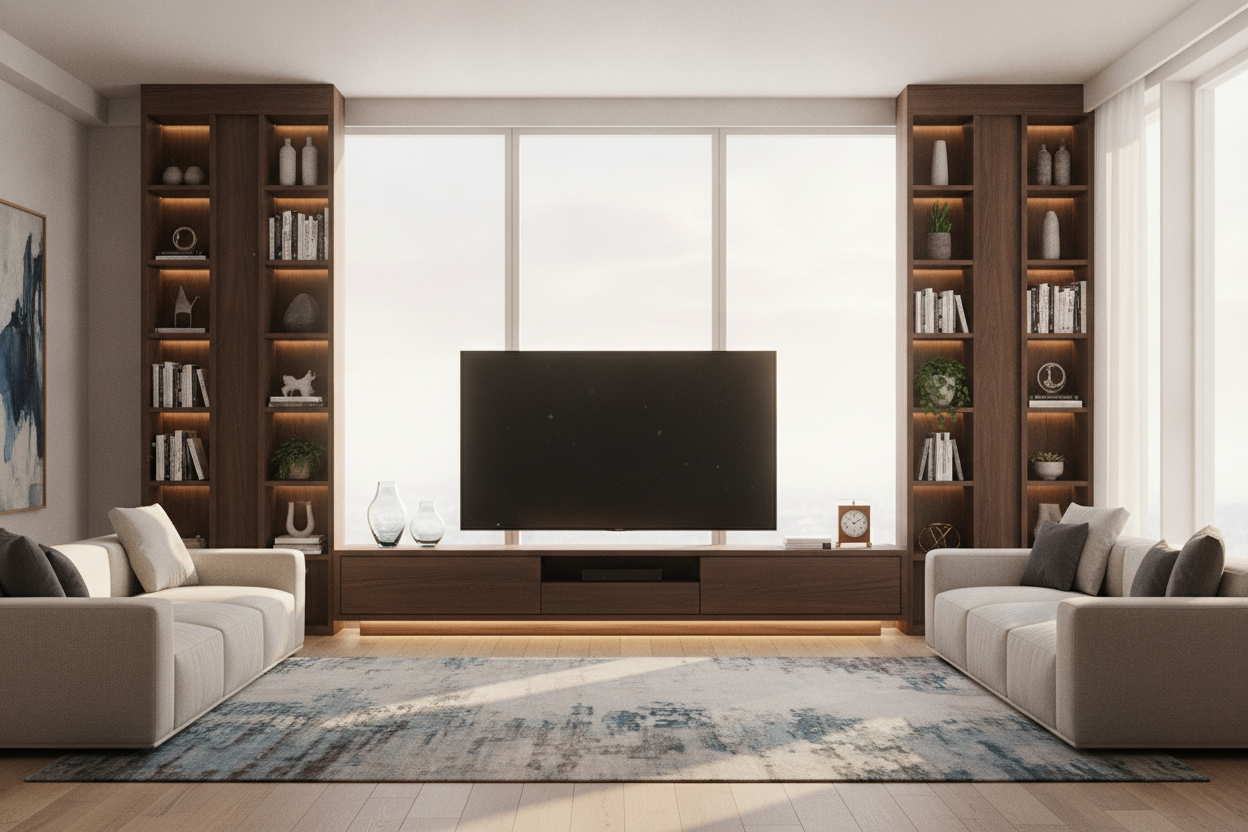
I once spent three weeks tracking a shipment for a beautiful mid-century console, only to unbox it and realize it looked like a postage stamp against my living room wall. It was 60 inches wide—the industry standard—but on a 14-foot stretch of drywall, it looked lost, lonely, and frankly, a bit cheap. That was the day I stopped buying 'standard' and started hunting for 90 inch tv stands.
Quick Takeaways
- A 90-inch console acts as an architectural anchor, making a room feel intentional rather than cluttered.
- You do not need a massive TV to justify a massive stand; negative space is your best friend.
- In open-concept homes, these units serve as essential 'visual walls' to define different zones.
- Always measure your hallway corners—an 8-foot box does not bend.
The 'Tiny Island' Effect (And Why Your Living Room Feels Off)
Most people make the mistake of sizing their furniture to their electronics rather than their architecture. You buy a 55-inch TV, so you buy a 60-inch stand. But if that setup is sitting on a massive wall, you’ve created a 'tiny island.' It makes the ceiling feel too high and the floor space feel cavernous in a bad way.
When you start browsing the endless sea of standard Tv Stands, you’ll notice most stop at the six-foot mark. By jumping up to 90 inches, you’re finally giving the wall some weight. It’s the difference between a piece of furniture and a built-in feature. It anchors the room, drawing the eye across the space rather than letting it get stuck on a black rectangle in the middle of a blank void.
Do You Actually Need a Massive Screen for a 90 Inch Wide Media Console?
I’ll be the first to tell you: no, you don't. In fact, putting a 65-inch TV on a 90 inch wide media console is a pro-level styling move. It creates what designers call negative space. Instead of your TV hanging over the edges like a mushroom cap, you have 15 inches of breathing room on either side.
This is where you actually get to live in your house. Use that extra real estate on a 90 in tv console for a heavy ceramic lamp, a stack of oversized art books, or a sculptural vase. It turns your tech center into a curated vignette. If you’re looking at tv stands for 90 inch tv setups, you’re likely dealing with a massive screen, but even for smaller sets, the extra width prevents the 'top-heavy' look that ruins so many living rooms.
Solving the Open Concept Problem With Extra Length
Open-concept living is great until you realize you have no place to put anything without it looking like a mess. I’ve found that an entertainment center for 90 inch tv is the most effective way to create a 'zone' without building a physical wall. It creates a long, horizontal line that tells the eye, 'The living room ends here, and the dining room begins there.'
I’ve seen this work wonders in lofts and suburban Great Rooms alike. For instance, I remember reading about How a 90 Inch TV Stand With Fireplace Fixed Our Open Layout, and the logic holds up. The sheer scale of a 90 inch console cabinet provides enough visual mass to compete with a kitchen island or a large dining table nearby. It’s about balance.
The Logistics of Wrestling a 90 Inch Console Cabinet Into Your House
Let's talk about the nightmare scenario: the delivery truck arrives, and the box won't fit in the elevator. A 90 tv stand is essentially an eight-foot-long slab of wood or MDF. It is heavy, it is awkward, and it does not like tight corners. Before you hit 'buy,' take a piece of blue painter's tape and mark out the path from your front door to the living room.
If you live in a walk-up or have a narrow entryway, look for modular options—units that come in two or three pieces that bolt together. If you're going for a solid 90 inch media cabinet, make sure you have at least two strong friends and a heavy-duty dolly. I once had to return a stunning walnut piece because it couldn't clear the 90-degree turn in my hallway. Learn from my heartbreak.
Floating vs. Freestanding: Getting the Proportions Right
If a 90-inch piece feels too 'heavy' for your room, consider going off the floor. A floating tv stand up to 90 inch wide can make a massive difference in how the room breathes. When you can see the floorboards running all the way to the wall, the room feels larger, even if the furniture is huge. I’ve even seen people who I Put a 90 Inch Floating TV Stand in a Surprisingly Small Room and it actually made the space feel less cramped than a bulky 50-inch unit on legs.
That said, if you have a 100-pound television, skip the floating DIY and go for a solid, floor-sitting 90 inch media cabinet. There is nothing less 'chic' than your drywall failing at 3 AM because you underestimated the weight of kiln-dried oak and a plasma screen.
FAQ
Is a 90-inch stand too big for a 65-inch TV?
Not at all. It’s actually ideal. It gives you roughly 15 inches of space on each side for decor, which prevents the TV from dominating the entire visual field of the room.
How high should a 90-inch console be?
Since these units are so wide, I prefer them lower—around 18 to 22 inches. If they get too tall, they start to look like a kitchen sideboard or a dresser, which can feel overwhelming in a standard living room.
What material is best for long spans?
Look for solid wood or high-grade plywood with a center support leg. Cheap particle board will sag in the middle over time when you're dealing with an 8-foot span, especially with a heavy TV on top.

Dejar un comentario
Este sitio está protegido por hCaptcha y se aplican la Política de privacidad de hCaptcha y los Términos del servicio.