










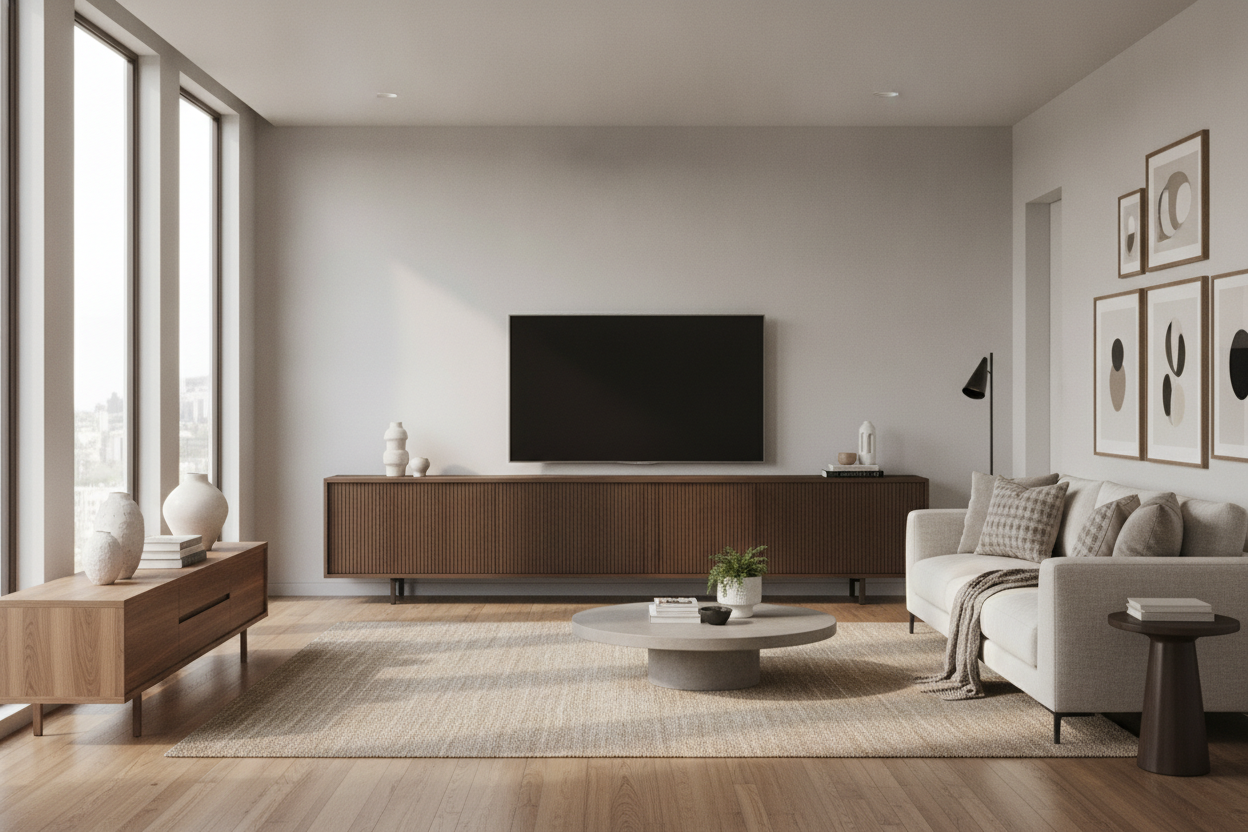
I spent three years staring at a tangle of black HDMI cables and dusty power strips behind a $40 minimalist shelf I bought in a fit of aesthetic optimism. Every Saturday morning, I’d try to wipe down the top of my Xbox, only to realize the dust had settled into the fan vents and formed a grey crust on the back of the TV. It didn't look like a curated living room; it looked like the back of a Best Buy.
The reality is that unless you live in a vacuum-sealed laboratory, open media shelving is a trap. I finally reached my breaking point when I realized I was spending more time cleaning my electronics than actually using them. I swapped the 'airy' look for a solid tv furniture unit with doors that actually close, and my living room finally feels like an adult lives here.
Quick Takeaways
- Open shelves turn your expensive electronics into high-maintenance dust magnets.
- Visible cables create visual noise that makes even expensive rooms look cluttered.
- A closed unit tv cabinet acts as a foundational anchor for your room's design.
- Ventilation and IR repeaters solve all the 'overheating' and 'remote signal' myths.
- Sizing up is the secret to hiding the mess effectively.
The Open-Shelving Trap (Why We All Fell For It)
We’ve all seen the Pinterest boards: a slim, mid-century modern rack with a single, perfectly placed ceramic vase and a record player. It looks light, it looks breezy, and it’s a total lie. In a real home, that space is occupied by a router, a mesh node, three different remote controls, and a stack of games you haven't played in six months. When these items sit on open shelves, they aren't 'decor'—they are clutter.
The biggest issue isn't just the look; it's the maintenance. Admitting that an open tv unit is a dust magnet was the first step in my journey toward a cleaner house. Static electricity from your tech literally pulls dust out of the air and glues it to your hardware. If you have pets, double that problem. I found myself using a whole pack of microfiber cloths every month just to keep the 'minimalist' look from looking like a basement storage unit.
Then there are the cords. No matter how many Velcro ties or plastic channels you use, those black rubber snakes always find a way to peek out. They break the clean lines of your walls and distract from the art or the TV itself. Closed storage doesn't just hide the dust; it kills the visual chaos that keeps your brain from fully relaxing on the sofa.
What Happened When I Finally Bought Doors
The moment I hauled my new unit tv cabinet into the room, the energy changed. Instead of a 'tech stand,' I suddenly had a piece of furniture. It’s a subtle shift, but when you hide the plastic boxes and blinking LED lights behind solid wood or textured doors, the TV stops being the center of a hardware store display and starts being part of a room.
I wanted to see if a tv cabinet for living room actually look like real furniture rather than a utilitarian rack. The answer is a resounding yes. By choosing a unit with a bit of weight and some interesting door details—like fluted wood or brass hardware—the media center became a design choice. It anchored the wall. My 85-inch screen no longer looked like it was floating on a flimsy wire rack; it had a base that matched its scale.
The best part? My Sunday morning routine changed. Instead of carefully dusting between every port on the back of the receiver, I just swipe a cloth across the top of the cabinet and I'm done. The inside stays pristine. My consoles stay cleaner, and my sanity remains intact. The room looks 'expensive' not because the furniture cost a fortune, but because the mess is gone.
Do Solid Doors Ruin Remote Signals and Airflow?
This is the first thing everyone asks: 'Won't my PlayStation melt?' or 'How will I change the channel?' These are 2010 problems that we have very easy 2024 solutions for. Most modern consoles and streaming sticks use Bluetooth or RF remotes, which work perfectly through solid wood. If you still have an old-school IR cable box, a $15 IR repeater kit lets you stick a tiny, invisible sensor on the outside while the box stays hidden inside.
As for heat, it’s all about the back panel. A good cabinet isn't a sealed tomb. Most high-end units have 2-inch gaps at the back for cable runs that also act as chimneys for hot air. If you’re running a high-powered gaming PC or a beefy receiver, you can do what I did: spend $20 on a quiet USB-powered cooling fan. I cut a small hole in the back of my cabinet, mounted the fan to pull air out, and my components actually run cooler now than they did sitting in a stagnant corner on an open shelf.
Don't let the fear of 'tech suffocating' keep you in a world of visible wires. A little bit of airflow planning goes a long way. I’ve had my setup closed up for over a year, and even during four-hour gaming sessions, the internal temperature never hits anything concerning. It's a small price to pay for a room that doesn't look like a server closet.
Three Features to Look For in Your Next Console
When you're ready to make the switch, don't just buy the first box you see. You need to look for specific 'smart' furniture features. First, prioritize adjustable shelving. Tech changes. That soundbar you have today might be replaced by a taller center-channel speaker next year. If your shelves are fixed, you're stuck. Look for those little brass peg holes that give you options.
Second, consider the door material. If you absolutely hate the idea of an IR repeater, look for a black cabinet with glass doors. If the glass is smoked, tinted, or fluted, you get the best of both worlds: the remote signal passes through easily, but the 'tech mess' inside is blurred and hidden from view. It gives a sleek, high-end look without the total blackout of solid wood.
Finally, scale matters more than you think. A common mistake is buying a stand that is exactly the width of the TV. It looks top-heavy and cheap. You want a large tv cabinet that extends at least 6 to 10 inches past the edges of your screen. This extra width gives you more internal volume for cable management and makes the whole setup feel proportional to the room. Plus, it gives you a surface to place a lamp or a plant, further disguising the fact that this is a 'TV stand.'
The Final Verdict: Hide the Tech, Highlight the Furniture
Stop treating your media center as a secondary thought. We spend a huge chunk of our lives looking in the direction of the TV; why shouldn't the thing holding it be as beautiful as your dining table or your sofa? Moving to a closed system was the single best thing I did for my living room's aesthetic and my own cleaning-induced stress levels.
By choosing a piece with character and hiding the plastic 'black boxes,' you reclaim your space from the tech companies. Your living room should be a reflection of your style, not a graveyard for cables and dust bunnies. Get the doors, hide the mess, and finally enjoy a movie without staring at a glowing router light in your peripheral vision.
FAQ
Will my remote work through solid wood doors?
If your remote uses Bluetooth (like Apple TV or Fire Stick), it works perfectly. For older infrared remotes, you’ll need a cheap IR repeater or a cabinet with glass or mesh door inserts.
How do I prevent my electronics from overheating?
Ensure there is at least 2-3 inches of clearance around your devices and check that the cabinet has cable cutouts in the back for airflow. For high-heat devices, a small USB fan is an easy fix.
Is a larger cabinet better for a small room?
Counter-intuitively, yes. A larger, closed cabinet hides more visual clutter than a small, busy open shelf. It creates a single, clean horizontal line that actually makes the room feel wider and more organized.

Dejar un comentario
Este sitio está protegido por hCaptcha y se aplican la Política de privacidad de hCaptcha y los Términos del servicio.