










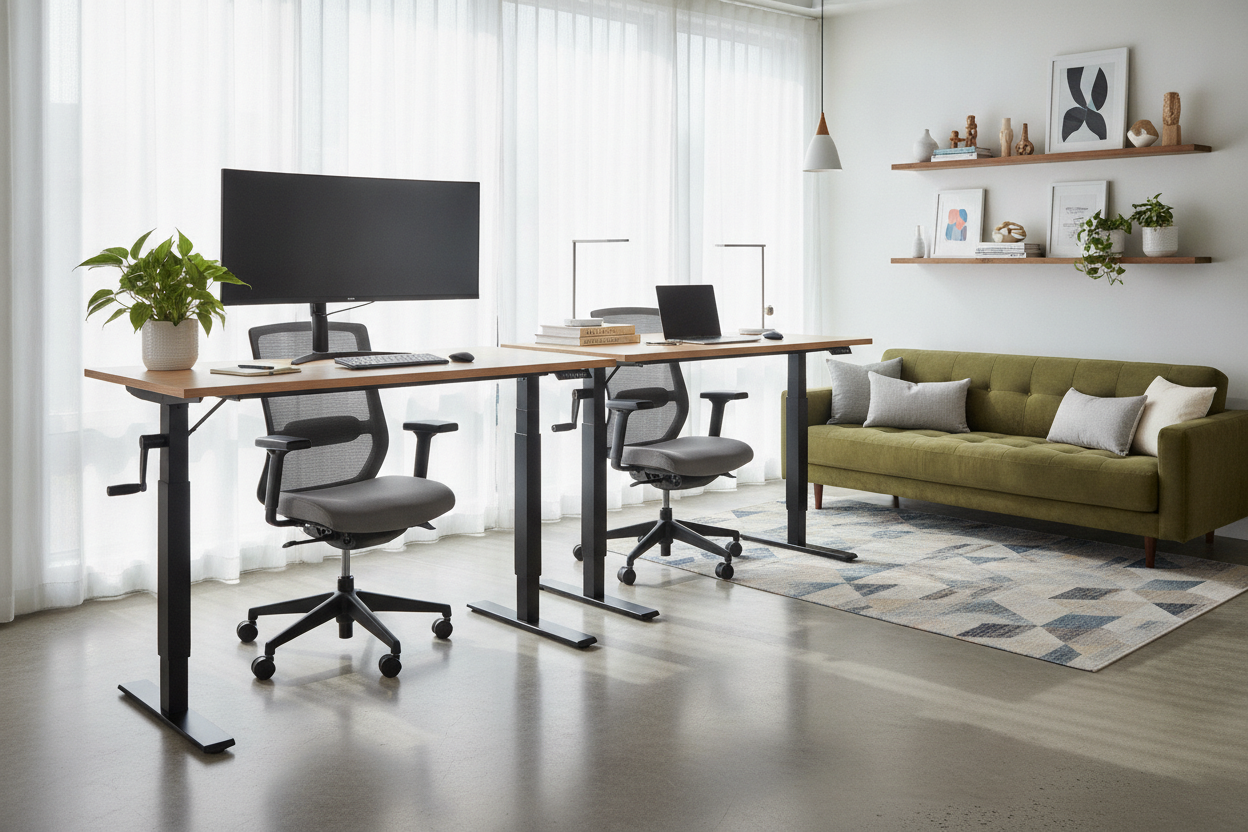
It is 2:14 AM. I am three cups of coffee deep into a deadline, and my lower back is screaming. My partner is sound asleep exactly four feet to my left. In a perfect world, I would hit a button and my desk would glide to standing height. In the real world—the one with a shared bedroom office—that button press triggers a mechanical whine that sounds like a drill through drywall. I usually just stay seated and suffer.
Sharing a workspace in a small apartment is a lesson in compromise. You learn to type softer, you buy the 'silent' mouse that feels like clicking a marshmallow, and you eventually realize that your expensive motorized desk is actually a liability. After six months of tiptoeing around my own furniture, I realized I needed a change that didn't involve a power cord.
- Zero Noise: No motor means no 2 AM wake-up calls for your partner.
- Cable Management: One less cord to hide under the rug.
- Reliability: Gears do not fry during power surges; motors do.
- Analog Vibe: The crank adds a tactile, industrial feel to the room.
The 2 AM Problem With Motorized Desks
The marketing for electric desks always shows a sun-drenched, empty loft. They never show the reality of a 600-square-foot apartment where the 'office' is just a corner of the bedroom. When the house is dead silent, the decibel level of a standard electric motor jumps from 'low hum' to 'industrial nuisance.' It is the kind of sound that cuts through white noise machines and earplugs.
I spent weeks trying to justify the noise. I tried lubricating the tracks and even considered building a soundproof box around the motor housing, which is as ridiculous as it sounds. For a while, I genuinely considered giving up on the standing dream entirely. I looked at a simple writing computer desk as a replacement, thinking that if I could not stand in silence, I might as well just sit in peace. But my spine disagreed. The problem was not the standing; it was the electricity.
Most people do not realize that electric motors in consumer-grade desks are often the first thing to fail. You are paying a premium for a component that eventually burns out, leaves your desk stuck at a lopsided angle, and makes a racket in the meantime. In a shared living space, that motor is not a luxury—it is a chore.
Why I Switched to a Jarvis Crank-Powered Standing Desk
I eventually ditched the electronics for the jarvis crank-powered standing desk. It felt like a regression at first—like trading a Tesla for a vintage bicycle—until I actually used it. The beauty of this setup is the mechanical simplicity. The Jarvis frame uses a high-quality gear system that turns your manual effort into vertical lift with surprising efficiency. You are not fighting the weight of the tabletop; the hardware is doing the heavy lifting.
I was worried about the weight capacity. My setup is not light. I have a heavy ultrawide monitor, a pair of studio monitors, and a thick hardwood top. I assumed a manual crank would struggle or, worse, rattle my gear to the floor. However, even when compared to a massive 71 W height adjustable standing desk, the Jarvis manual frame holds its own. It is rated for 150 lbs, which is more than enough for a serious workstation. The lift is steady, and because you control the speed, there is no sudden 'jerk' when the motor starts or stops.
The build quality is what surprised me most. The legs are heavy-duty steel, not the thin aluminum you find at big-box retailers. It feels anchored. When I am cranking it up, the desk does not shimmy or sway. It feels like a piece of machinery designed to last thirty years, not a piece of tech designed to be obsolete in five.
Is a Jarvis hand crank desk actually silent?
This is the question everyone asks. If you are expecting absolute, ghostly silence, you will be disappointed—but only slightly. The jarvis hand crank desk makes a faint, rhythmic mechanical click as the gears engage. It is a satisfying, low-frequency sound, similar to a high-end fishing reel or a vintage clock. It is significantly quieter than an electric motor. My partner, who can sleep through a thunderstorm but wakes up if I drop a pen, has never once been disturbed by the crank. It is the difference between a drone and a whisper.
Designing Around a Mechanical Vibe
Beyond the noise, there is an aesthetic argument for going manual. Most electric desks have a bulky control box and a mess of wires hanging from the underside. The crank version is much cleaner. The handle usually tucks away under the desktop when not in use, leaving you with a streamlined profile that fits better in a home environment than a corporate one.
I have found that an industrial crank standing desk gets more compliments than almost any other piece in my office. People are drawn to the handle; they want to touch it and see how it works. It turns a piece of utility furniture into a conversation starter. It feels intentional, like you chose a tool rather than just buying an appliance.
Practically speaking, the lack of a power cord for the frame gives you way more freedom. You can actually use some of the more creative designer ideas for standing desk layouts that involve floating the desk in the middle of the room. You do not have to worry about tripping over a cord or being tethered to a specific wall outlet just to make the desk functional. It opens up the floor plan in a way electric models simply cannot.
The Verdict on the Daily Arm Workout
Let’s be real: you have to turn the handle. To go from sitting to standing, you are looking at about 35 to 40 rotations. If you are the kind of person who changes positions every fifteen minutes, you might find it tedious. For me, the 'workout' is negligible. It takes maybe thirty seconds of light effort. I actually find the physical movement helps break the mental fog of a long shift.
The trade-off is worth it. I get a desk that will never have a software error, never blow a fuse, and never wake up my family. It is a piece of furniture that respects the boundaries of a shared home. If you are tired of the digital hum and want something that just works, the manual Jarvis is the smartest upgrade you can make for your midnight oil sessions.
FAQ
How long does it take to assemble?
Expect about 45 minutes to an hour. The instructions are clear, but the legs are heavy. I recommend having a second person help you flip it over once the feet are attached so you don't strain the crank housing.
Can the crank handle be moved to either side?
Yes, the Jarvis frame is designed to be versatile. You can install the crank on the left or the right side depending on your dominant hand or room layout.
Does the desk wobble at full height?
Every two-leg standing desk has a tiny bit of movement at max extension, but the Jarvis is remarkably stable. Unless you are aggressively scrubbing out a drawing, you won't notice any monitor shake.


Dejar un comentario
Este sitio está protegido por hCaptcha y se aplican la Política de privacidad de hCaptcha y los Términos del servicio.