










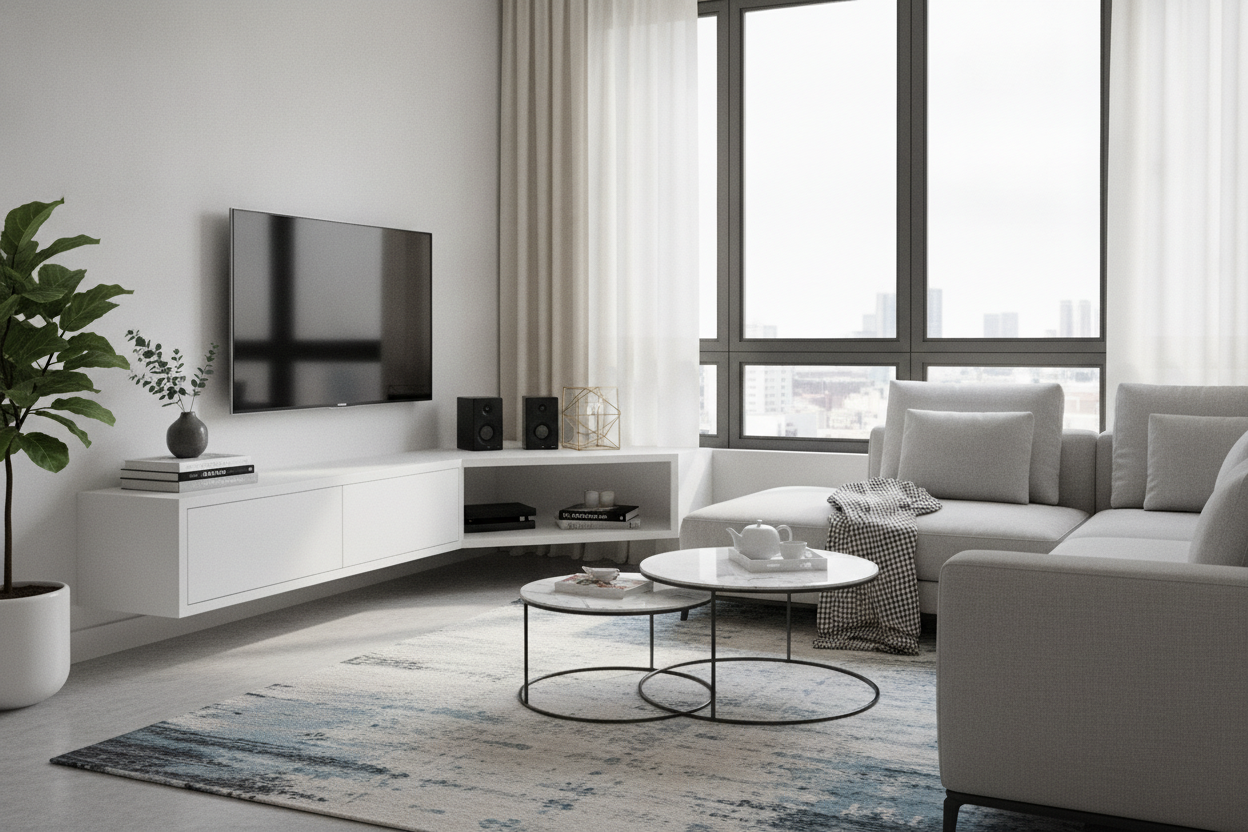
I spent three hours trying to fit my 55-inch TV into a living room that felt like it was designed by someone who hated furniture. Between the radiator, the balcony door, and a weird diagonal fireplace, I had exactly zero usable wall space for a traditional credenza. I was staring at my 47th browser tab of mid-century sideboards when I realized the only unoccupied real estate was a 90-degree angle currently housing a dusty floor lamp. That is when I decided to go with a floating corner media console.
- Saves Traffic Flow: Clears the floor so you stop stubbing your toes in tight walkways.
- Visual Magic: Seeing more of the floor plan actually trickles your brain into thinking the room is bigger.
- Weight Limits: Most units handle 50-75 lbs easily if you hit the studs.
- Cable Stealth: Requires a bit of planning, but keeps the 'floating' look clean.
The Nightmare of the 'Three Door' Living Room
My apartment has what I call the 'Three Door' problem. The main living space is a 12x14 box, but it is punctured by the front door, a hallway door, and a closet door. Every time I tried to put a standard TV stand against a wall, it blocked a walking path or made the room feel like an obstacle course. I even tried a slim console, but it still jutted out 18 inches—just enough to be a nuisance.
The corner was the only spot that did not interfere with the flow of humans. But traditional corner units are massive, heavy blocks of MDF that look like they belong in a 1990s basement. I needed something that felt light, which is how I ended up looking at wall-mounted options to reclaim that dead space.
Why I Finally Chose a Floating Corner TV Console
When you live in a small space, the floor is your most valuable asset. The second you put a piece of furniture on the ground, that square footage is gone. By installing a floating corner tv console, I suddenly had a clear view of the baseboards. It sounds like a small thing, but it completely changed the energy of the room. It no longer felt like the furniture was closing in on me.
I had been browsing for a floating wooden tv shelf for a standard wall, but the corner version was the real breakthrough. It tucked the screen away into a zone that was previously useless. If you are dealing with a room where every wall has a window or a door, the corner is your best friend. It turns a 'dead zone' into the focal point of the room without sacrificing an inch of walking space.
Will a Floating Corner Entertainment Shelf Hold Real Gear?
I will be honest: I was terrified my TV was going to end up in a heap of splinters and drywall dust. Most people worry that a floating corner entertainment shelf is just for show, but if you do it right, it is rock solid. I am currently running a PS5, a heavy Sonos soundbar, and a mesh router on mine. The key is ignoring the cheap plastic anchors that come in the box.
You must hit at least two studs. In a corner, you usually have a stud right in the vertex or very close to it. I used 3-inch lag bolts to secure the mounting bracket. If your studs are weirdly spaced, use high-quality toggle bolts (the metal ones, not the plastic wings) for the secondary holes. My unit is rated for 60 pounds, and even with my cat occasionally jumping on it, it has not budged a millimeter in six months.
The Ugly Truth About Cable Management
Here is the thing no one tells you about floating furniture: if you don't hide the wires, it looks like a tech octopus is attacking your wall. A floating corner console looks sleek in photos because the photographer hid the cords behind the wall. In a rental, you probably cannot drill massive holes to fish wires through the drywall.
I solved this by using paintable cord covers. I ran a single channel down the very corner of the wall where the two planes meet. Because it is in the shadows of the corner, it is practically invisible. I also used adhesive zip-tie mounts under the shelf to keep the power bricks and HDMI cables from sagging into view. It took an extra hour of work, but it is the difference between a 'dorm room hack' and a high-end custom look.
How to Style a Floating Corner Console (Without It Looking Weird)
The biggest risk with corner furniture is that it can look like an afterthought. To make it look intentional, you have to style the surrounding area. I put a tall, leafy fiddle-leaf fig next to mine to soften the hard angles of the shelf. It helps the unit blend into the room rather than just sticking out of the wall like a shelf in a garage.
You also have to decide if you want to replace your media console entirely or just use the shelf for the TV. I went minimalist. I kept the top surface clear of clutter—just the soundbar and one small ceramic bowl for remotes. If you pile it high with DVDs and knick-knacks, you lose that airy, floating feeling that makes the corner setup so effective in the first place.
FAQ
Can I install this in a rental apartment?
Yes, as long as you are comfortable patching a few holes when you move out. Most landlords don't mind a few bolt holes if you fix them properly with spackle and a dab of matching paint. It is much better than a bulky unit that scuffs the floors.
What is the best height for a floating console?
Aim for 'eye level while seated.' For most sofas, the bottom of your TV should be about 24 to 30 inches off the floor. I mounted my console so the top surface is at 26 inches, which feels perfect for long movie nights without neck strain.
Will a soundbar fit on a corner shelf?
Most corner units have a clipped front or a curved edge. Measure your soundbar before buying! I had to choose a unit with a 42-inch front width to ensure my soundbar didn't overhang the edges, which looks messy.

Dejar un comentario
Este sitio está protegido por hCaptcha y se aplican la Política de privacidad de hCaptcha y los Términos del servicio.