







Retrofitting a standard desk with an amazon standing desk converter provides an accessible pathway to alternating between seated and upright postures throughout the workday. Unlike full desk replacements, a tabletop riser rests directly on top of your existing primary surface, transforming a stationary credenza, traditional executive desk, or compact writing table into an active workspace. However, sorting through the vast marketplace of desktop risers requires careful consideration of mechanical movement profiles, footprint dimensions, and overall room organization.
Workstation Foundations: Understanding the Amazon Standing Desk Converter Landscape
When browsing online marketplaces for a standing desk converter amazon shoppers encounter a wide spectrum of configurations. These units are generally designed as self-contained elevation platforms powered by pneumatic gas springs, manual counterbalance systems, or compact electric motors. The core appeal of choosing a standing desk topper amazon solution lies in preserving an existing tabletop while gaining height flexibility.
For individuals seeking to refine their desktop environment, understanding how the converter interfaces with your current furniture is critical. A detailed review of layout principles, such as those covered in our standing desk converter guide, highlights how crucial proper proportion and weight distribution are when setting up an ergonomic workstation.
Mechanical Lift Profiles: X-Lift, Z-Lift, and Motorized Risers
The internal geometry of an amazon standing desk riser dictates how smoothly it elevates and how much horizontal room it requires during adjustment. The two most common mechanical geometries found across retail platforms are vertical X-frame designs and cantilevered Z-frame structures, alongside fully powered motorized risers.
Vertical X-Frame Elevation Mechanisms
Vertical X-frame converters utilize crossing steel arms connected to pneumatic gas cylinders. When released via a side handle, the mechanism lifts straight up and down along a continuous vertical plane. This vertical trajectory prevents the platform from shifting forward toward your seating position, making X-frame units particularly well-suited for shallow desks or tight office footprints where forward protrusion would crowd the room.
Forward-Arced Z-Lift and Scissor Configurations
Z-lift risers operate on a cantilevered hinge system that moves upward in a subtle forward arc. As the converter elevates, the upper surface steps out slightly toward the user. On deeper workstations, this forward motion helps bring screens closer to natural focal distance. However, it requires sufficient clearance behind the chair to accommodate the forward shift without forcing you into an awkward standing posture.
Dimensional Sizing Tiers and Desktop Footprint Strategy
Selecting the right size for a standing desk amazon converter depends on your monitor layout, peripheral needs, and the structural depth of your base desk.
Compact Laptop and Single-Screen Risers
Compact risers prioritize a minimal base footprint. Designed primarily for single laptops or modest auxiliary monitors, these platforms fit comfortably on corner desks, secretary tables, and writing desks with restricted surface areas. They allow you to establish a functional sit-stand cadence without overwhelming the aesthetics of a shared or multi-purpose living space.
Dual-Tier Monitor Platforms with Dropped Keyboard Decks
Dual-tier converters feature a stepped design with an elevated main deck for monitors and a lowered, forward-facing tray for a keyboard and mouse. This vertical separation helps align your screen at eye level while allowing your forearms to rest at an open angle relative to the typing deck. Many keyboard trays feature quick-release brackets, allowing users to remove the lower deck when using the converter strictly as a reading or writing lectern.
Extra-Wide Workstations for Multi-Monitor Layouts
For expansive setups involving dual monitors, widescreen displays, or dedicated reference material trays, wide-span converters offer extended horizontal surface space. These broader platforms require a sturdy base desk with substantial continuous depth to ensure structural balance when elevated to their maximum height.
Converter vs. Full Height-Adjustable Desk: Decision Matrix
While tabletop converters offer significant convenience, they do add visual mass and consume permanent surface space on top of the host desk. If your workflow requires seamless, corner-to-corner surface transitions, uninhibited under-desk leg clearance, or substantial storage integration, stepping up to a dedicated standing desk product may provide a cleaner architectural profile.
- Choose a desktop converter if: You have high-quality stationary furniture you wish to preserve, rent in a space with existing built-in surfaces, or need a portable sit-stand retrofit.
- Choose a full standing desk if: You want a unified single surface, require maximum vertical adjustment range, or prefer completely integrated cable management pathways.
Integrating Storage, Cable Organization, and Ancillary Furniture
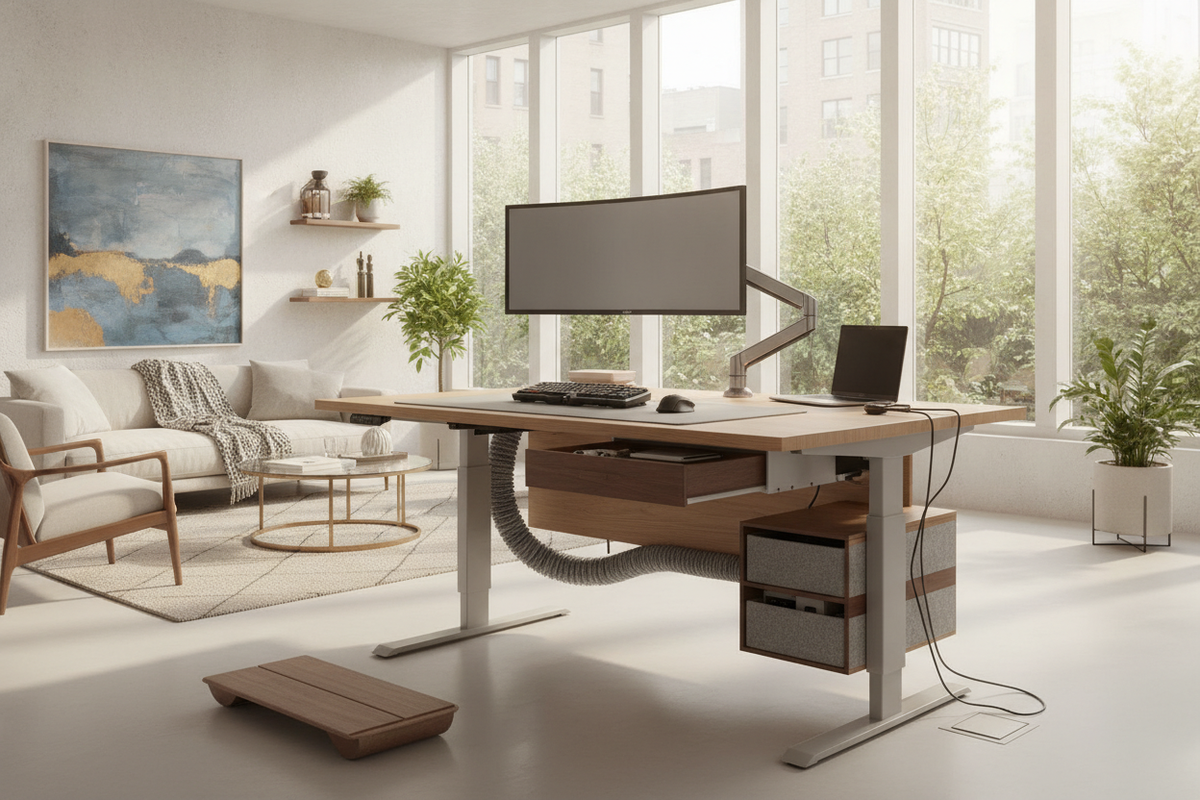
Because a desktop riser moves independently from the stationary desk surface below it, cable management requires intentional slack and routing. Fastening monitor cords, power strips, and peripheral connections with flexible wraps prevents binding during elevation changes.
To keep the primary work deck clear of everyday stationery, pairing your converter setup with adjacent organization solutions is essential. Incorporating mobile filing pedestals, modular credenzas, and dedicated desk trays—as explored in our desk amazon guide—ensures that non-digital necessities remain accessible without overcrowding your elevating platform.


Dejar un comentario
Este sitio está protegido por hCaptcha y se aplican la Política de privacidad de hCaptcha y los Términos del servicio.