





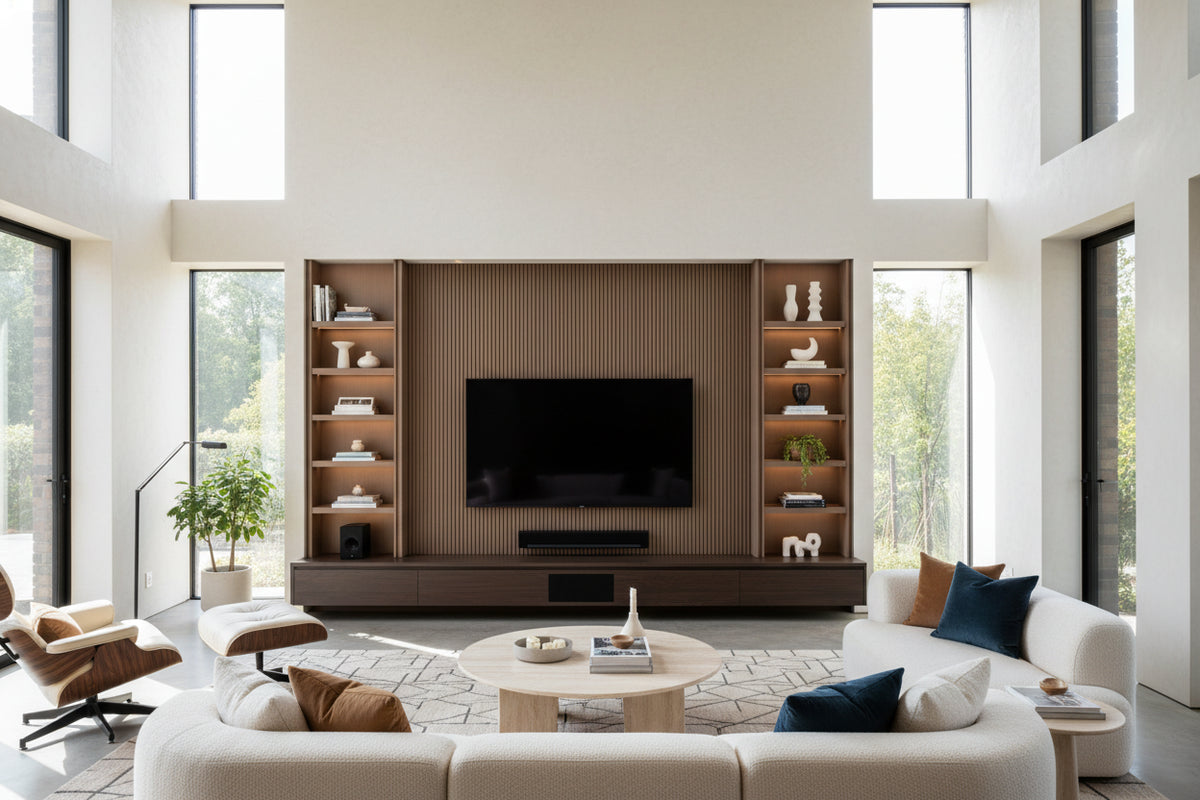
The big 1990s entertainment center, a heavy box with doors and a deep opening sized for a tube TV, does look dated today. Storage around a flat TV is not out of style, though: long, low media consoles, wall units with an open center and built-in looks are what people buy for the living room now.
This guide covers what looks dated and what looks current, how to update an old unit, sizing for a modern TV and tip-over safety, then compares six pieces from the FUFU&GAGA entertainment center collection.
Key takeaways
- Dated: a deep, boxy TV opening built for a tube TV, heavy orange-toned oak, and glass-front stereo bays for components most homes no longer own.
- Current: a long, low console under a wall-mounted or stand-mounted TV, a wall unit that frames the screen with open shelves, or a piece with a built-in look.
- Size first: a 65-inch TV is about 56.7 inches wide, more than twice the width of a 32-inch tube screen, so many old openings are simply too narrow.
- Closed storage still matters: doors and drawers hide game consoles, routers and cables, as long as the devices get air.
Are entertainment centers outdated?
The traditional entertainment center is outdated; the idea of a media wall is not. Design writers split on how far the change goes. A 2026 Hunker article argues that screens have grown so large they are most easily wall-mounted while streaming made the rest of the equipment tiny, and calls entertainment centers in general well along the path to extinction (Hunker). A 2026 House Digest article agrees the bulky units are unlikely to come back, but says modern entertainment centers are becoming popular with people who want a dedicated media area, since they can hide wires and hold gaming consoles and sound bars (House Digest).
So ask what the piece does for your TV and your things. A unit that frames the TV, hides the clutter and fits the screen you own today is not dated; one that boxes the TV into a cave probably is.
Why the 1990s entertainment center went out of style
Old entertainment centers were built around cathode-ray tube (CRT) TVs, which were deep and heavy. In a CPSC staff study, the 32-inch CRT TVs tested weighed between 106 and 163 lb, while the 32-inch flat-screen TV weighed 18.75 lb. The same report notes that tube size had a manufacturing limit, while flat-screen TVs have exceeded the size limits of CRT TVs and keep getting bigger (CPSC, TVs: Tipping the Scale to Safety, 2015). A deep, reinforced box made sense for a 150 lb tube. It makes much less sense for a thin panel.
The screen shape changed too. Tube TVs were 4:3; most flat TVs are 16:9. The arithmetic shows why old openings feel narrow:
- A 32-inch 4:3 screen is 32 x 0.8 = 25.6 inches wide and 32 x 0.6 = 19.2 inches tall.
- A 65-inch 16:9 screen is about 65 x 0.872 = 56.7 inches wide and 65 x 0.49 = 31.9 inches tall.
An opening built for a 26-inch-wide tube cannot hold a 57-inch-wide panel. Our 90s entertainment center guide shows how to measure an old opening against your TV's spec sheet.
What looks dated vs what looks current
This is design guidance, not a rule; a well-made "dated" piece can still suit your room.
| Element | Looks dated | Looks current |
|---|---|---|
| Overall shape | A tall, deep box that fills the wall and encloses the TV | A long, low console, or a wall unit with an open center and slim side towers |
| TV opening | Narrow and deep, sized for a tube, often behind doors | No opening at all: the TV sits on the console or on the wall above it |
| Finish | Heavy, orange-toned honey oak; dark cherry with ornate trim | Matte white or black, lighter or warmer wood tones, simple fronts |
| Component storage | Glass-front stereo bays and tape or CD drawers | Closed doors and drawers for consoles and routers, with cable openings |
| Fronts and details | Raised panels and heavy crown molding everywhere | Flat, push-open, fluted or reeded fronts, or paneled doors used sparingly |
| Display | Every shelf filled with media | Open shelves either side of the TV for books and a few objects |
| Floor | A solid plinth to the floor | Legs or a wall-mounted floating console that shows more floor |

A floating console mounts to the wall above the floor, which keeps the floor visible and can make a small room feel less crowded. A built-in look uses one tall piece, or several pieces placed together, to frame the TV with shelves and cabinets so the TV wall reads as architecture rather than as an appliance.
Are wall units out of style?
Wall units are not out of style when they frame the TV instead of boxing it in. The current version usually has an open center wide enough for a flat TV, two side towers (piers) with shelves or cabinets, and sometimes a bridge across the top. The look that dates fastest is the one-piece wall unit with a small TV hole in the middle. If you want the full wall, our entertainment center and wall unit guide covers widths, depths and modular vs one-piece units.
A few ways to keep a wall unit looking light:
- Leave some shelves partly empty and group objects instead of filling every inch.
- Match the unit's finish to the walls so it reads as built in.
- Keep the TV area open, so a bigger TV still fits later.
Are TV cabinets out of style?
A TV cabinet that hides the screen behind doors is less common than it was, but closed storage for the equipment is very much in use. Game consoles, streaming boxes, routers and cables still need a place, and doors or drawers keep them out of sight. Two cautions apply.
Heat. Electronics need air. VIZIO's TV manual says the slots and openings on the back and bottom of the TV are for ventilation and must not be blocked, and tells owners not to place the TV in a bookcase or cabinet unless proper ventilation is provided (VIZIO 4K TV user manual). Follow your own TV's manual and each device's instructions, keep cable holes open, and open the doors if devices run hot.
The modern version of a TV that disappears is a lift cabinet: a motor raises the TV out of the top of the cabinet and lowers it out of sight. Our TV lift cabinet buying guide covers how they work and where they fit.
How to update an old entertainment center
If you already own a solid unit and the TV still fits, a few plain changes can modernize it:
- Change the finish. Paint is the biggest change. Clean, scuff-sand and prime first, go gently on thin veneer, follow the product labels and work in a ventilated space.
- Swap the hardware. Measure the hole spacing of the old pulls so the new ones cover the holes.
- Remove doors that block the screen or trap heat, and keep the hinges and screws in a labeled bag.
- Split a multi-piece unit. Use the side towers as bookcases beside a new low console. Anchor each tall piece.
Avoid cutting the face frame or center partitions to widen a TV opening; they hold the case square and carry the shelves above. If the TV no longer fits, the cabinet can live on as a pantry, bar, craft or toy cabinet; see how to repurpose an old TV entertainment center.
How to size an entertainment center for a modern TV
A 16:9 TV's screen is about 0.872 times its diagonal wide, so a 55-inch TV is about 48.0 inches wide, a 65-inch about 56.7 inches and a 75-inch about 65.4 inches. Check the maker's spec page for the exact size.
- Width: a console should be wider than the TV. Our TV stand size chart uses 4 to 12 inches wider in total, so 61 to 69 inches for a 65-inch TV (56.7 + 4 and 56.7 + 12, rounded up).
- Feet: the TV's feet or pedestal must sit fully on the top. VIZIO's manual also says the TV should not overhang the edge of the furniture.
- Height: a low console puts the screen closer to seated eye level; the size chart covers the numbers.
- Depth: measure your deepest component, such as an AV receiver, before you buy. If depth is the question, our guide to what a 24 inch TV stand actually means covers deep and shallow stands.
- Two limits: a listing's maximum TV size and its weight capacity are separate numbers. Check both against your TV.
Tip-over safety for TVs and entertainment centers
CPSC estimates that from 2020 to 2022, U.S. emergency departments treated an average of 17,800 tip-over injuries a year, and 44% of victims were under 18. From 2013 to mid-2023, 217 tip-over deaths were reported (CPSC, 2026).
CPSC's Anchor It guidance says TVs should only be placed on furniture designed to hold a television, such as TV stands or media centers; flat-screen TVs should be mounted to the wall or to furniture; TVs that are not wall-mounted should still be anchored to the wall; existing furniture can be anchored with inexpensive anti-tip brackets; and toys and remote controls that might tempt kids to climb should be kept off the top of TVs and furniture (CPSC Anchor It).
Not every listing includes anti-tip hardware; buy a kit when it is missing. Our guide on how to anchor a bookcase to the wall covers finding studs and fitting straps; tall piers and wall units are anchored the same way.
Checklist: choosing an entertainment center that won't look dated
- Measure the TV's real width and the feet spacing from the maker's spec page.
- Choose a console at least 4 inches wider than the TV, or an open TV space wider than the TV with air around it.
- Confirm the listing's maximum TV size and weight capacity both cover your TV.
- Measure your deepest component against the shelf depth.
- Decide what to hide (doors, drawers) and what to show (open shelves).
- Measure the wall: width, ceiling height for a tall unit, and outlets.
- Plan anchoring for the furniture and the TV before you assemble it.
Our picks: entertainment centers and TV stands for a current look
Sizes, TV limits and capacities come from each listing; where a listing leaves a figure out, we say so.

133.9" TV Console Cabinet with Adjustable Length
The long, low console in its plainest form. It extends from about 95 inches to 133.9 inches wide, so it can run most of a wall, and stands 13.1 inches tall and 15.7 inches deep on 3.1-inch legs. The listing gives a maximum TV size of 78 inches and a weight capacity of 120 lb. Four drawers, adjustable interior shelves, a sound bar shelf, cable management and a removable back panel keep devices organized. White or black.
Best for: a wide wall and a wall-mounted TV, where the console carries the look and the storage.
Skip it if: you want the TV's feet on the top. The photos show a stepped top with a lower center section, and the listing gives no flat-top width for TV feet, so measure your TV's feet against it or ask first. The tipover restraint is not included.
110" Floating High-Gloss TV Stand with LED Light
A wall-mounted floating console, 110 inches wide, 11.8 inches deep and 9.4 inches tall, in high-gloss black with handle-free drawers. The listing gives a maximum TV size of 88 inches and a weight capacity of 150 lb. Integrated LED lighting plugs in and has three color modes, and it mounts to the wall, which keeps the floor clear.
Best for: a minimalist room that wants the floor visible and a glow under the TV.
Skip it if: you can't drill into the wall (wall mounting is required), you rent, or you need deep shelves: at 11.8 inches deep, check a receiver or console before you order. The LEDs need an outlet nearby.
102.4" TV Hutch Large Entertainment Center
A wall unit in four pieces: a 57-inch console, two tall piers and an overhead bridge, which together frame the TV with shelves. The specs give 82.3" H x 104.3" W x 17.4" D overall (the title says 102.4", so plan for the larger figure). The console holds TVs up to 55 inches. Storage is 5 drawers on metal slides, 5 cabinets with magnetic catches and 6 interior shelves, with cable management, an 800 lb weight capacity for the whole unit and tipover restraint hardware included.
Best for: a full storage wall around a TV of 55 inches or less, with room for books and display pieces.
Skip it if: your TV is larger than 55 inches or soon will be, or your wall is narrower than 104.3 inches. It weighs 301.62 lb and four people are recommended for assembly.

101.7" Farmhouse White Entertainment Center with Arched Glass Doors
The built-in look in one piece: 85 inches tall, 101.7 inches wide and 16 inches deep. A large open center holds the TV, arched glass-door display cabinets with fixed glass shelves sit on each side, and six drawers plus two wood-door cabinets run along the base. The listing describes adjustable LED lighting for the display area and says anti-tip hardware (a safety strap) is included.
Best for: a farmhouse or traditional room where you want a whole TV wall that looks built in.
Skip it if: you need a stated TV size or weight limit. The listing gives neither, nor the width of the TV opening, so ask before you buy. It weighs 336.5 lb.
90.6" Modern Farmhouse TV Stand with Glass Doors
The farmhouse look in a low cabinet: 31.4" H x 90.6" W x 19.7" D, with a matte white body, a brown wood-grain top and black knobs. Ten storage spaces include three cabinets, four small drawers on metal slides and a central glass-door cabinet for components. Two adjustable shelves move in 1.25-inch steps, cable openings sit in the upper and lower center sections, and a tipover restraint is included. The listing gives a maximum TV size of 88 inches.
Best for: closed and glass-front storage under a large TV, with a deep top for components.
Skip it if: you have a large, heavy TV. The weight capacity in its specs looks low for an 88-inch screen, so confirm it against your TV's weight before you order. It weighs 212 lb.
50.4" Lifting TV Stand with Motorized Vertical Lift
The current answer to doors that closed over the TV. A remote-controlled lift raises a TV of up to 50 inches to between 28.7 and 68 inches high, then lowers it into the cabinet. It measures 50.4" W x 15.7" D x 39.3" H with a cabinet interior of 35" H x 50" W x 10" D, has four memory settings, two paneled doors and side cable ports, and is finished on all sides. An integrated TV mount and a TV anti-tip kit are included. Black, white, natural or brown.
Best for: a bedroom, or a living room where you want the screen out of sight when it's off.
Skip it if: your TV is larger than 50 inches. The listing gives no TV weight limit, says no tipover restraint is included for the cabinet itself, and the lift needs a power outlet.
Compare the picks
| Pick | Look | Size (W x D x H) | Max TV size | Weight capacity | Anti-tip in listing |
|---|---|---|---|---|---|
| 133.9" adjustable console | Long, low console | about 95 to 133.9 x 15.7 x 13.1 in | 78 in | 120 lb | Not included |
| 110" floating stand | Floating, LED | 110 x 11.8 x 9.4 in | 88 in | 150 lb | Wall-mounted |
| 102.4" TV hutch | Wall unit | 104.3 x 17.4 x 82.3 in (specs) | 55 in | 800 lb, whole unit | Included |
| 101.7" farmhouse | Built-in look | 101.7 x 16 x 85 in | Not listed | Not listed | Safety strap included |
| 90.6" farmhouse stand | Farmhouse, doors | 90.6 x 19.7 x 31.4 in | 88 in | Confirm before ordering | Included |
| 50.4" lift cabinet | Hidden TV | 50.4 x 15.7 x 39.3 in | 50 in | Not listed | TV kit only |
How the TV widths work out, using 0.872 x the diagonal: a 55-inch TV is about 48.0 inches wide, so the hutch's 57-inch console leaves 57 - 48.0 = 9.0 inches (4.5 per side). A 50-inch TV is about 43.6 inches wide, which leaves 50 - 43.6 = 6.4 inches inside the lift cabinet's 50-inch interior. A 78-inch TV is about 68.0 inches wide, well inside the adjustable console's shortest setting of about 95 inches.
FAQ
Are entertainment centers still in style?
Low media consoles, wall units with an open center and built-in-look pieces are in style; the deep 1990s box with a small TV opening is not. What makes a piece look current is a TV area wide enough for a flat screen, simple fronts, closed storage for devices and some open shelves for books or display.
Do entertainment centers make a room look smaller?
They can if they are too tall, deep or dark for the room. A low or floating console, or a light finish that matches the walls, looks lighter.
How do I hide TV wires without a wall unit?
Choose a stand with cable openings or a removable back, gather cords with ties, and run a cord cover along the wall from the TV down to the stand. Running power through the inside of a wall is electrical work, so hire a licensed electrician for it.
Ready to replace a dated unit? Browse consoles, wall units and lift cabinets in the FUFU&GAGA entertainment center collection, and measure your TV and wall with the steps above before you choose.


Dejar un comentario
Este sitio está protegido por hCaptcha y se aplican la Política de privacidad de hCaptcha y los Términos del servicio.