





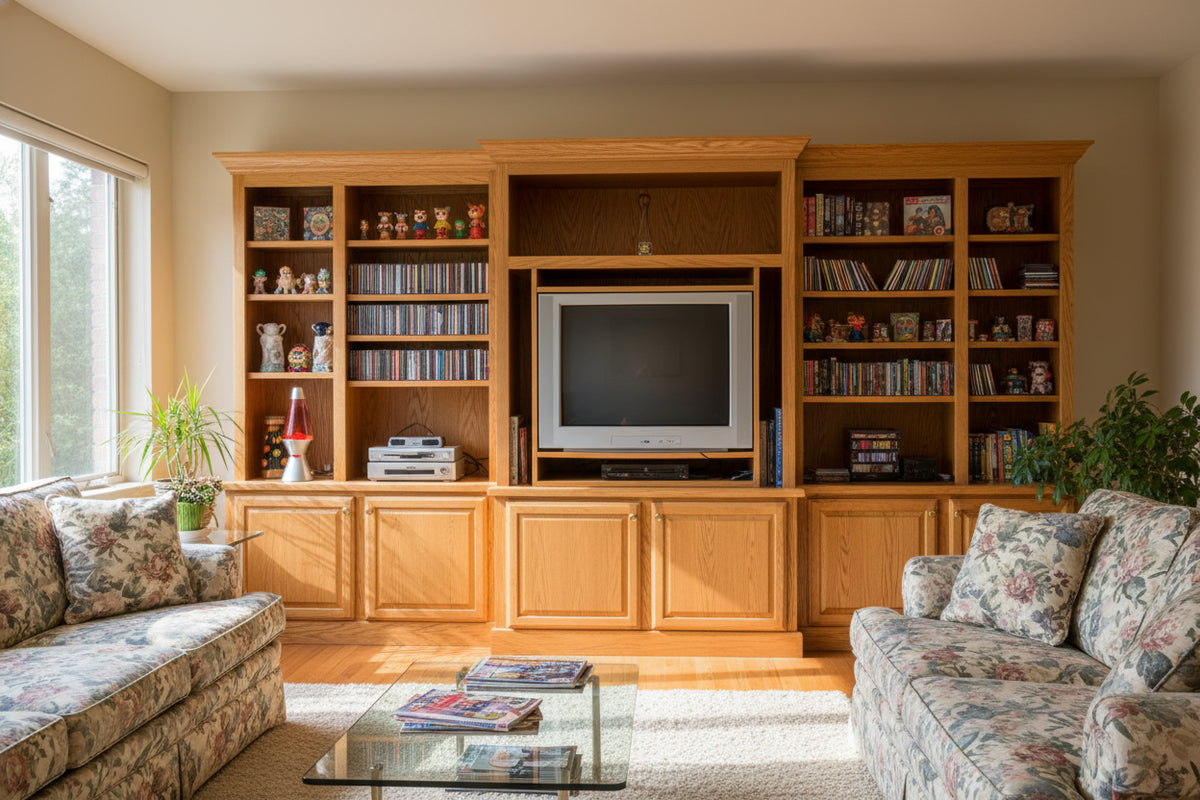
A 90s entertainment center is the large wooden cabinet or wall unit that held a family's TV in the 1990s: a deep box opening for a heavy tube TV, often behind doors that closed over the screen, with shelves and cabinets around it for the VCR, stereo, tapes and CDs. It fell out of use when thin, wide flat-screen TVs replaced tube TVs, because many TV openings built around a tall, deep box are too narrow for today's screens.
So can an old one still hold a modern TV? Sometimes. It comes down to three measurements of the TV opening, compared with the width, height and depth printed on your TV maker's spec page. This guide shows the arithmetic, what to check before buying a used unit, how to update or repurpose one, and five modern alternatives from the FUFU&GAGA entertainment center collection that keep the doors and the storage.
Key takeaways
- Width is usually the limit: measure the opening's width, height and depth and subtract your TV's dimensions with stand from the maker's spec page.
- Leave room for air: TV makers warn against putting a TV in a cabinet without proper ventilation.
- Buying used: check swollen particleboard, the back panel, doors and hinges, and anchor it to the wall.
- Modern equivalents: wall units with piers and a bridge, consoles with glass doors, or a TV lift cabinet.
What was a 90s entertainment center?
A 1990s entertainment center was a piece of living room furniture built around a cathode-ray tube (CRT) TV. Mental Floss describes the typical one as taking up most or all of one wall, going from floor to ceiling, with cabinets and shelves around a centerpiece large enough to fit a TV, and notes that by the '90s VCRs were in almost every household (Mental Floss).
The common features were:
- A deep, boxy TV opening, often with hinged or pocket doors to hide the screen.
- Component shelves for a VCR, cable box or stereo, with holes in the back for wires.
- Media storage for videotapes, cassettes and CDs.
- A multi-piece layout on larger units: a TV section, two side towers (piers) and a bridge across the top.
- Wood tones such as oak, in solid wood or veneer over particleboard.
The TVs themselves explain the shape. In a CPSC staff report on falling TVs, the most common sets in fatal incidents from 2010 to 2012 were 27-inch and 32-inch CRT TVs. The 32-inch CRT TVs CPSC tested weighed between 106 and 163 lb, while the 32-inch flat-screen TV weighed 18.75 lb (CPSC, TVs: Tipping the Scale to Safety, 2015). A box that heavy needed a deep, strong shelf, and the cabinet was built around it.
Why did 90s entertainment centers go out of style?
Flat-screen TVs changed the shape of the TV. The same CPSC report notes that tube sizes had a manufacturing limit, while flat-screen TVs have exceeded the size limits of CRT TVs and keep getting bigger. It also observes that as families bought flat-screen TVs for the main viewing area, the older CRT sets may be moved to other rooms of the home.
The screen shape changed too. Tube TVs had a 4:3 screen; most flat TVs are 16:9. The arithmetic shows why an old opening often feels too narrow:
- A 4:3 screen is 0.8 times its diagonal wide and 0.6 times its diagonal tall. A 32-inch tube screen is about 32 x 0.8 = 25.6 inches wide and 32 x 0.6 = 19.2 inches tall.
- A 16:9 screen of the same 19.2-inch height is 19.2 x 16 / 9 = 34.1 inches wide, about 39 inches diagonal.
Those are screen sizes only; a TV's body is larger. But the trend is clear: a cabinet built for a tall, deep, narrow box now has to hold a thin, wide one.
Can a 90s entertainment center hold a modern TV?
It can if the TV, with its stand, fits inside the opening with air space around it. Compare your own measurements with your TV maker's spec page; the screen size on the box is the diagonal, not the width.
How to measure the TV opening
- Width: measure at the narrowest point, including the face frame, hinges and any door tracks.
- Height: from the TV shelf to the lowest point above it, such as a top rail or light.
- Depth: from the front edge of the shelf to the back panel, or to the closed doors if they must close.
- Pocket doors: measure with them pushed fully back, since their edges may stick into the opening.
Compare with a real TV spec
Here are the dimensions with stand for three TVs, taken from the manufacturer's spec pages. Use your own TV's page for your setup; models of the same size can differ.
| TV (maker's spec page) | Width | Height with stand | Depth with stand | Weight with stand |
|---|---|---|---|---|
| VIZIO 43-inch class V4K43M-0804 | 37.71 in | 24.22 in | 9.38 in | 15.21 lb |
| VIZIO 55-inch class V4K55M-0801 | 48.35 in | 30.50 in | 10.91 in | 28.88 lb |
| VIZIO 65-inch class V4K65M-0804 | 56.92 in | 35.47 in | 12.82 in | 38.13 lb |
Now subtract. Say your tape reads 46 inches wide, 34 inches tall and 22 inches deep (an example, not a standard 90s size):
- 65-inch: 46 - 56.92 = -10.92 inches. It does not fit, by almost 11 inches.
- 55-inch: 46 - 48.35 = -2.35 inches. It does not fit either.
- 43-inch: width 46 - 37.71 = 8.29 inches spare (about 4.1 inches each side), height 34 - 24.22 = 9.78 inches spare, depth 22 - 9.38 = 12.62 inches spare. It fits, with room around it.
Depth is rarely the problem, since an opening built for a tube TV is far deeper than a flat TV's stand, and these flat TVs weigh a fraction of the tube sets. Still check that the shelf is flat and firm, with no sag or cracks.
Leave space for ventilation
A snug fit is not a good fit. VIZIO's user manual says slots and openings in the back and bottom of the TV are for ventilation, must not be blocked, and that you should not place a TV in a bookcase or cabinet unless proper ventilation is provided (VIZIO 4K TV user manual). Keep the doors open while the TV is on, leave the wire holes open, and follow any clearance your TV's manual gives. The manual also says the TV should not overhang the edge of the furniture.
Buying a used 90s entertainment center: what to check
Used units turn up at thrift stores, estate sales and local resale listings. Before you pay, check:
| Check | What to look for | Why it matters |
|---|---|---|
| Opening size | Width, height and depth, measured as above | Confirms your TV fits before you haul it home |
| Weight and pieces | One solid case or separate console, piers and bridge | Large units don't flat-pack; plan helpers, a dolly, a vehicle, and measure your doorways and stairs |
| Particleboard | Swollen or crumbling edges, especially at the base, and peeling veneer | Swelling usually means water damage, and swollen board may not hold screws or hinges |
| Back panel | Thin back board fully attached, not cracked or missing | A loose back lets the case lean and rack |
| Doors and hinges | Doors close flush; pocket doors slide in and out smoothly; no missing hinge screws | Doors that hide the TV and components get used every day |
| Shelves | No sag in the TV shelf or component shelves; shelf pins present | A sagging shelf makes the TV less stable |
| Wire access | Holes or an open back behind the TV | Cables and airflow need a way out |
Tip-over safety for old units
A tall entertainment center should be anchored to the wall, and so should the TV. CPSC's Anchor It guidance says TVs should only be placed on furniture designed to hold a television, such as TV stands or media centers; that TVs that are not wall mounted should still be anchored to the wall; that existing furniture can be anchored with inexpensive anti-tip brackets; and to recycle older CRT televisions (CPSC Anchor It).
CRT sets matter here. CPSC's report explains that CRT TVs are heavier toward the front because of the tube, which makes them prone to falling forward if tilted. If the old unit comes with its old tube TV, CPSC advises placing a large, heavy CRT TV on a low, stable piece of furniture, or recycling it if you no longer use it. VIZIO's manual adds: never place a TV on tall furniture without anchoring both the furniture and the TV to a suitable support, and never put toys or remotes on top that might tempt children to climb.
An old unit won't come with anti-tip hardware, so buy a bracket or strap kit. Our guide on how to anchor a bookcase to the wall covers studs and straps; a tall pier is anchored the same way.
How to update or repurpose a 90s entertainment center
If the TV fits, a few plain updates can make an old unit look current:
- Change the finish. Orange-toned honey oak is the finish that most often looks dated. Clean, scuff-sand and prime before painting; go gently on veneer, which is thin. Follow the product labels and work in a ventilated space.
- Swap the hardware. Measure the old pulls' hole spacing so new ones cover the holes.
- Split a multi-piece unit. Take off the bridge and use the piers as bookcases beside a new TV stand. Anchor each tall piece.
- Remove doors that block the screen or airflow, and keep the hinges and screws in a labeled bag.
- Line the shelf backs with paint or peel-and-stick paper.
Avoid cutting the face frame or the center partitions to widen the TV opening. Those parts hold the case square and support the shelves above, and cutting them can weaken the whole unit.
If the TV doesn't fit, the cabinet still works as a pantry or bar cabinet, toy and game storage, a craft cabinet or a bookcase. Keep it anchored wherever it goes.
Modern equivalents that keep the doors and storage
The 90s idea of a storage wall with doors that hide the clutter comes in three modern forms. Our entertainment center and wall unit buying guide goes deeper on sizing a wall unit.
| Type | What it keeps from the 90s | What changes |
|---|---|---|
| Wall unit with piers and a bridge | The whole-wall look, side towers, top shelf, cabinets with doors | An open, wide center for a flat TV instead of a deep box |
| Long console with glass doors | Closed and glass-front storage for media and games | Low and wide, with the TV on top or on the wall above |
| TV lift cabinet | The TV disappears when it's off, like doors closing over the screen | A motorized lift instead of doors; needs a power outlet |
Whichever you choose, check the listed maximum TV size and weight capacity; if a listing gives only one, ask before you order.
Our picks: modern 90s-style entertainment centers
Five FUFU&GAGA pieces with 90s-style storage, sized for flat TVs. Sizes and limits come from the listings.

102.4" TV Hutch Large Entertainment Center with Storage Cabinets
The closest thing to a classic 90s wall unit: a four-piece set with a 57-inch console, two tall piers and an overhead bridge. Its specs give 82.3" H x 104.3" W x 17.4" D overall (the title says 102.4", so plan for the larger figure). The console holds TVs up to 55 inches; the 55-inch VIZIO above is 48.35 inches wide, which leaves 57 - 48.35 = 8.65 inches of console to spare. Storage is 5 drawers on metal slides, 5 cabinets with magnetic catches and 6 interior shelves, with cable management, an 800 lb total weight capacity and tipover restraint hardware included. The listing says the pieces can also be used separately.
Best for: a full wall of storage around a TV of 55 inches or less, with room for books and display pieces.
Skip it if: your TV is larger than 55 inches or might be soon, or your wall is narrower than 104.3 inches. It weighs 301.62 lb and four people are recommended for assembly.
102" TV Bench Large Entertainment Center with 4 Doors
The same wall-unit idea for a larger screen. The listing describes a 102-inch-wide set made of a 68-inch TV console, two bookcase piers and an overhead bridge, and says the console fits most 65-inch TVs. The 65-inch VIZIO above is 56.92 inches wide, leaving 68 - 56.92 = 11.08 inches of console. Behind its 4 cabinet doors are 8 adjustable interior shelves, and the open middle shelf adjusts for a large media player. Weight capacity is 360 lb, a tipover restraint is included, and it comes in white, black or gray.
Best for: a 65-inch TV with closed storage for components and open shelves for books.
Skip it if: you need the overall height and depth before you order: the listing gives only the 102-inch width and the 68-inch console, so ask for the rest. It weighs 253.44 lb and three people are recommended for assembly.

101.7" Farmhouse White Entertainment Center with Arched Glass Doors
A one-piece unit with a built-in look, 85" H x 101.7" W x 16" D. A large open center holds the TV, arched glass-door display cabinets with fixed glass shelves sit on each side, and six drawers plus two wood-door cabinets run along the base. The listing describes adjustable LED lighting for the display area and says anti-tip hardware (a safety strap) is included.
Best for: a farmhouse or traditional living room where you want glass-door display storage around the TV.
Skip it if: you need a stated TV size or weight limit: the listing gives neither, so measure your TV against the opening and ask before you buy. It weighs 336.5 lb.

90.6" Modern Farmhouse TV Stand with Glass Doors and 10 Storage Compartments
A lower take on the 90s media cabinet: 31.4" H x 90.6" W x 19.7" D, listed for TVs up to 88 inches. Ten storage spaces include three cabinets, four small drawers on metal slides and a central glass-door cabinet for components. Two adjustable shelves move in 1.25-inch steps, cable openings sit in the upper and lower center sections, and a tipover restraint is included.
Best for: a large TV on its own stand with closed and glass-front storage underneath.
Skip it if: you have a large, heavy TV. The weight capacity in its specs looks low for an 88-inch screen, so check your TV's weight against it with customer service before you order. It weighs 212 lb.
50.4" Lifting TV Stand with Electric Vertical Lift
The modern answer to doors that closed over the TV: a remote-controlled lift raises a TV of up to 50 inches out of the cabinet, to between 28.7 and 68 inches high, and lowers it out of sight when you're done. It measures 50.4" W x 15.7" D x 39.3" H, has four memory settings, two closed cabinets and side cable ports, and the listing says it is finished on both sides. An integrated TV mount and a TV anti-tip kit are included. Our TV lift cabinet buying guide covers placement and lift types.
Best for: a bedroom or a living room where you want the screen hidden when it's off.
Skip it if: your TV is larger than 50 inches. The listing gives no TV weight limit, it says no tipover restraint is included for the cabinet itself, and the lift needs a power outlet.
Compare the picks
| Pick | Size (W x D x H) | Max TV size | Weight capacity | Doors | Best for |
|---|---|---|---|---|---|
| 102.4" TV hutch | 104.3 x 17.4 x 82.3 in (specs) | 55 in | 800 lb total | Cabinets with doors, drawers | Full storage wall, 55-inch TV |
| 102" TV bench, 4 doors | 102 in wide; console 68 in | 65 in | 360 lb | 4 cabinet doors | 65-inch TV with piers |
| 101.7" farmhouse | 101.7 x 16 x 85 in | Not listed | Not listed | Arched glass sides, wood base doors | Glass display around the TV |
| 90.6" farmhouse stand | 90.6 x 19.7 x 31.4 in | 88 in | Confirm before ordering | Glass center, wood sides | Large TV, low cabinet |
| 50.4" lift cabinet | 50.4 x 15.7 x 39.3 in | 50 in | Not listed | Two cabinet doors; TV lifts out | Hidden TV |
FAQ
Will a 65-inch TV fit in an old 90s entertainment center?
Only if the opening is wider than the TV with room for air. The VIZIO 65-inch class TV in the table above is 56.92 inches wide. Measure the opening at its narrowest point and subtract the width on your TV's spec page. If the result is negative, or leaves no air space, use the side pieces as bookcases and put the TV on a new stand or the wall.
Are 90s entertainment centers worth buying used?
They can be, if the opening fits your TV, the particleboard isn't swollen, the back is firmly attached and the doors work. Plan the move, and add an anti-tip kit, since an old unit won't include one.
What can I do with an old entertainment center?
Paint it and change the hardware, split a multi-piece unit into bookcases, or reuse it as a pantry, bar, toy or craft cabinet. Don't cut the frame to widen the opening, and anchor it.
Want the storage of a 90s unit with room for a flat TV? Browse wall units, consoles and lift cabinets in the FUFU&GAGA entertainment center collection, and measure your wall and TV with the steps above before you choose.


Dejar un comentario
Este sitio está protegido por hCaptcha y se aplican la Política de privacidad de hCaptcha y los Términos del servicio.