


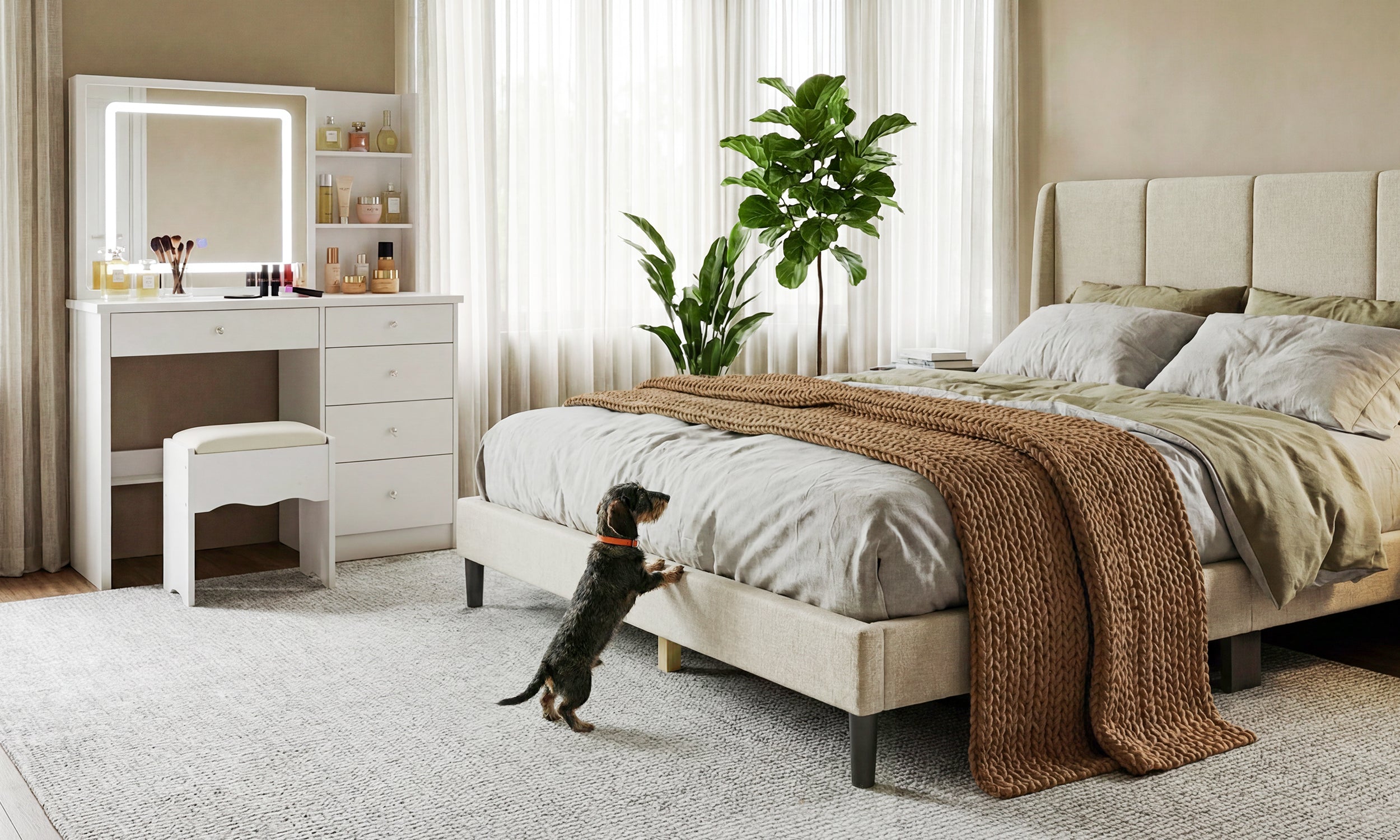
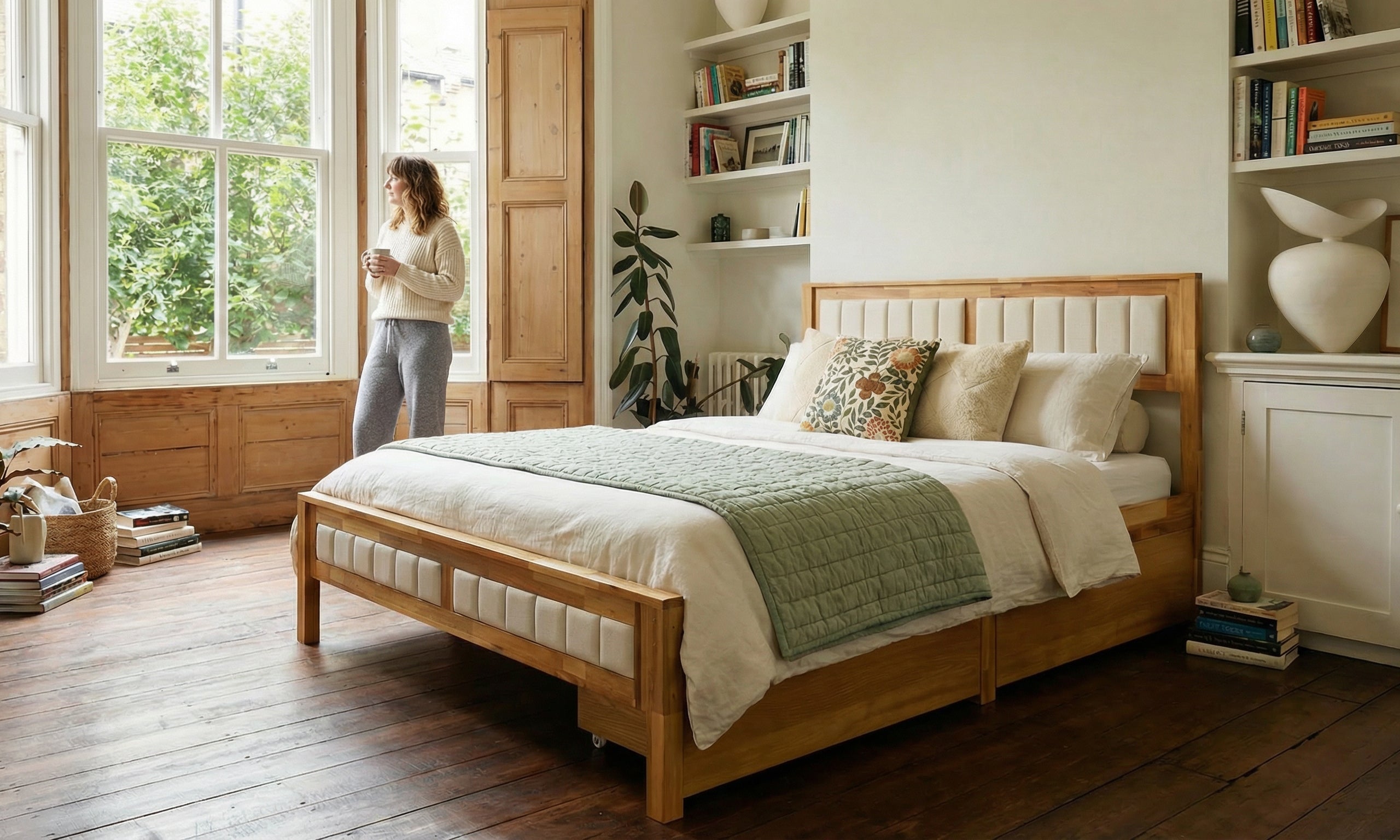



A bookcase headboard is a headboard with built-in shelves, cubbies or small doors, so the wall behind your bed holds books, a lamp, a phone and glasses instead of a nightstand doing all the work. Before you buy one, check five things: that it matches your bed size and frame, how deep the shelves are compared with what you will keep there, how high the shelves sit above the mattress, how any lights or outlets are powered, and how the piece is secured so it cannot tip.
This guide walks through each of those with real mattress sizes and plain arithmetic, covers lights and cords, and ends with a twin storage bed from the FUFU&GAGA beds with storage collection that has a bookcase headboard built in.
Key takeaways
- Size: match the headboard to the mattress size and to the frame it will attach to. A queen mattress is 60 x 80 inches, a full 53 x 75 and a twin 38 x 75.
- Depth: every inch of shelf depth moves the bed an inch further from the wall, so buy the depth your items need, not the deepest you can find.
- Height: sit up in bed and measure. The lowest shelf should clear your head when you lean back to read.
- Power: lights and outlets mean cords behind the bed. Keep them unpinched, off the floor path and out from under the frame.
- Safety: anchor tall or freestanding shelving to the wall, keep heavy and breakable things low, and keep nothing on the top shelf that could fall on a sleeping head.
What is a bookcase headboard?
A bookcase headboard is a headboard built like a short, wide bookcase: a panel or cabinet at the head of the bed with open shelves, cubbies, and sometimes flip-up doors or small cabinets. People also call it a storage headboard or a headboard with shelves. Some versions add LED lighting along the shelves or a power strip for charging a phone, which is where the search term "headboard with lights" comes from.
They come in three common forms, and the form decides how it fits your bed and how it is secured:
| Type | How it is held up | What to check |
|---|---|---|
| Headboard only, frame-mounted | Bolts to the head of an existing bed frame | Bed size on the listing, whether your frame has headboard bolt holes, legs or a base |
| Headboard only, freestanding | Stands on its own legs or base behind the bed | Overall height, depth and weight, wall anchoring |
| Bed with a built-in bookcase headboard | Part of the bed itself | Mattress size, slats or box spring, under-bed storage, whether the headboard is optional |
A bookcase headboard replaces some of what a nightstand does, but not all of it. Shelves behind the bed are good for things you reach for at night; a nightstand still wins for a drink, because you are not reaching over your head to set it down.
What size bookcase headboard do you need?
Start with the mattress. The Better Sleep Council, which is sponsored by the International Sleep Products Association, lists these standard mattress sizes (Better Sleep Council):
| Mattress size | Width x length | What it means for the headboard |
|---|---|---|
| Twin | 38 x 75 inches | Twin headboards and twin storage beds |
| Twin XL | 38 x 80 inches | Same width as a twin; check the frame, not just the headboard |
| Full | 53 x 75 inches | Often sold as a "full/queen" headboard |
| Queen | 60 x 80 inches | Queen or full/queen headboards |
| King | 76 x 80 inches | Needs a king-labeled headboard |
A headboard is often listed wider than the mattress, so always read its own width. A headboard labeled "full/queen" has to span both widths: a queen mattress is 7 inches wider than a full (60 minus 53), so on a full bed the headboard will overhang more on each side. That is normal, but it matters if the bed sits between two nightstands or in an alcove: measure the space between them and compare it with the headboard's listed width, not the mattress width.
For a "queen bookcase headboard," the check is the same: confirm the listing says queen (or full/queen), then read the overall width, height and depth on the dimension drawing and hold a tape measure against your wall.
Will it fit my bed frame?
Bed size is only half the match. A headboard that bolts to a frame needs bolt holes or brackets at the head of the frame, in the right place. Before you order a headboard-only piece, look at your frame:
- Bolt holes or headboard brackets: if your frame has none, choose a headboard the listing describes as freestanding or one with its own legs, rather than drilling the frame.
- Adjustable bases: a power base moves the mattress, so only buy a headboard the listing says is compatible with adjustable bases, and leave room for the head of the mattress to rise without hitting the shelves.
- Platform beds: many platform beds have no headboard brackets. A bed with the bookcase headboard already built in avoids the question entirely.
- Height of the frame and mattress: a tall mattress on a tall frame hides more of the headboard. If the shelves start low, a thick mattress can cover the bottom row.
How deep should headboard shelves be?
There is no single standard depth for headboard shelves, so size it to what you will put there. Before you shop, gather what you want behind the bed (a paperback, a hardcover, your glasses case, phone, a small lamp or clock) and measure the deepest one. The shelf needs that depth plus a little room so nothing hangs over the edge.
Depth also costs floor space. A bookcase headboard sits between the wall and the mattress, so the bed's footprint grows by the headboard's depth. As an example, a headboard 12 inches deep behind an 80-inch queen mattress means the bed now reaches at least 92 inches (80 plus 12) from the wall, before you count any gap at the foot of the frame. In a small bedroom, check that this still leaves a walkway at the foot of the bed and room to open dresser or closet doors.
Shallow shelves are not a flaw. For phones, glasses and paperbacks, a shallow shelf keeps the bed closer to the wall; deep shelves suit hardcovers, baskets and a lamp base.
How high should the shelves sit above the mattress?
The right height depends on your mattress, your frame and how you sit in bed, so measure rather than guess:
- Make the bed with your real mattress and pillows.
- Sit up against the wall or the current headboard the way you read or use your phone.
- Have someone measure from the top of the mattress to a few inches above the top of your head.
The lowest shelf edge should sit above that mark, or you will hit it every time you lean back. Then check the reverse: the highest shelf you use daily should still be within reach when you are sitting up, without kneeling on the bed. If you also want a nightstand, our nightstand height guide covers matching its top to the mattress.
What should go on the shelves, and what should not?
Anything on a headboard shelf is above someone's head all night, so load it with that in mind:
- Good: paperbacks, a phone, glasses, a small clock, a light basket of things you use in bed.
- Keep lower or elsewhere: heavy hardcover stacks, glass and ceramic decor, framed photos in glass, candles, and drinks.
- Top surface: keep it light and stable. A bump against the bed should not be able to tip anything off the top.
The same rule helps the furniture stay put. The CPSC's Anchor It campaign advises placing "heavy items towards the bottom" of storage furniture and anchoring it to the wall (Anchor It checklist).
Headboard with lights: LEDs, outlets and cords
Lights and charging make a storage headboard more useful at night, but they also put cords and plugs right behind your pillows, so plan the power before the bed goes against the wall.
Read the listing for exactly what is included. Note whether the lights are an LED strip, how they are switched (button, remote or app), whether there is a built-in power strip or USB port, and how the whole thing connects to the wall. Count on nothing the listing does not state.
Keep cords from being pinched. A headboard and bed frame pushed tight to the wall can trap a cord. The U.S. Fire Administration advises: "Avoid putting cords where they can be damaged or pinched, like under a carpet or rug" (U.S. Fire Administration). The CPSC adds: "Do not run extension cords under carpets, through doorways or under furniture" (CPSC, Household Extension Cords Can Cause Fires). Route the cord along the wall to the outlet, not under the bed.
Do not overload the strip. The U.S. Fire Administration says "Do not overload power strips" and "Use power strips that have internal overload protection." A built-in strip on a headboard is for phones, a clock and a small lamp, not a space heater or anything else that draws heavy current.
Treat heat as a warning. The CPSC notes that "If any part of the extension cord is hot while in use, it is a warning sign that it may be overloaded," and that extension cords should only be used temporarily. If a cord, plug or strip behind the bed feels hot, unplug it and fix the cause. Keep pillows and blankets from bunching over plugs and the power strip, and keep phones charging on the shelf, not under the pillow.
Look for a testing-lab mark. The CPSC tells consumers to check that cords "have been listed by a recognized national testing laboratory," naming UL, Intertek (ETL) and CSA.
For a side-by-side look at charging furniture next to the bed, see our nightstand with charging station guide.
Does a bookcase headboard need to be anchored to the wall?
A headboard with shelves is still a piece of furniture with shelves, and the CPSC's Anchor It campaign is direct about those: "Anchoring all furniture with drawers, doors, and shelves to the wall prevents tip-over injuries and deaths" (Anchor It, CPSC).
How that applies depends on the type:
- Freestanding headboard: it stands on its own legs or base and can tip forward onto the bed. Anchor it to the wall with the hardware the manual specifies, or a furniture anchoring kit, before you load the shelves.
- Frame-mounted headboard: bolted to the bed, it is steadier, but follow the manual on any wall strap it provides, and recheck the bolts when you move the bed.
- Bed with a built-in headboard: follow the manual for how the headboard is fixed to the bed. If the instructions include a wall strap, install it.
The Anchor It checklist also says to make an anchoring kit "part of your purchase and install it right away," and to keep tempting items low, "otherwise kids may climb on shelves to grab them." Our step-by-step guide to anchoring a bookcase to the wall covers finding studs and fitting straps; the same method works for a freestanding bookcase headboard.
Bookcase headboards in kids' rooms
A bookcase headboard is a popular choice for a child's bed because it keeps bedtime books in reach. In a kids' room, three habits matter most: anchor anything that can tip, keep toys and treats off the upper shelves so there is no reason to climb, and keep cords and power strips out of reach where you can. Our kids dresser guide explains how to anchor bedroom storage in a child's room; the same steps apply to a freestanding headboard.
Buying checklist
- Bed size: the listing names your mattress size (twin, full, queen or king), or "full/queen" if you have either.
- Frame match: your frame has headboard bolt holes, or the headboard is freestanding, or the headboard is part of the bed.
- Width: the headboard's listed width fits between nightstands, windows or an alcove, measured on your wall.
- Depth: the shelves fit your deepest item, and the bed's new length (mattress plus headboard depth) still leaves a walkway.
- Height: the lowest shelf clears your head when you sit up in bed; the shelves you use daily are reachable.
- Lights and outlets: you know what is included, how it switches and how it plugs in, and the cord reaches an outlet without running under the bed.
- Anchoring: you have the wall hardware the manual calls for, or a kit, ready on day one.
- Assembly: you have the tools and the second person the instructions call for. Our flat-pack assembly guide covers the basics.
Our pick: a twin storage bed with a bookcase headboard
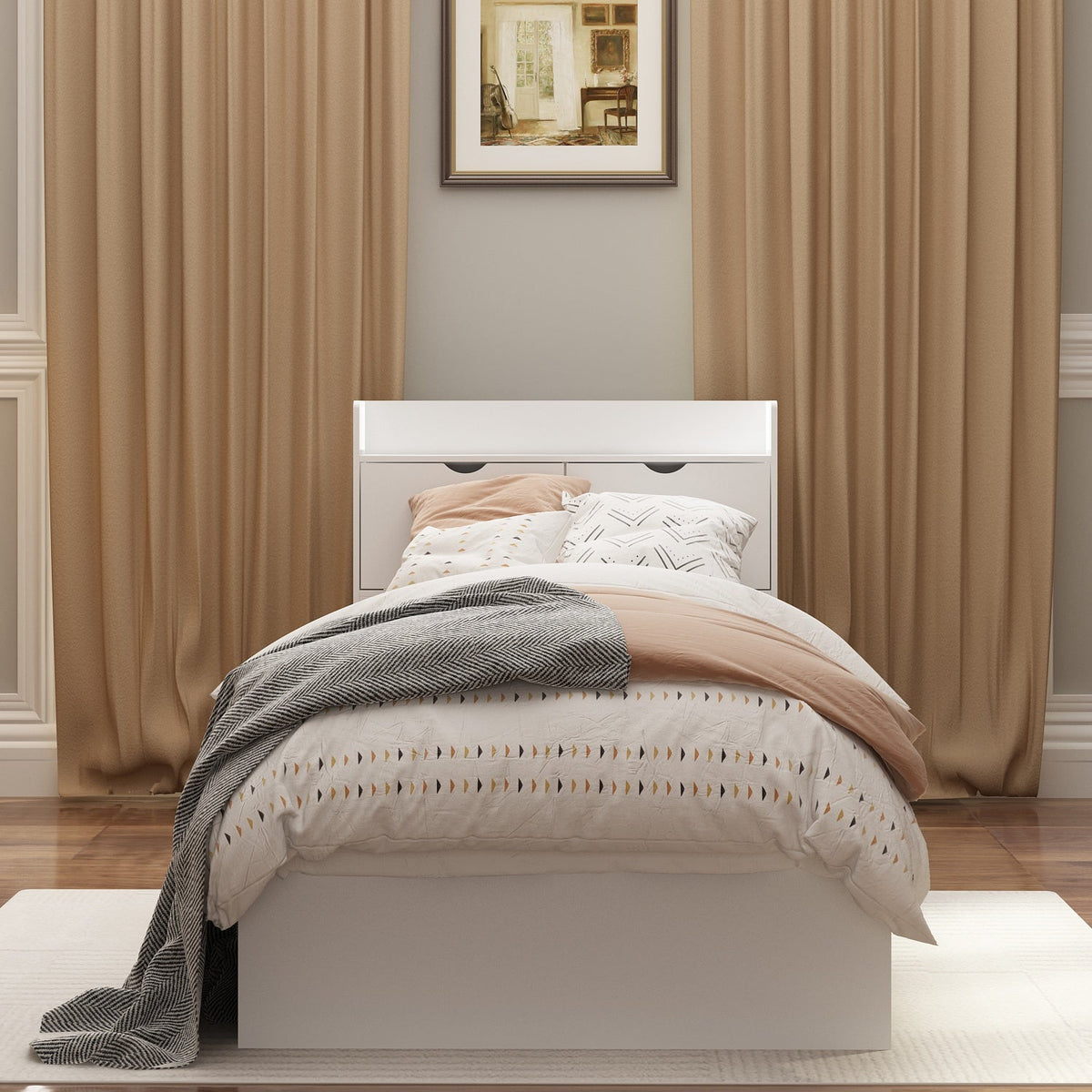
For a twin, the simplest way to get a bookcase headboard is a bed that has one built in, so there is no frame to match. This FUFU&GAGA bed adds drawer storage under the mattress as well.
40.9" Modern Minimalist White Twin Platform Storage Bed with Storage Headboard

A white engineered wood twin platform bed with a bookcase headboard that has an open shelf plus flip-door storage, for books, a lamp or bedtime essentials. Drawers run along one side of the bed on wheels and metal slides with built-in safety stops, so the other side can sit against a wall. Solid wood slats support the mattress, so no box spring or foundation is needed. The headboard is optional: the bed can be set up with or without it.
- Size: twin, 40.9" wide.
- Headboard: bookcase style, open shelf plus flip-door storage.
- Under-bed storage: drawers along one side, on wheels, with metal slides and safety stops.
- Mattress support: solid wood slats, no box spring needed; mattress not included.
- Lights and outlets: none listed.
- Setup: detailed instructions included; the guide is in the User Manual tab.

Best for: a kids' room, guest room or small bedroom where one twin bed has to replace a nightstand and part of a dresser.
Skip it if: you need a full or queen bed, want built-in lights or charging (none are listed), or have no clear floor on the drawer side. The listing gives only the width, so check the length, height and shelf depth in the User Manual tab before you plan the room.
| Pick | Bed size | Headboard storage | Other storage | Lights / outlets | Best for |
|---|---|---|---|---|---|
| 40.9" white twin platform storage bed | Twin, 40.9" wide | Open shelf plus flip-door storage | Drawers along one side | None listed | Kids' rooms, guest rooms, small bedrooms |
Looking for a full or queen? Use the checklist above on any headboard in the beds with storage collection: confirm the bed size, frame fit, shelf depth and how it is anchored before you order.
FAQ
Are bookcase headboards worth it?
They are worth it when wall space beside the bed is tight or you want books, a phone and glasses within reach without a large nightstand. They are less useful if your bed sits under a window, if you need the bed close to the wall, or if you would only store heavy or breakable items there.
Can you put a bookcase headboard on any bed frame?
No. A frame-mounted headboard needs headboard bolt holes or brackets on a frame of the same size. If your frame has none, choose a freestanding headboard that is anchored to the wall, or a bed with the headboard built in. Check adjustable-base compatibility on the listing if you have a power base.
How deep is a bookcase headboard?
It varies by model, so read the depth on the listing. Size it to your deepest item, then add the depth to the mattress length to see how far the bed will reach into the room.
Is it safe to have shelves above your bed?
It can be, if the piece is secured and loaded sensibly. Anchor freestanding shelving to the wall, keep heavy and breakable things low or elsewhere, keep the top surface light, and keep cords and power strips unpinched and uncovered.
Do headboards with lights need an outlet?
Plug-in lights and power strips do. Check the listing for the power source, then plan the cord route along the wall to the nearest outlet without running it under the bed or the rug.

Dejar un comentario
Este sitio está protegido por hCaptcha y se aplican la Política de privacidad de hCaptcha y los Términos del servicio.