










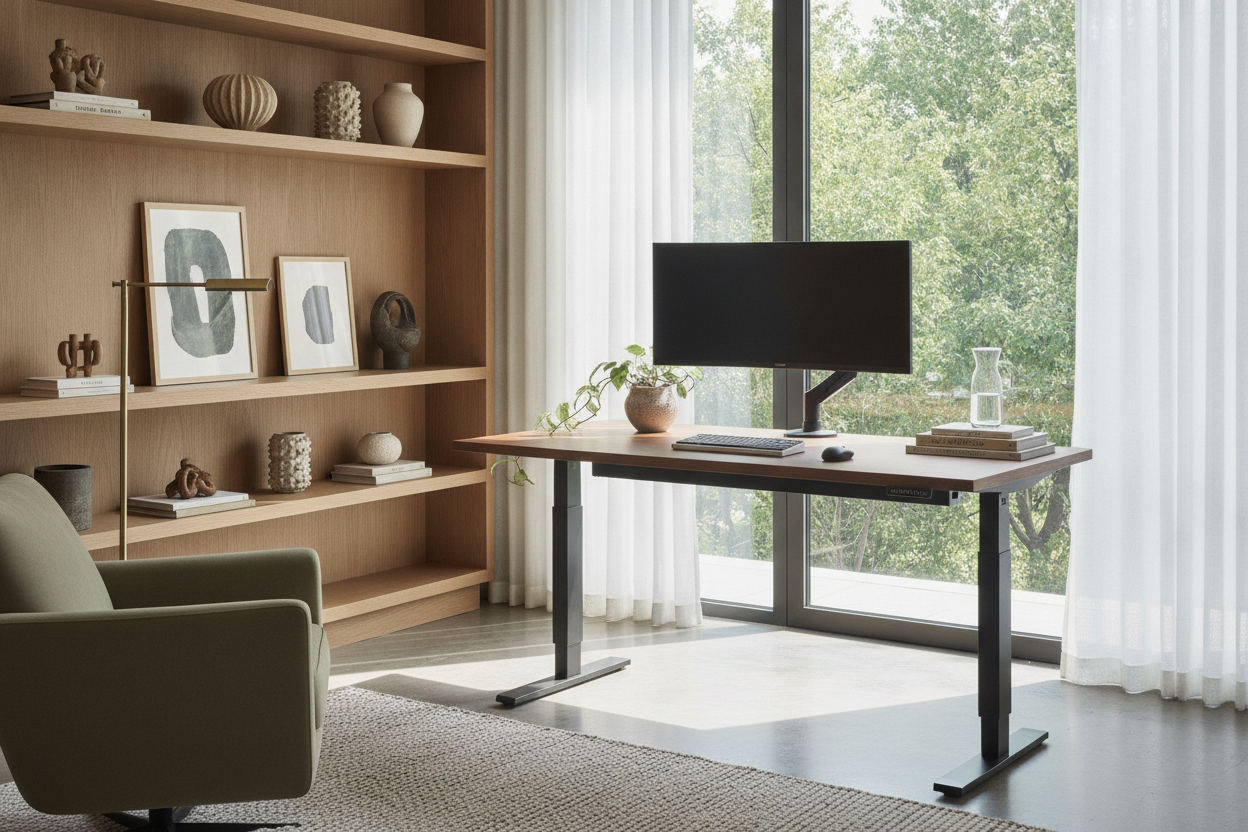
I spent three months hunting for a desk that wouldn't make my bedroom look like a WeWork basement. I finally realized that finding a decent adjustable standing height desk is like trying to find a comfortable pair of heels—most of them are ugly, and the pretty ones usually lack support. You want to save your spine, but you also don't want your home to look like a sterile tech startup.
- Swap the cheap laminate top for a solid wood slab.
- Use a desktop converter to keep your existing antique furniture.
- Place your desk against a gallery wall to hide the mechanical legs.
- Invest in a model with hidden motors and integrated cable management.
The 'Corporate Spaceship' Dilemma
The struggle is real. You’ve spent years curating a home that feels like you—warm textiles, curated art, and maybe a vintage rug. Then you realize your back is killing you and you need an office desk for standing. Suddenly, you’re looking at these massive, T-shaped metal monsters that look like they belong in a medical lab.
It’s hard to make a motorized frame feel cozy. Most standing height desks are designed for utility first, aesthetics second. They usually come in two flavors: 'Industrial Gray' or 'Laminate White,' neither of which screams high-end interior design. But you don't have to surrender your style just to get some blood flow back into your legs.
Why Most Sit or Stand Desks Ruin Your Room's Vibe
The problem usually starts with the legs. Most sit or stand desks use heavy-duty steel legs that are far wider than they need to be for a residential setting. They look bulky and clunky. Then there’s the top—usually a 1-inch thick piece of particle board with a fake wood grain that fools absolutely no one.
Exposed motors and dangling power bricks are the final nail in the coffin. Nothing kills a room's vibe faster than a 'black spaghetti' mess of cables hanging under a height adjustable desk sit stand setup. If your office table stand is sitting in the corner of your living room, those mechanical guts are the first thing guests see. It’s a design hurdle, but it isn’t insurmountable.
3 Ways to Disguise an Adjustable Standing Height Desk
You don't have to settle for the out-of-the-box look. With a little bit of effort, you can make these ergonomic tools look like they were custom-made for your home. Here is how I’ve managed to blend technology with traditional decor.
1. Hack It With a Vintage or Solid Wood Top
The best thing I ever did was buy a high-quality motorized frame separately and ditch the included top. I went to a local lumber yard and found a beautiful piece of kiln-dried walnut. By attaching a real wood top to the frame, you turn a corporate piece of equipment into a custom stand work table.
Real wood has a weight and texture that laminate can't touch. Even a simple 1.5-inch thick butcher block from a hardware store looks 100 times more expensive than the standard tops sold by most brands. It adds warmth to the room and makes the metal legs feel like an intentional industrial choice rather than a compromise.
2. Keep Your Antique Table and Fake It Instead
If you have a desk you already love—maybe a mid-century teak piece or a heavy oak writing desk—don't toss it. You can get the ergonomic benefits by using an adjustable table stand that sits right on top of your current furniture. This way, the 'mechanical' part of your office is only visible when you're actually working.
Choosing the best desk stand allows you to maintain the character of your room. When the workday is over, some of these converters fold down so flat they almost disappear. It’s the perfect compromise for someone who refuses to let a motorized base dictate their room's floor plan.
3. The 'Gallery Wall' Distraction Trick
Visual weight is everything in interior design. If your desk legs look too clinical, draw the eye upward. I recommend hanging a dense gallery wall directly behind your desk. Use a mix of 8x10 and 18x24 frames to create a vertical focal point that competes with the desk's silhouette.
When the eye is busy looking at art and clever lighting, the base of your height adjustable desk sit stand setup recedes into the background. Use a floor lamp with a warm bulb nearby to cast shadows that soften the harsh lines of the metal frame. It’s all about misdirection.
My Favorite Pre-Made Options That Don't Look Terrible
If you aren't the DIY type, there are finally some brands catching on to the fact that we want our furniture to look like furniture. Look for frames that offer 'tapered' legs instead of the standard thick rectangles. Some newer models even feature wood-veneer leg wraps to hide the steel entirely.
The Ergonomic Home Office Sit Stand Up Desk is one of the few I've seen that actually handles cable management gracefully. It has a built-in tray that hides the power brick and those ugly motor wires. When the desk is at its lowest setting, it looks just like a standard modern writing desk, which is the ultimate goal.
Personal Experience: The Wobbly Mistake
I once bought a cheap $200 standing desk from a big-box retailer because I loved the price. Big mistake. The motor sounded like a dying blender, and at full height, the whole thing wobbled so much my monitor looked like it was in an earthquake every time I typed. I eventually sold it for $50 and invested in a frame with a dual-motor system and a 300-lb weight capacity. Trust me: spend the extra money on a stable base, or you'll regret it every time you stand up.
FAQ
Do standing desks wobble at high heights?
Cheaper single-motor desks definitely do. If you're tall, look for a dual-motor frame with a crossbar or heavy-duty steel columns. A 1.5-inch thick top also helps add enough weight to keep things grounded.
How do I hide the cables?
Under-desk cable trays are your best friend. Use 'J-channel' raceways to guide wires down one of the legs, and use a power strip that mounts directly to the underside of the desk so only one cord ever has to reach the wall.
Can I use any tabletop with a standing frame?
Mostly, yes. Just ensure the screws aren't longer than the thickness of your wood and that the top doesn't exceed the frame's weight limit. Most frames can handle 200-300 lbs easily.


Dejar un comentario
Este sitio está protegido por hCaptcha y se aplican la Política de privacidad de hCaptcha y los Términos del servicio.