





A good cat feeding station sits in a quiet, low-traffic spot your cat can reach easily, well away from the litter box, with the water bowl in a separate place from the food. Feline vets' environmental guidelines say food, water and toileting areas should each have their own location, that every cat in the home should have its own feeding station, and that each cat should have at least two feeding areas to choose from.
This guide covers where to put cat food and water bowls, stations for more than one cat, bowls, keeping dogs and toddlers out, cleaning, and furniture from the FUFU&GAGA cat furniture collection that hides the station and the litter box.
Key takeaways
- Quiet, private and easy to reach: away from busy hallways, cat flaps and glass patio doors.
- Food, water and litter in three different places: food and water separated from each other, and ample space between the litter area and both.
- One station per cat, and at least two feeding areas: separate eating spots prevent the stress of feeding competition.
- Wide, shallow, non-plastic bowls suit many cats, especially those that dislike their whiskers touching the sides.
- Wash food bowls after every use and water bowls daily, and store dry food in its original bag in a cool, dry place.
What is a cat feeding station?
A cat feeding station is a fixed, dedicated place where your cat eats: bowls on a mat, a raised stand, a wall shelf, or furniture with a pull-out feeding tray. A good one gives your cat a calm place to eat, keeps food out of reach of other pets and small children, and keeps food and supplies together so the daily routine is quick. Cat feeding station furniture hides all of this behind cabinet doors, but decide where the station goes first: placement matters more to your cat than the furniture does.
Where to put cat food bowls
The AAFP and ISFM Feline Environmental Needs Guidelines, written by feline veterinarians and behaviour specialists, list food, water, toileting, scratching, play and resting areas as the key resources every cat needs. Each should be placed in its own location, separate from the others, and each cat should have a choice, for example a minimum of two feeding areas (AAFP and ISFM Feline Environmental Needs Guidelines). VCA Animal Hospitals sums up the same guidelines for owners and adds that the food bowl should not be near the litter box (VCA Animal Hospitals).
Cats Protection, the UK feline welfare charity, advises placing food and water bowls in more private but accessible locations, away from the cat flap, glass patio doors and high-traffic areas such as hallways (Cats Protection). Many cats also like to eat with a wall behind them and the room in front, so try pulling the bowls a little away from the wall and let your cat choose which way to face.
Good spots include a quiet corner of the kitchen or dining room away from where people walk and cook, a spare room or home office, or a side of the living room away from the TV and the front door. Avoid the litter box area, busy hallways, the door your cat uses to go out, and anywhere a dog, another cat or a toddler can corner your cat while it eats.
Should cat food and water be next to each other?
Usually not. The AAFP and ISFM guidelines state that food and water resources should be separated from each other. Cats Protection explains the instinct: cats prefer to drink away from their food, which in the wild avoids contaminating a water source with the gut contents of their prey.
VCA's advice on getting cats to drink more points the same way: keep water away from the litter box, offer more than one water bowl in different places, and try a quiet area or a spot near your cat's bed (VCA Animal Hospitals). A practical setup is food at the station, a water bowl a few steps away, and another water bowl in a different room.
How far should food be from the litter box?
None of the veterinary or welfare sources we checked gives a distance in feet. The AAFP and ISFM guidelines say ample physical separation should be kept between toileting areas and other resources. The clearest way to meet that is a different room, or at least the far side of a large room with furniture in between.
The rule applies to combination furniture too. If one cabinet has a litter compartment and a food tray, use it for one job and put the other in another room. Our litter box furniture buying guide covers sizing and ventilating a litter enclosure, so this guide does not repeat it.
| Resource | Where it goes | Keep it away from |
|---|---|---|
| Food | Quiet, private, easy to reach; one station per cat | Litter box, busy hallways, cat flap and patio doors |
| Water | Its own spot, plus more than one bowl around the home | Food bowls and the litter box |
| Litter box | Quiet, accessible location | Food and water (ample separation) |
| Food storage | Cool, dry cabinet, food in its original bag | Heat, damp and pets that can open doors |
Feeding stations in a multi-cat home
Cats hunt alone, and competing for food is a source of stress. The AAFP and ISFM guidelines say every cat within a household should have its own separate feeding station, and that individual eating locations give the privacy needed to prevent the stress of feeding competition. If your cats form separate social groups, each group should have physically separate resources.
The arithmetic is simple: each cat needs its own station, and even a single cat should have at least two feeding areas, so the minimum is two stations or one per cat, whichever is higher.
| Cats | Feeding stations (minimum) | How to place them |
|---|---|---|
| 1 | 2 | A main station plus a second spot, such as a puzzle feeder in another room |
| 2 | 2 | One per cat, in different rooms or out of sight of each other |
| 3 | 3 | One per cat; a raised station suits a cat that likes height |
| 4 | 4 | One per cat, spread across at least two rooms |
Plan water the same way, in several places away from the food. VCA also suggests offering a variety of bowl types when you have several cats, since their preferences may differ.
What kind of bowl is best for a cat feeding station?
- Wide and shallow: Cats Protection says cats generally prefer a wide, shallow bowl so their whiskers do not touch the sides, especially diabetic cats, which can have extra-sensitive whiskers.
- Water filled to the top: VCA notes that some cats dislike their whiskers touching the edge of the water bowl.
- Material: VCA says cats generally prefer glass, metal or ceramic water bowls over plastic, and Cats Protection suggests trying ceramic if plastic seems to put your cat off.
- Fountains: a filtered fountain keeps water moving and fresh; VCA says to clean the filter weekly or as directed.
- Puzzle feeders: the AAFP and ISFM guidelines suggest puzzle feeders, hiding food in several places and timed feeders that promote small, frequent meals.
Raised bowls are a comfort choice rather than a rule: none of the veterinary or welfare pages we used recommends them for every cat. If your cat is older or seems stiff when it bends to eat, ask your veterinarian what suits it.
How to keep dogs and toddlers out of the cat food
- Height: a sturdy shelf or low cabinet top your cat can jump to but your dog cannot reach.
- Cat-sized openings: a small cat hole keeps out larger dogs, though small dogs may still fit.
- Doors and gates: feed the cat in a room you can close, or behind a gate the cat can get past and the dog cannot. A crate gives some dogs a calm spot of their own at the cat's mealtimes; our dog crate furniture guide covers sizing.
- Set mealtimes: less food sits within reach, and leftovers go back in the fridge or the bin promptly.
- Not outdoors: the AAFP and ISFM guidelines advise against putting food outdoors where other animals can get to it. Our outdoor cat enclosure guide covers shade and water in a catio.
How to keep a cat feeding station clean
The US Food and Drug Administration advises washing and drying pet food bowls after each use, washing water bowls daily, and washing scoops and measuring cups after each use and keeping them for pet food only (FDA). The ASPCA says to provide fresh, clean water at all times and to wash and refill water bowls daily (ASPCA).
The FDA's storage advice shapes the furniture too: keep food and treats in the original bag (put the whole bag inside a bin if you use one), store dry food and unopened cans in a cool, dry place below 80 F, and promptly refrigerate or throw out leftover canned and pouched food. So avoid a cabinet next to the oven, a heater or a sunny window, and choose a wipeable surface and a washable mat under the bowls.
Cat feeding station furniture: what are the options?
| Type | Good for | Watch out for |
|---|---|---|
| Bowls on a mat or raised stand | One cat, no dog | No protection from dogs or toddlers |
| Wall shelf at cat-jump height | Homes with dogs | Must be fixed securely; not for cats that struggle to jump |
| Cabinet with pull-out feeding tray | Living rooms and small spaces | A floor-level tray is not dog-proof |
| Cat condo with feeding station | One or two cats in a small home | Do not put the litter box in the same unit as the food |
Cat feeding station buying checklist
- Location first: a quiet spot away from the litter box, the cat flap and the main walkway; measure it.
- Stations: one per cat, and at least two feeding areas even for one cat.
- Water elsewhere: at least one water bowl in a separate spot from the food.
- Bowl space: room for wide, shallow bowls.
- Storage: a closed cabinet big enough for the food in its original bag, away from heat.
- Dogs and toddlers: height, a cat-sized opening or a door you can close.
- Stability: anti-tip hardware and a wall anchor for tall pieces; our anchoring guide shows how.
Our picks: cat feeding station furniture and a separate litter spot
One piece in our range is built around a feeding station. The other is a litter box enclosure for a separate litter spot in another room, so food and litter never share a piece of furniture.
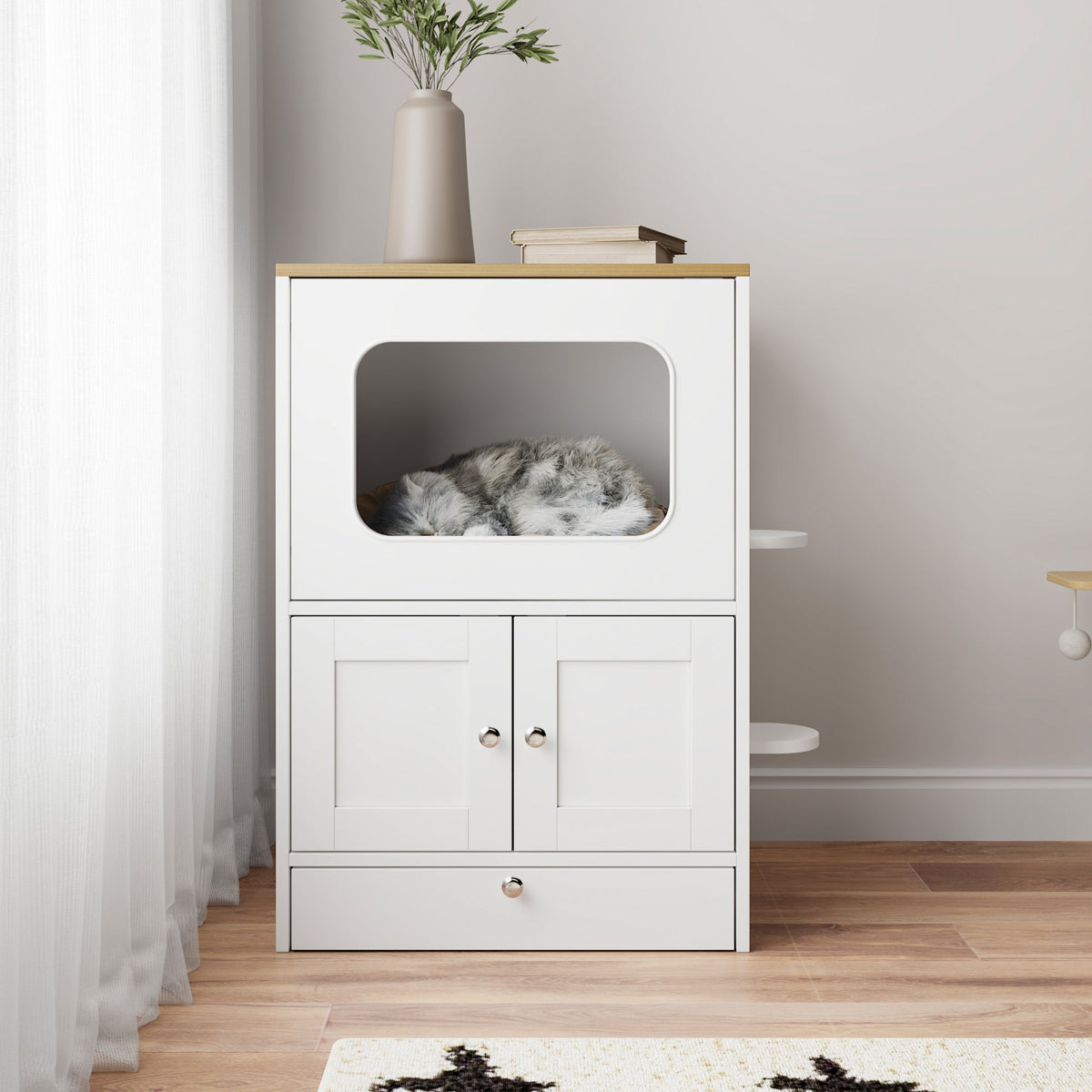
21.7" Modern White Multi-Functional Cat Condo Cabinet with Feeding Station and Storage

This white cabinet combines a cat condo, closed storage and a pull-out feeding station that rolls out on wheels and holds two cat bowls (bowls not included). Behind the double doors there is room for food, toys and supplies, so the food bag can stay in its original packaging next to the bowls. The upper condo has a door plus front and side entry openings, side steps make climbing easier for senior cats, and a sisal panel gives claws a scratching spot.
The listing says the upper condo can hold a bed or a litter box. For a feeding station, use it as a bed or hideaway and keep the litter box in another room. Likewise, use the two bowls for food and put water in a separate spot.
Key facts: white, pull-out feeding tray on wheels for two bowls, double-door lower cabinet, upper condo with front and side openings, side steps, sisal scratching panel, anti-tip hardware, magnetic door closures, metal hinges and handles. Two people can assemble it in about 30 minutes.
Best for: one cat, or two that get along, in a living room or small apartment where bowls, food and a cat bed should live in one tidy piece.
Skip it if: your dog will raid a floor-level tray, you want the upper condo for the litter box, or you need exact outer dimensions before buying: the listing's measurements do not agree, so confirm the size with customer service first.
40" Modern Chic White Wood Litter Box Enclosure

The separate litter spot for homes with cats and dogs. Your cat climbs steps on the left side and goes through an arched cat hole to the litter box, which sits in a large drawer, so cleaning means pulling out the drawer, scooping and sliding it back. The listing says the side steps are the only way in, which lets cats in while keeping dogs out. A runway inside acts as a litter trap, and the fenced top can be a cat bed.
Key facts: 35.5" H x 40" W x 23.5" D, interior 36.6" W x 21.7" D, 97.46 lb, manufactured wood and wood per the spec, metal hinges, white, wood or black, all hardware included, screwdriver needed.
Best for: a large litter box in a room away from the feeding station, in a home with a dog.
Skip it if: your cat is elderly or stiff and avoids steps, or you have only a short wall; at 40 inches wide it needs more space than a small enclosure.
Compare the picks
| Pick | Job | Size (from the listing) | Standout feature |
|---|---|---|---|
| Cat condo cabinet | Feeding station, storage, bed | Confirm with customer service | Pull-out tray on wheels for two bowls |
| 40" litter enclosure | Separate litter spot, homes with a dog | 35.5" H x 40" W x 23.5" D | Side-step entry, litter drawer |
When to call your vet
If your cat suddenly eats or drinks much more or less than usual, or starts avoiding its bowls or litter box, talk to your veterinarian rather than changing the setup alone.
FAQ
Where should I put my cat's food bowl?
In a quiet, private spot your cat can reach easily, away from the litter box, busy hallways, the cat flap and glass patio doors. The AAFP and ISFM guidelines say food should have its own location and each cat its own feeding station. Many cats like a wall behind them and the room in front while they eat.
Should a cat's water be away from its food?
Ideally, yes. The AAFP and ISFM guidelines say food and water should be separated, and Cats Protection notes that cats prefer to drink away from their food. VCA suggests several water bowls around the home, all away from the litter box.
How many feeding stations do I need for two cats?
At least two, one for each cat, in different rooms or out of sight of each other. The AAFP and ISFM guidelines say every cat in the household should have its own feeding station, because individual eating locations prevent the stress of feeding competition. Give each cat its own water spot too.
How often should I clean my cat's bowls?
The FDA advises washing and drying food bowls after each use and washing water bowls daily, along with scoops and measuring cups after each use. The ASPCA also says to wash and refill water bowls daily so fresh, clean water is always available.
Browse the full cat furniture collection for feeding stations, litter box enclosures and catios.

Dejar un comentario
Este sitio está protegido por hCaptcha y se aplican la Política de privacidad de hCaptcha y los Términos del servicio.