





A freestanding kitchen cabinet with a countertop is a stand-alone base cabinet, buffet or hutch that gives you closed storage and a worktop where there is no built-in counter run. Before you buy, check four things: how its top height compares with a standard 36-inch kitchen counter, how deep it is against your walkway, what the listing says the top can hold, and whether it can be anchored. Use the top for a microwave or coffee maker only when the listing says the worktop is meant for one, and never run a heat-producing appliance inside closed doors.
Below: the sizes that matter, safe appliance use, and three picks from the FUFU&GAGA pantry cabinets collection and its sideboards, with every number taken from the listing.
Key takeaways
- Height: kitchen counters are 36 inches high as standard; our picks' tops run from 30.7 to 31.5 inches (the 94-inch hutch does not list its worktop height), fine for serving and a coffee station.
- Depth: freestanding pieces are shallow (about 16 inches here), so check your appliance's depth first.
- Load: use only the capacity the listing gives, for the whole cabinet.
- Appliances: on an open top the listing approves, plugged into a wall outlet; never inside closed doors.
- Anchor it, and keep heavy items low.
What counts as a freestanding kitchen cabinet with a countertop?
It is any cabinet that stands on its own, is not fixed into a fitted kitchen run, and has a flat top you can work on. The name usually tells you the shape:
- Kitchen sideboard or buffet: a low, wide cabinet with doors and often drawers. The whole top is the work surface.
- Pantry hutch or buffet with hutch: a base cabinet with a shelf or cabinet section above it and an open worktop in between. This is the "kitchen hutch with microwave space" many people search for.
- Two-piece base and wall set: a floor cabinet with a separate wall-hung upper unit.
A kitchen island is also a freestanding cabinet with a countertop, but it stands away from the wall and needs clearance on every side. That is a different planning job, covered in our drop-leaf kitchen island guide. This post is about pieces that stand against a wall.
What height should a freestanding kitchen counter be?
The Journal of Light Construction's kitchen field guide puts it plainly: "Standard countertop height is 36 in." (JLC Field Guide: Kitchens). It is the height to match if you want a freestanding cabinet to line up with the rest of the kitchen.
Many furniture-style cabinets sit lower. Here is how our three picks compare:
| Cabinet | Top height | Below a 36 in counter by | Feels right for |
|---|---|---|---|
| 63.2 in pop-up door sideboard | 31.5 in | 4.5 in | Serving and setting down dishes |
| 63 in 4-door cabinet | 30.7 in | 5.3 in | Serving, display, a landing spot near a table |
| 94.5 in pantry hutch | Not listed | Not listed: check before buying | Microwave and coffee maker worktop |
A top a little below the counter is easy to live with for pouring coffee or reheating food. For long chopping or rolling sessions, every inch lower means a little more bending, so if prep is the main job, choose the tallest top you can find and stand a sturdy cutting board on it rather than raising the cabinet on blocks, which makes it less stable.
How deep and how wide should it be?
Our three picks are 15.7 to 15.9 inches deep, which keeps them out of the walkway but leaves less room on top than a fitted counter. Two checks:
- Appliance depth: measure your microwave or coffee maker from the back to the front of its door or drip tray. If it is deeper than the top, the feet will sit near the front edge, where a knock can tip it off. Leave room behind it for the power cord and any rear vents.
- Walkway: the JLC guide says to "make walkways at least 36 in. wide (42 in. is a better target)". Measure from the cabinet front to the nearest obstacle opposite, and allow for open doors.
For width, leave a few inches each side so doors and drawers clear casings and radiators. JLC suggests at least 15 inches of landing space beside or below a microwave, which a 59-inch top gives you with room to spare. If your wall is narrow, our narrow kitchen hutch guide covers slim pieces.
How much weight can the top hold?
Only what the listing says. Listings usually give one total capacity for the whole cabinet, sometimes per shelf or drawer, rarely for the top alone. Treat the total as the limit for everything inside and on top, keep a margin, and take your appliance's weight from its manual or spec label. A heavy microwave on a hutch's middle worktop also raises the center of gravity, one more reason to anchor it and keep cans and cookware in the bottom cabinets.
Microwaves, coffee makers and toaster ovens: on top, never inside
Small appliances make heat. The National Fire Protection Association's electrical safety tip sheet warns that "fires can start when heat builds up near things that burn" (NFPA electrical safety tips). A closed cabinet full of packaging and dish towels is that kind of space. Cooking is also the leading cause of home fires and home fire injuries in the U.S. according to the U.S. Fire Administration, which lists unattended equipment as the top factor in non-confined cooking fires.
The rules that follow from the sources and the listings:
- Use the open top or worktop only. Put a microwave or coffee maker on a cabinet only if the listing says its top or worktop is meant for one. One of our picks says so; the other two are serving pieces.
- Never run a heat-producing appliance behind closed doors. None of our picks lists an enclosed appliance compartment. A microwave maker explains that countertop models vent through the back, and inside a cabinet "these vents will be blocked and unable to release steam" (microwave maker's guidance). Built-in placement needs a model or trim kit made for it.
- Keep vents clear on the open worktop too. Follow the clearance your appliance's manual gives above, behind and at the sides, and check it against the gap between the worktop and any shelf above.
- Plug in directly. NFPA says microwave ovens and other major appliances "should be plugged directly into a wall receptacle outlet," without extension cords or plug strips, and advises only one heat-producing appliance, such as a coffee maker or toaster, plugged into an outlet at a time.
Our post on a microwave in a pantry cabinet goes further into trim kits and outlet placement.
Small kitchens, dining rooms and pantries
Small kitchens: a buffet or hutch on the one free wall adds a second work zone, with the coffee maker on one side and clear landing space on the other. Keep the depth near 16 inches so the walkway stays open, and use drawers for cutlery and wraps.
Dining rooms: a low sideboard near the table is a serving counter, with linens and serving pieces below. A lower top is no drawback when you are setting dishes down rather than working on it.
Pantries and laundry rooms: a cabinet with a top turns a storage corner into a spot for packing lunches or sorting groceries. Keep it away from heat sources and damp walls.
Anchor it, especially a hutch
The CPSC's Anchor It campaign states: "Anchoring all furniture with drawers, doors, and shelves to the wall prevents tip-over injuries and deaths" (AnchorIt.gov). In its ten-year campaign update, the CPSC also urges people to "store heavier items on lower shelves" and to avoid storing appealing items where kids may climb to reach them (CPSC).
Snacks on a worktop are exactly the kind of item a child climbs for. Use the restraint the listing includes, with a wall fixing suited to your wall, and tug it after fitting. Our anchoring guide walks through studs, anchors and straps.
For a tall hutch, check the ceiling too. A cabinet built lying down has to tilt up, and the diagonal is longer than its height: for the 83.3-inch-tall hutch below, the square root of 83.3 squared plus 15.8 squared is about 84.8 inches, comfortably under a 96-inch ceiling.
Buying checklist
- Top height: as close to your 36-inch counters as you can find if you will prep on it; a lower top is fine for serving.
- Depth: deeper than your appliance plus room for the cord behind it.
- Walkway: at least 36 inches clear in front, measured from the cabinet front.
- Width: wall width minus a few inches each side for doors and trim; 15 inches of landing space beside a microwave.
- Weight capacity: listed, and comfortably above what you plan to store plus anything on top.
- Appliance use: the listing names a microwave or coffee maker for the top or worktop if you plan to use one.
- Power: a wall outlet within reach, no extension cords.
- Tip restraint: included, and a wall you can fix it to.
Our picks: three freestanding cabinets with a work surface
Sizes, capacities and features come from each listing. The first is a kitchen piece whose listing names a microwave and coffee maker for its worktop; the other two are low sideboards that work as serving counters.
94" Gray Large Food Pantry Kitchen Sideboard Buffet with Glass-Front Doors
The whole-wall option: a pantry, buffet and hutch in one piece, 83.3" H x 94.5" W x 15.8" D. Two double-door cabinets with glass-fronted hinged doors sit up top, each with three shelves behind it, beside two large open shelves. Below them is a spacious worktop, and under that a bank of drawers of different sizes on metal slides with silver pulls. The listing marks it as having a microwave shelf and says the worktop can hold a microwave and a coffee maker. It holds 400 lb in total, weighs 300 lb, and is MDF in gray or white. A tipover restraint is included.
Best for: a large kitchen or open-plan dining area with a long blank wall, where you want an appliance worktop, display and closed storage in one run.
Skip it if: you need to know the worktop height before you buy, as the listing does not give it, or your wall is shorter than 94.5 inches plus a little clearance. The drawer count differs between the copy and the photos, so count them in the photos rather than relying on a number. At 300 lb, plan on help to stand it up, and anchor it.
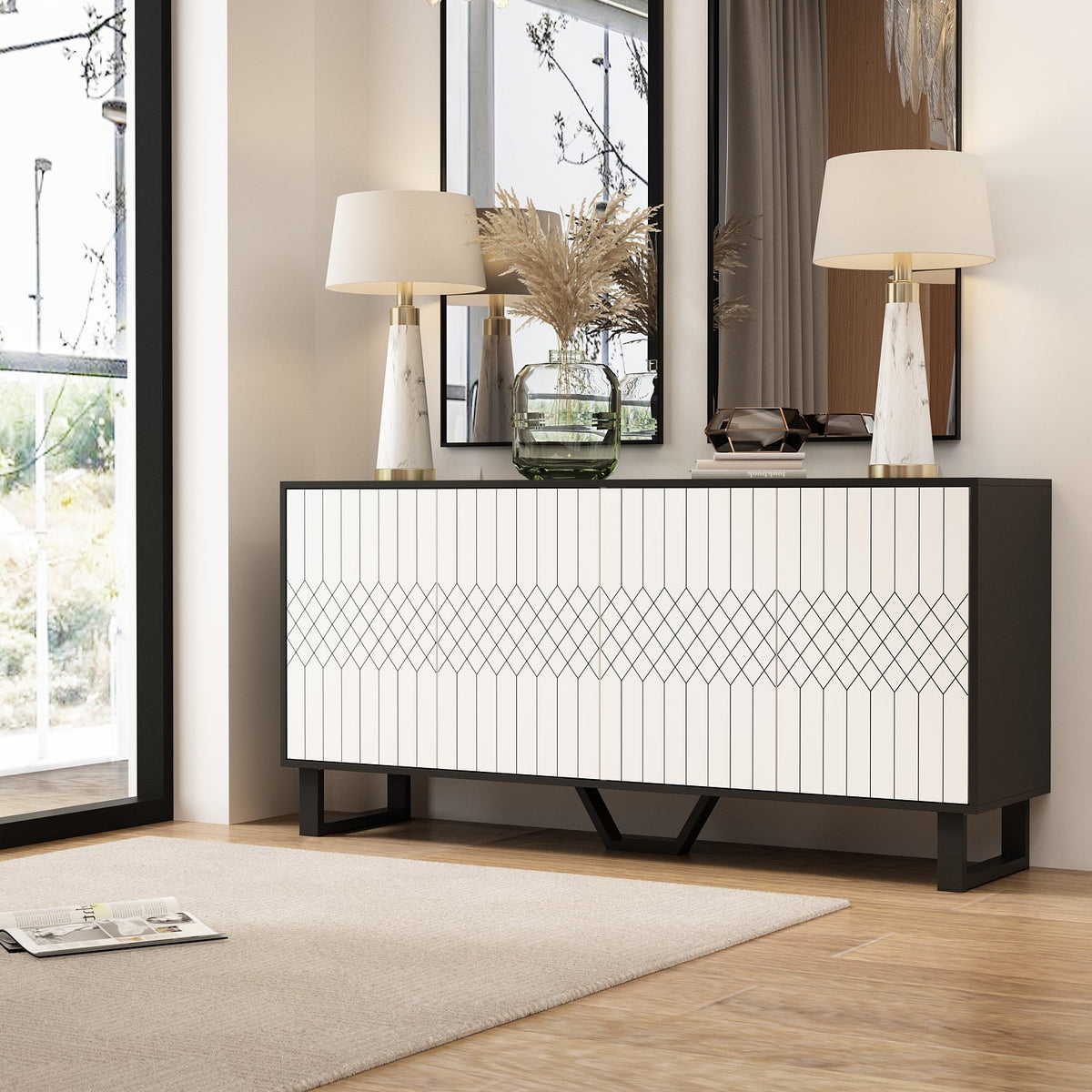
63.2" Modern White/Black Sideboard with 4 Pop-Up Doors

The dining-room serving counter: 31.5" H x 63.2" W x 15.9" D on 6.7" feet. Four push-to-open doors keep the front handle-free, and the adjustable shelves inside (30.1" W x 14.8" D) hold 30 lb each, with a cabinet interior 23.5" high. It holds 120 lb in total, weighs 90.5 lb and is MDF with water- and scratch-resistant surfaces, in white or black. A tipover restraint is included. The listing presents it as a dining room buffet, living room cabinet or hallway console, and does not mention appliances, so treat its top as a serving and display surface.
Best for: setting out dishes beside a dining table, with plates, linens and serving bowls behind the doors.
Skip it if: you want to run a microwave or coffee maker on it (the listing does not cover that), or it will stand where the back shows: the back is unfinished. Push-to-open doors can be pressed open by small children, so anchor it and keep breakables off the lowest shelf.
63" Modern Minimalist 4-Door Storage Cabinet

The low, long option for a dining wall: 30.7" H x 63" W x 15.7" D, raised on black iron legs 5.9" high. White door panels with a fine line design sit on a black frame, and the four doors open with a press thanks to rebound devices, so there are no handles. Inside, the shelves move to three heights or come out; the cabinet interior is 23.1" H x 30.7" W x 15" D. It weighs 90.2 lb, is particle board laminated with melamine, water- and scratch-resistant with a finished back, and has an anti-tip device on the back panel. The listing names it as a dining cabinet as well as an entry or living room piece.
Best for: a serving and display counter in a dining room or an open-plan kitchen-living space where you want a furniture look.
Skip it if: you need a weight rating, as the listing gives none, or you want to put appliances on it: the listing does not mention them. At 30.7 inches it is the lowest top here, 5.3 inches below a 36-inch counter (36 minus 30.7). Keep it out of direct sunlight, as the listing advises.
Compare the picks
| Pick | H x W x D | Top | Doors and drawers | Capacity | Appliance on top (per listing) |
|---|---|---|---|---|---|
| 94.5 in pantry hutch | 83.3 x 94.5 x 15.8 in | Middle worktop, height not listed | 4 glass-front doors, drawers, 2 open shelves | 400 lb | Microwave and coffee maker |
| 63.2 in pop-up sideboard | 31.5 x 63.2 x 15.9 in | 31.5 in | 4 push-open doors | 120 lb | Not mentioned |
| 63 in 4-door cabinet | 30.7 x 63 x 15.7 in | 30.7 in | 4 push-open doors | Not listed | Not mentioned |
All three list a tip restraint. Measure your wall, walkway and outlet first, then compare the rest of the range in the pantry cabinets collection. All three arrive flat-packed; our flat-pack assembly guide covers the build, and every FUFU&GAGA cabinet above should be anchored before you load it.
FAQ
What is a freestanding kitchen cabinet called?
Depending on its shape: a sideboard or buffet (low, with a full-width top), a pantry hutch or buffet with hutch (base, open worktop and upper shelves), a pantry cabinet (tall, mostly doors) or a utility base cabinet.
Can I put a microwave on a sideboard?
Only if the listing says the top is meant for one, and the top is deep enough for the microwave's feet and vents. Plug it straight into a wall outlet and keep the vents clear. Never run a microwave, toaster oven or coffee maker inside a closed cabinet unless the listing says that space is designed for it.
How tall should a freestanding kitchen cabinet be?
To match fitted counters, 36 inches is the standard countertop height. Furniture-style buffets and sideboards are often lower (our two sideboards are 30.7 and 31.5 inches; the hutch does not list its worktop height), which suits serving and a coffee station better than long prep work.
Can a freestanding cabinet replace a kitchen counter?
It can add a work zone, but it is usually shallower and lower than a fitted counter, and the tops of our picks are manufactured wood. Use a cutting board for prep, wipe spills quickly, and keep heavy appliances within the listed weight capacity.

Dejar un comentario
Este sitio está protegido por hCaptcha y se aplican la Política de privacidad de hCaptcha y los Términos del servicio.