










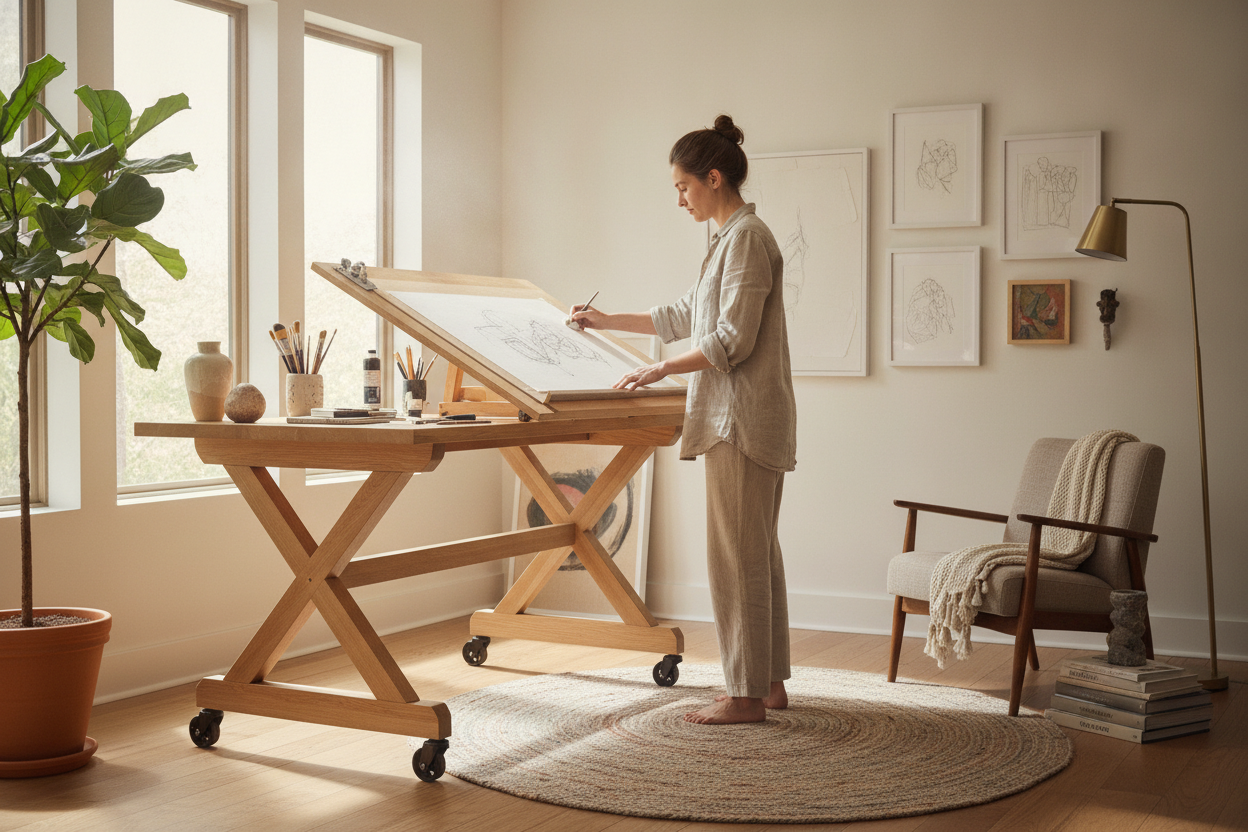
I used to spend eight hours a day hunched over a kitchen table, my neck locked in a C-curve that would make a chiropractor weep. When I finally bought a cheap motorized desk, I realized I couldn't actually draw on it because every time I erased a stray pencil mark, my monitor did a nervous dance and my ink lines came out jagged. Finding a real standing art desk that doesn't feel like a card table is surprisingly hard.
- Stability is the only metric that matters; if it wobbles, it is trash.
- Dual-motor frames are mandatory for smooth lifting with wet media.
- Solid wood tops beat particle board for mounting heavy lamps and arms.
- A 71-inch width is the sweet spot for a hybrid digital and traditional workflow.
Why Most Standing Desks Are Terrible for Artists
Most office furniture is designed for people who just tap on keys. If you are an illustrator, you are putting downward pressure on the surface and making rhythmic, aggressive movements. Compared to standard writing computer desks, an artist standing desk needs to handle the vibration test. If I can not scrub a 2B pencil mark off without the whole rig swaying, it is a failure.
The dreaded wobble factor is what kills most setups. Cheap T-frame legs might be fine for a laptop, but the second you lean in to detail a character's eyes, that microscopic shake will ruin your line work. Standing desks for artists require a much higher stability threshold and a weight capacity that keeps the center of gravity low even when the desk is at its highest point.
Drafting Board vs. Standing Art Table: The Showdown
I debated getting a dedicated standing art table with a built-in tilting top. The problem? Once that surface is tilted, you can't put a coffee cup, a palette, or an iPad Pro on it without everything sliding into your lap. It limits you to one way of working and kills your usable flat surface area.
I eventually settled on a rock-solid flat motorized desk paired with a large tabletop easel. This gives me the angle I need for watercolor washes but keeps a flat landing zone for my supplies. It is the best of both worlds. When I am done with the traditional stuff, I just fold the easel flat and I have my full desk back for digital editing or scanning.
How I Built the Ultimate Artist Standing Desk
I stopped looking for a kit and started looking for parts. I went with a heavy-duty dual-motor frame. Single motors are jerky; they start and stop with a jolt that is a death sentence for a full jar of dirty paint water. A dual-motor system glides. It is quiet and smooth enough that I can leave a half-finished oil painting on the surface while it transitions from sitting to standing height.
The Surface (Why I Ditched the Factory Top)
Most out-of-the-box desks come with flimsy 1/2-inch particle board tops. I hated them. They chip if you drop a palette knife and they bow under the weight of a monitor arm. I am a huge advocate for buying desk tops for standing desks separately.
I grabbed a 1.5-inch thick birch butcher block. It is dense enough to absorb vibration and I can drill hooks directly into the underside for my rags and headphones without worrying about the wood splitting. Plus, if I get ink on it, I can just sand it down and refinish it. Try doing that with laminate.
Where Do All the Paints and Brushes Go?
Let's talk about the spatial reality of being a creative. Between my 24-inch pen display, my keyboard, and my actual paper, a 48-inch desk felt like a coffin. If you have the floor space, a 71-inch adjustable standing desk is the only way to go.
I need room for a wet palette, a jar of brushes, and my reference tablet without feeling like I am playing a game of Tetris every time I want to switch colors. Having that extra breathing room allows for distinct digital and traditional zones, which keeps my workflow from getting claustrophobic.
The Verdict: Did It Cure My Hunched Posture?
My lower back does not throb at 4 PM anymore. Being able to stand up during the big movement phases of a painting—like blocking in large backgrounds—changed how I work. It is not just about ergonomics; it is about the freedom of movement. When you stand, you paint with your whole arm, not just your wrist. That alone made the upgrade worth every penny.
FAQ
Does the desk shake when you draw?
Not if you use a dual-motor frame and a thick solid wood top. Avoid the cheap 50-pound models; they are too light to stay still during aggressive sketching or erasing.
Can I use a monitor arm with an art desk?
Yes, but make sure your desk top is solid wood. Particle board will eventually crack or compress under the concentrated pressure of a heavy monitor arm clamp.
How much weight can these desks actually hold?
Most dual-motor frames handle 250 to 300 lbs. That is plenty for a computer, a large pen display, and a stack of heavy art books without the motor straining.

Dejar un comentario
Este sitio está protegido por hCaptcha y se aplican la Política de privacidad de hCaptcha y los Términos del servicio.