










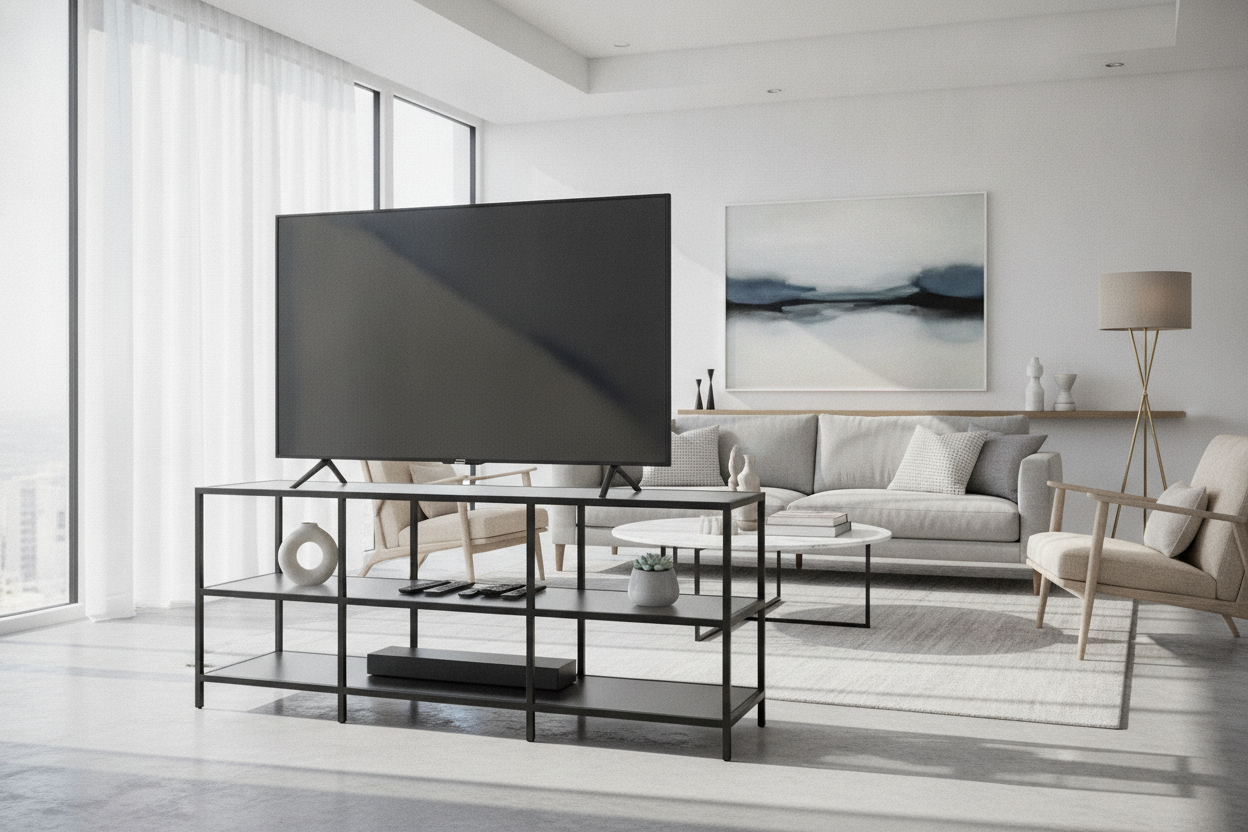
I spent three years staring at a mid-century modern credenza that was basically a 70-pound block of walnut-stained MDF. It looked great in the catalog, but in my 12x15 living room, it felt like I had parked a small SUV under my television. The room felt crowded, the air felt stagnant, and no matter how many plants I put on top, the furniture just felt heavy. Last month, I finally cracked and swapped it for a minimalist metal and glass tv stand. The difference was immediate—like the room finally took a deep breath.
- Visual Airflow: Transparent shelves let you see the floor and wall, making small rooms feel significantly larger.
- Industrial Edge: Metal frames provide a structural, architectural look that wood often lacks.
- Cable Management: It requires more effort, but the clean result is worth the 20 minutes of zip-tying.
- Durability: Tempered glass and powder-coated metal handle heat from electronics better than cheap veneers.
The Problem With 'Heavy' Living Room Furniture
We are often told that solid wood is the gold standard for 'real' furniture. But here is the truth: wood is a visual anchor, and not always in a good way. In a compact apartment or a room with limited natural light, a massive wooden media console acts like a black hole. It absorbs light, stops the eye from moving, and creates a physical barrier that makes the floor plan feel chopped up. My old credenza was barely 60 inches wide, yet it dominated the entire wall. It felt like a tombstone for my electronics.
When you have a piece of furniture that is essentially a solid box, you lose all that negative space. The area under the stand becomes a graveyard for dust bunnies you can't see, and the bulk of the piece makes the surrounding furniture feel cramped. I realized that my 'sturdy' investment was actually dragging down the energy of the room. It was too much mass for too little square footage. I needed something that felt structural rather than bulky—something that provided the necessary surface area without the visual weight.
Why I Took a Risk on a Metal and Glass TV Stand
I will be honest: I had some serious hesitation. For a long time, I associated the metal glass tv stand with those generic, three-tier AV carts from the late 90s—the kind you’d find in a corporate conference room or a freshman dorm. I was terrified that my living room would lose its warmth and start feeling like a sterile waiting room for a tech startup. I spent a lot of time wondering is a glass and metal TV stand too cold for a space where I actually want to kick back and watch a movie?
But the modern versions of these pieces are a different breed. Instead of chunky silver poles, I looked for slim, matte black frames with inset tempered glass. The look is more 'Parisian loft' and less 'Best Buy clearance rack.' When the piece arrived, the architectural lines actually made my 65-inch screen look like a deliberate design choice rather than just a glowing rectangle on the wall. The transparency of the shelves allowed the pattern of my rug to continue all the way to the baseboard, which instantly made the wall feel three feet wider.
How to Style a Metal TV Stand With Glass Shelves (Without It Looking Like Best Buy)
The secret to making a black metal and glass tv stand work is all in the contrast. Since metal and glass are inherently cold and hard, you have to overcompensate with organic textures. I don't just throw my PlayStation and a soundbar on there and call it a day. That is how you get the retail display vibe. Instead, I treat the metal tv stand with glass shelves like a curated bookshelf. I use stacks of linen-bound design books to add height and a matte ceramic vase to break up the reflective surfaces.
Think about the materials you are putting near it. I paired mine with a chunky knit rug and a leather armchair. If you have a larger wall to fill, you can tie the whole look together by placing a black cabinet with glass doors on the adjacent wall. This creates a rhythm of glass and metal throughout the room, making the TV stand feel like a part of a larger, intentional design language rather than a random industrial outlier. Avoid plastic bins or glossy organizers; stick to wood, clay, or woven grasses to ground the piece.
The Reality of Cords in a Transparent Metal and Glass Entertainment Center
Let's talk about the elephant in the room: cables. On a solid wood console, you just shove the mess behind the cabinet and pretend it doesn't exist. On a metal and glass entertainment center, your cable management (or lack thereof) is on full display. If you have a rat's nest of HDMI cords and power strips, the 'airy' look is immediately ruined. You have to be meticulous. I spent an afternoon with a pack of black velcro ties and a set of adhesive cable clips.
The trick is to run every single wire down the back of the thinnest metal leg. I used black electrical tape to secure the main power trunk to the frame so it’s virtually invisible from the front. If you have a white wall, you might even consider using white cord raceways that blend into the drywall. It sounds like a chore, but it is actually quite satisfying. Once the cords are tucked away, the 'floating' effect of the glass shelves is genuinely impressive. It forces you to be a minimalist, which, in the long run, actually makes your tech setup easier to troubleshoot.
Is the Dust Factor Actually That Bad?
Yes, glass shows dust. There is no way around it. If you have a shedding dog or a particularly dusty HVAC system, you are going to see a fine layer of gray on those shelves within three days. I keep a microfiber cloth in the drawer of my coffee table and give the stand a quick 'once-over' every Saturday morning. It takes about 45 seconds. For me, that is a fair trade-off for the visual clarity the piece provides. However, I know that for some people, the constant maintenance is a deal-breaker.
If you love the reflective look of glass but absolutely loathe dusting every week, a media console with glass doors is the perfect middle ground. You get that hit of light and the ability to see your decor, but the glass acts as a shield for the interior shelves. You only have to wipe down the front face of the doors. Personally, I stick with the open metal and glass because I like the challenge of keeping it curated, but the 'closed' glass look is a lifesaver for high-traffic family rooms.
FAQ
Will glass shelves hold a heavy TV?
Most modern stands use tempered glass rated for 100-150 pounds on the top shelf. Always check the specific weight capacity, but a standard 65-inch LED TV usually weighs less than 60 pounds, so you are well within the safety margin.
How do I hide a power strip?
I use a slim power strip and mount it to the underside of the metal frame using heavy-duty command strips or magnetic mounts. This keeps the 'brain' of your electronics off the floor and out of sight.
Does the glass scratch easily?
Tempered glass is surprisingly tough, but it can scratch if you drag metal components (like a heavy receiver) across it. I use small clear rubber bumpers on the bottom of my electronics to prevent any direct contact.


Dejar un comentario
Este sitio está protegido por hCaptcha y se aplican la Política de privacidad de hCaptcha y los Términos del servicio.