










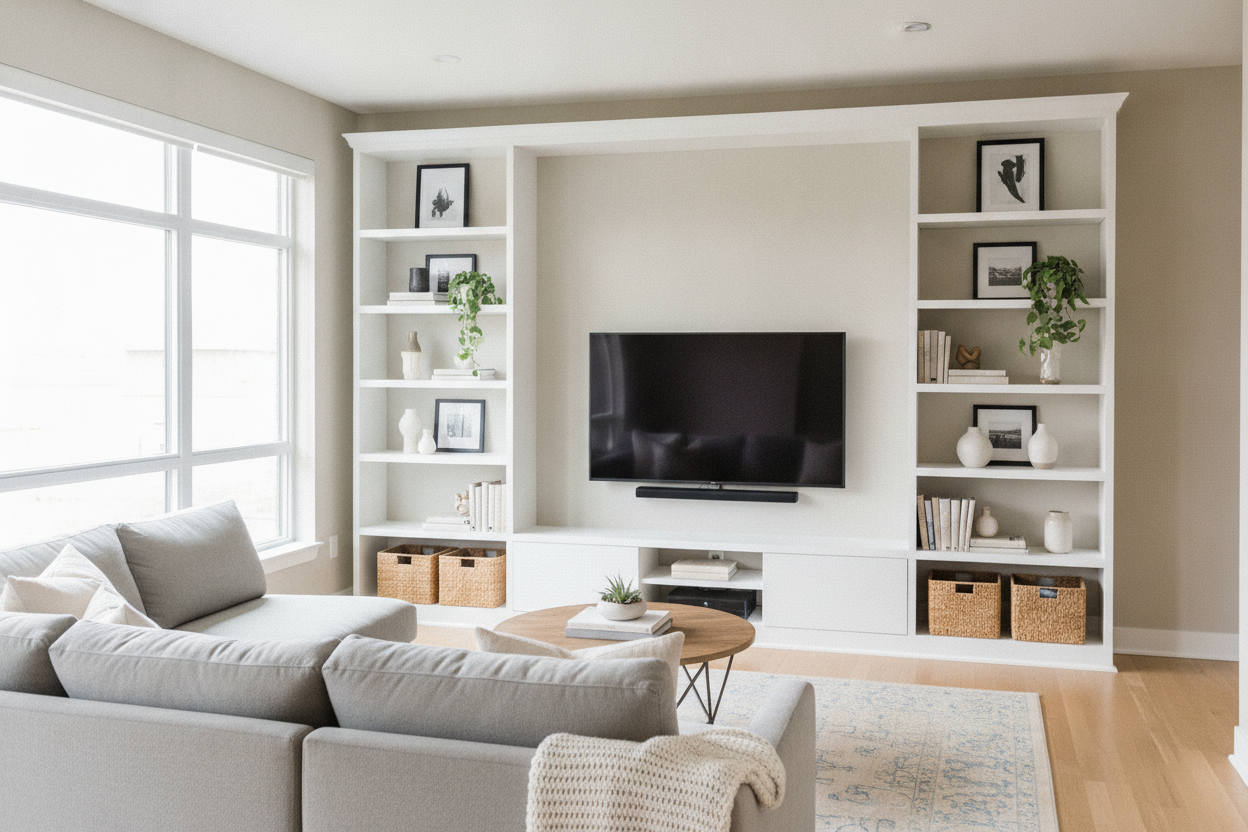
I spent three weeks staring at a blank 14-foot wall in my living room, convinced that only custom floor-to-ceiling cabinetry would save the space from looking like a dorm room. Then I got the quote from a local carpenter: $5,200, plus paint. My bank account actually laughed at me. I realized I didn't need a contractor; I just needed a clever tv-stand-for-entertainment-center strategy that wouldn't look like a collection of random boxes shoved together.
- Choose an adjustable-width console to eliminate gaps between bookshelves.
- Match the depth of your side units to the center stand within one inch.
- Secure everything to wall studs to prevent leaning and 'seam-spread.'
- Swap out factory hardware for high-end brass or matte black pulls.
The $5,000 Custom Millwork Quote That Broke Me
I originally thought I wanted a massive, one-piece unit. I even looked into a giant tv stand to fill the void, but those often look like heavy, monolithic blocks that swallow the room whole. They lack the architectural detail that makes a room feel 'designed.'
The custom quote was a wake-up call. I wanted that high-end, built-in look—the kind where the shelves look like they grew out of the drywall—but I was working with a flat-pack budget. I decided to pivot. Instead of one expensive piece, I’d hunt for tv stands & entertainment centers that could be modularly combined to trick the eye.
The Secret Ingredient: An Extra-Wide, Adjustable Base
The biggest mistake people make when trying to fake built-ins is buying a center console that is exactly the width of their TV. It looks puny. To get the scale right, you need a base that stretches. I opted for 106-inch minimalist entertainment centers because they allow you to slide the outer sections in or out.
This adjustability is the 'secret sauce.' It means you can buy your flanking bookcases first, set them at the edges of your wall, and then expand your center console until it sits perfectly flush against them. No awkward 3-inch dust gaps that scream 'I bought this at a big-box store.'
Nailing the Dimensions for a Seamless Look
Measurement is where most DIYers fail. If your side bookshelves are 12 inches deep and your center television entertainment units are 18 inches deep, the illusion is ruined. You want the depths to match as closely as possible.
I spent an afternoon with a tape measure, ensuring my center piece would sit no more than two inches forward from the shelves. This slight stagger actually adds a bit of depth and looks intentional, like a traditional 'breakfront' cabinet, rather than a mistake.
Assembling Your Faux Wall Unit
Once the pieces arrived, the real work began. I didn't just line them up; I treated them like a single television entertainment cabinet. I pushed the side towers tight against the center console and used mending plates on the back to lock them together. This prevents the units from drifting apart over time.
Safety is non-negotiable here. When you are stacking entertainment centers for tvs this large, you must anchor every single piece to the wall studs. Not only does this prevent tipping, but it also pulls the units tight against the wall, hiding the fact that they aren't actually part of the house's framing.
Making It Look Expensive (Without Power Tools)
The final 10% of the work provides 90% of the 'wow' factor. Most budget modern entertainment units come with generic silver or plastic handles. I tossed those immediately and spent $40 on heavy, knurled brass pulls. It’s a small detail, but it changes how the furniture feels when you actually touch it.
Styling is the last hurdle. I used a mix of heavy coffee table books, some ceramic vessels with actual weight to them, and a few trailing plants to soften the hard edges. By treating the entire wall as one cohesive modern entertainment units display, the individual seams between the furniture pieces virtually disappeared under the layers of decor.
FAQ
Do I need to paint the units to match?
It helps, but it isn't strictly necessary. If you buy from the same brand, the whites or blacks usually match. If you're mixing brands, try to match the finish (matte vs. gloss) more than the exact shade.
How do I hide the cords in a modular setup?
I drilled 2-inch holes through the side panels of the bookcases so I could run all my lighting and tech wires horizontally behind the baseboards into the center console's cord management system.
Is this stable on carpet?
It's tricky. Carpet makes units lean forward. Use furniture shims under the front edge to level them out before you anchor them to the wall. If they aren't level, the vertical seams between the units will look like a 'V' shape.

Dejar un comentario
Este sitio está protegido por hCaptcha y se aplican la Política de privacidad de hCaptcha y los Términos del servicio.