










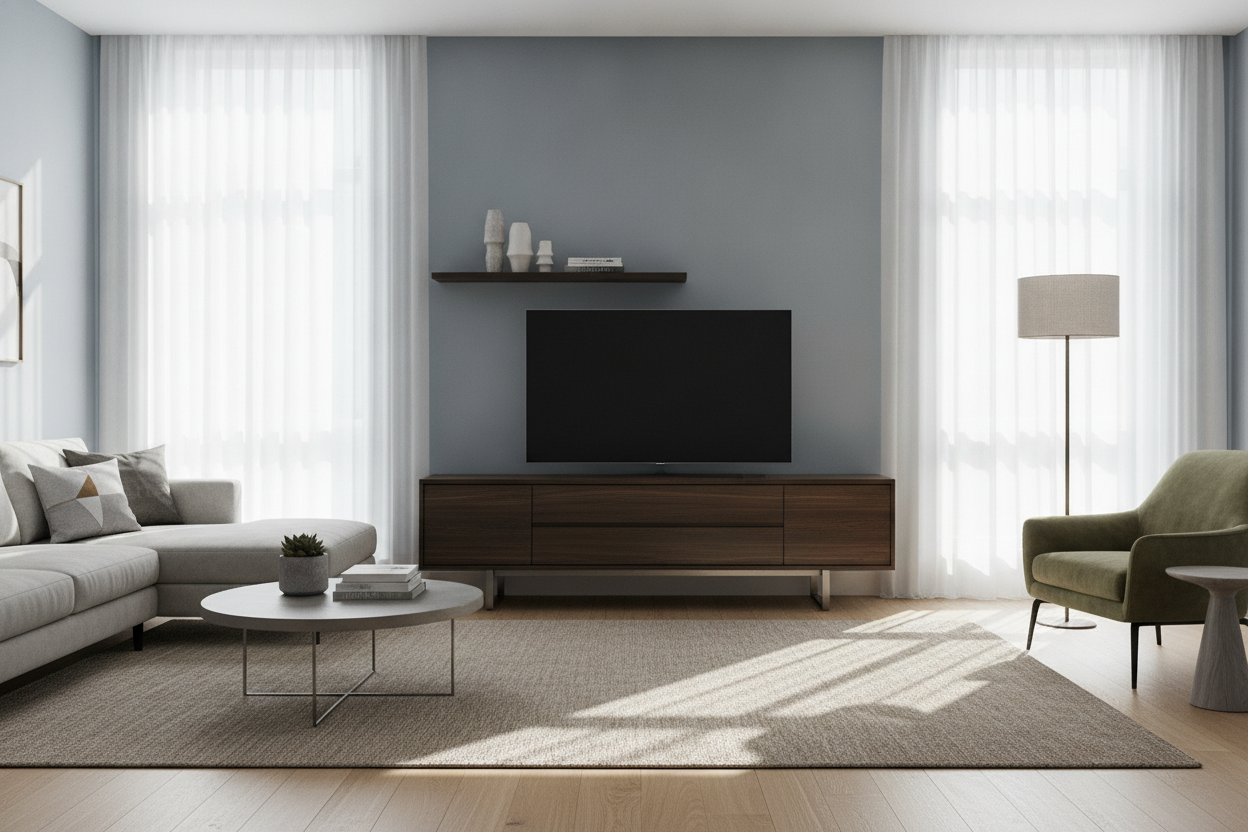
I remember staring at my first 'adult' living room and realizing my TV was sitting on a $20 IKEA Lack table that was literally bowing under the weight of a 50-inch screen. It looked like a temporary setup, even though I’d lived there for three years. Finding a modern stand for tv that doesn't feel like a placeholder is harder than it should be when you're scrolling through endless pages of flimsy particle board.
Quick Takeaways
- Avoid 'hollow-core' MDF; it is basically paper and air that sags within a year.
- Closed storage is your best friend for hiding the 'cable spaghetti' behind your consoles.
- Check the height—your eye level should be at the middle of the screen to avoid neck strain.
- Slatted doors are the ultimate hack for keeping tech hidden while maintaining remote control signals.
The 'First Apartment' Furniture Curse (And Why You Have to Escape It)
We have all been there. You buy a basic black open-shelf unit because it is cheap and 'fine for now.' Five years later, that 'fine' piece is still there, collecting dust and making your $1,200 OLED look like a clearance rack find. It is the first thing people see when they walk in, yet it is often the last thing we think to upgrade.
The problem with those open-shelf units is that they put your clutter on a pedestal. You aren't just looking at the TV; you're looking at the tangled HDMI cords, the dusty router, and that one random remote you haven't used since 2018. Upgrading the focal point of your living room completely changes the energy from 'just moved in' to 'actually lives here.'
What Actually Makes a Modern TV Stand Cabinet Look High-End?
Cheap stands usually have plastic legs and a 'wood' grain that looks like a bad photocopy. A high-end modern stand tv needs weight and better proportions. Look for mitered joints where the corners meet at a clean 45-degree angle rather than just being butt-jointed together with visible screws.
Hardware is another dead giveaway. If the handles feel like hollow tin, replace them or look for integrated finger pulls. Choosing a modern TV stand with cabinets and drawers is a pro move because it hides the visual noise. When you hide the tech, the furniture actually gets to look like furniture instead of a server rack.
The Magic of Slatted Doors for Hiding Ugly Tech
Slatted designs are having a major moment, and for good reason. They give you that warm, mid-century texture but are incredibly functional. A mid-century modern TV stand with slatted doors solves the 'ugly black box' problem perfectly.
Because of the gaps between the wood slats, IR signals from your remote can pass right through, and your gaming consoles actually get the airflow they need to keep from melting. I once kept my PlayStation in a solid cabinet and it sounded like a jet engine taking off within twenty minutes; slats fixed that overnight.
The Secret to Finding Cheap Modern TV Stands That Actually Last
I have built enough flat-pack furniture to know that cheap modern tv stands aren't always a bargain if they wobble when you walk past them. Avoid anything described as 'hollow-core.' Instead, look for high-density MDF or engineered wood with a real wood veneer. It’s more stable than cheap solid pine which can warp near heaters.
Check the base. A solid metal frame or splayed solid wood legs will always be more stable than four plastic pegs screwed into the corners. Before you commit to a 2 AM impulse buy, browse our favorite TV stands to see pieces that balance cost with actual structural integrity. My rule of thumb: if it weighs less than 50 pounds in the box, it’s probably going to sag.
Wait, Should You Just Get a Wall Cabinet Instead?
If your floor space is non-existent, stop looking at legs. Floating units are the ultimate minimalist flex. They make a small room feel significantly larger because you can see the floor running all the way to the baseboard. I actually swapped my TV stand for a wall cabinet last year in my guest room, and it turned a cramped corner into an airy office nook.
3 Rules for Styling Your New Modern Stand TV Setup
Once you have the modern tv stand cabinet in place, don't just plop the TV in the center and call it a day. First, use the 'rule of three' for decor—a stack of books, a small plant, and a ceramic bowl. Keep things at different heights to create visual interest.
Second, embrace negative space. You don't need to fill every inch of the surface. If your TV is massive, let it breathe. Finally, consider an asymmetrical layout. Placing the TV slightly to one side and balancing it with a tall table lamp on the other side makes the whole setup look like an intentional design choice rather than just a place to watch Netflix.
FAQ
How high should my TV stand be?
For most standard sofas, you want a stand that is 18 to 22 inches tall. You want the middle of the screen to be at eye level when you are seated. If you have to tilt your head back, it is too high.
Can a TV be wider than the stand?
Technically yes, but it looks terrible. It creates a 'top-heavy' look that feels unstable. Aim for a stand that is at least 6 to 10 inches wider than the TV itself to maintain visual balance.
Is metal or wood better for a media console?
Wood (or wood veneer) adds warmth to a room full of glass and plastic tech. Metal is great for industrial vibes and is usually more durable for heavy setups, but it can sometimes vibrate if you have a soundbar with heavy bass.

Dejar un comentario
Este sitio está protegido por hCaptcha y se aplican la Política de privacidad de hCaptcha y los Términos del servicio.