










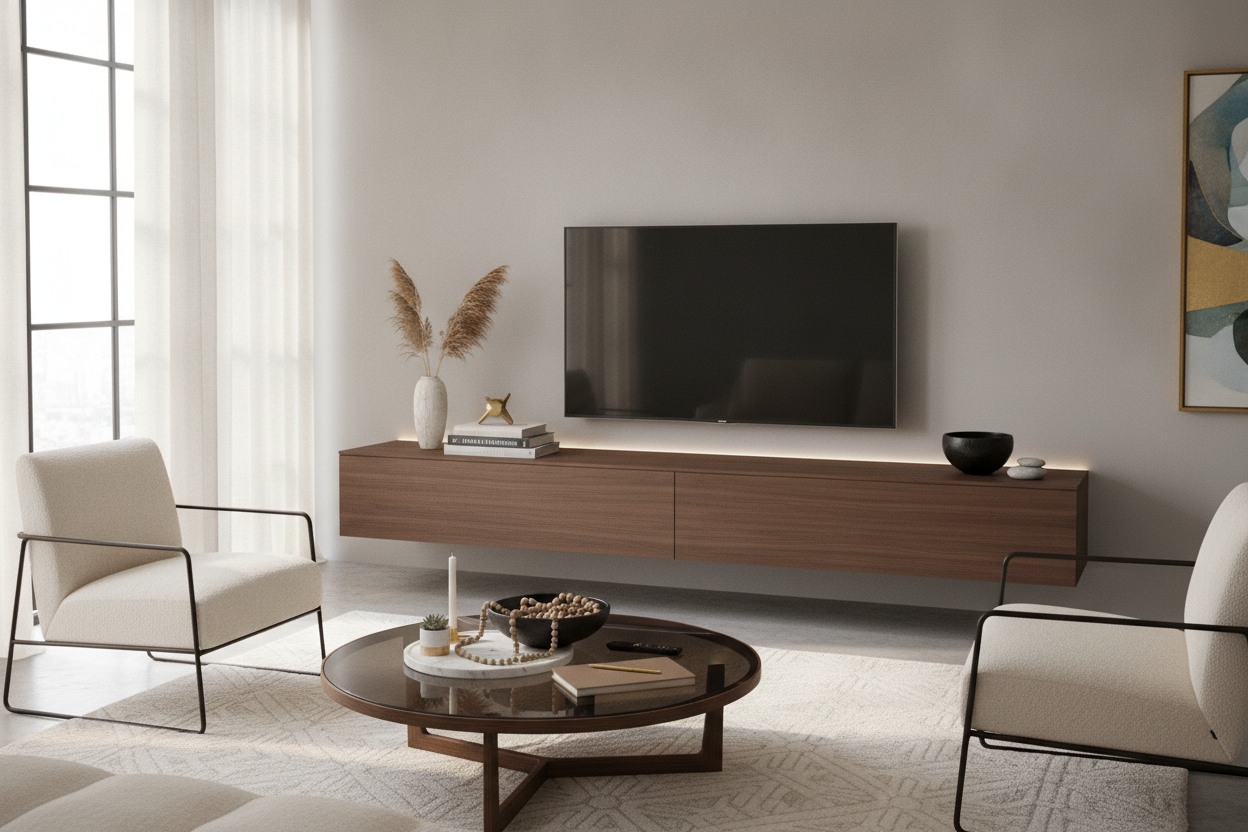
I’ve spent too many nights staring at a mess of tangled HDMI cables and a TV stand that looked like it was made of hardened crackers. We’ve all been there: you buy the budget option, and it looks exactly like what it is—a temporary fix. But when I finally got my hands on a manhattan comfort tv stand, I realized the 'budget' label didn't have to mean 'cheap-looking.'
The secret isn't just the piece itself; it's how you trick the eye into thinking you hired a carpenter. It’s about ditching the clutter and embracing the architecture of the furniture. My living room finally feels finished, and I didn't have to spend three months' rent to get there.
- Wall-mount it: Getting the unit off the floor creates an immediate custom look.
- Hide the wires: Cable raceways are non-negotiable for a professional finish.
- Go dark: Darker finishes hide seams and look more expensive in low light.
- Asymmetry is key: Don't just center everything; use the space to the side for height.
The Problem With Most Budget Media Setups
Most affordable units fail because they try to do too much with too little. You get spindly legs that wobble if the cat sneezes or finishes that peel if you set a coaster down too hard. A bad mid-century modern entertainment center can actually make a room feel smaller and more chaotic if the proportions are off. If the unit is too short for the wall, it looks like an afterthought; if it’s too deep, it eats your floor space.
The biggest offender is always the cord situation. Nothing kills the vibe of a manhattan entertainment center faster than a black web of cables dangling toward the outlet like some kind of tech-obsessed spider. It’s the visual equivalent of wearing a tuxedo with Crocs. To make a budget piece work, you have to solve the 'bulk' problem and the 'mess' problem simultaneously, or you're just putting lipstick on a particle-board pig.
Why I Chose a Manhattan Comfort TV Stand
I went through dozens of manhattan comfort tv stands before settling on one with clean, handle-less doors. The lack of hardware is a classic high-end design move—it keeps the silhouette uninterrupted and prevents the 'cheap metal' look that often plagues furniture in this price bracket. I specifically looked for a manhattan tv stand that offered a mix of hidden storage and open shelving so I could hide the ugly routers but show off the items that actually have some personality.
If you're aiming for a moody, sophisticated look, I'd suggest a stylish black TV stand entertainment center. Darker tones are much more forgiving when it comes to the texture of the laminate, and they make the screen blend into the background when it's turned off. It creates a seamless visual plane that feels much more expensive than a lighter wood grain that might look a bit 'printed' under bright lights. Plus, the storage capacity on these units is surprisingly deep—I managed to shove an entire console, two controllers, and a stack of board games into one cabinet without the door bulging.
The 'Floating' Hack That Changes Everything
Standard legs are fine, but a manhattan comfort floating tv stand is a total reset for your floor plan. When you can see the floor extend all the way to the baseboard, the room feels twice as large. It’s the ultimate designer trick for cramped apartments where every square inch of floor space is precious. It removes that heavy, 'anchored' feeling that bulky furniture usually brings.
I opted for a floating TV stand wall mounted media console because it mimics the look of a $4,000 custom built-in. Mounting it takes some patience—and a stud finder you actually trust—but the payoff is a manhattan floating tv stand that looks like it was born in the room. I’ll be honest: I initially tried to use drywall anchors because I was lazy, and I nearly ripped a hole in my wall. Don't be like me. Find the studs, use a level, and take your time. The levitation effect only works if the piece is perfectly straight.
3 Styling Rules to Fake a Custom Built-In
First, let's talk about cable management. For my manhattan floating entertainment center, I used paintable cord raceways that run straight down from the center of the unit. I painted them the exact color of my walls, and they virtually disappeared. If you can't go behind the drywall, this is the only way to go. It makes the manhattan comfort floating entertainment center look like it was professionally wired during a home renovation.
Second, stop centering your TV perfectly between two identical lamps. It’s boring and screams 'big box store showroom.' I flanked my unit with a tall, architectural floor lamp on one side and a stack of oversized art leaning against the wall on the other. This creates a visual 'zone' that feels like a curated gallery. By varying the heights of the objects around the manhattan comfort floating tv stand, you draw the eye away from the furniture's edges and toward the overall composition.
Third, edit your shelves ruthlessly. If you have open storage, don't fill it with old DVDs or dusty remotes. Use the 'Rule of Three': one horizontal item (like a stack of coffee table books), one vertical item (a ceramic vase), and one organic item (a small trailing plant like a Pothos). Negative space is what makes furniture look expensive. If every inch is covered in junk, even a designer piece will look cheap. Keep it airy, keep it intentional, and your manhattan comfort entertainment center will look like a million bucks.
The Final Verdict: Is It Worth the Hype?
Let's be real: the assembly of a manhattan comfort entertainment center isn't exactly a walk in the park. It took me about two hours, a power drill, and a fair amount of swearing to get the doors aligned perfectly. The instructions are mostly diagrams, so you have to pay close attention to the orientation of the cam locks. I actually put the back panel on backwards the first time—don't make that mistake, or you'll be staring at unfinished particle board every time you sit down.
But once it’s up and styled, the durability has surprised me. The finish hasn't chipped, even with my vacuum bumping into the corners, and the mounting hardware is rock solid. This isn't heirloom furniture you'll pass down for generations, but for anyone who wants a high-end look on a real-world budget, it’s a massive win. If you’re worried about the weight limit or the mounting process, I’d highly recommend checking out the FAQ support center before you start drilling holes in your wall. It’ll save you a headache and a few extra patches of spackle.
Can I mount a Manhattan Comfort stand on drywall?
Technically yes, but only if you hit the studs. These units are heavy, and once you add a TV and some decor, toggle bolts alone won't cut it. Always find the studs or use a heavy-duty mounting rail. If your studs don't line up with the mounting holes, you might need to mount a piece of plywood to the studs first, then mount the stand to the plywood.
How do I hide the gap between the wall and the stand?
Most Manhattan Comfort units have a small recess in the back for cables. If yours sits flush, use a 90-degree HDMI adapter so your cables don't push the unit away from the wall. It keeps everything tight and professional. Also, make sure your baseboards aren't pushing the bottom of the unit out if you're using a floor-standing model.
Is the finish easy to clean?
Yes, but avoid harsh chemicals. A damp microfiber cloth is all you need. I made the mistake of using a bleach wipe on a corner once and it dulled the sheen immediately. Stick to water or a very mild soap, and always dry it immediately to prevent the edges from swelling.

Dejar un comentario
Este sitio está protegido por hCaptcha y se aplican la Política de privacidad de hCaptcha y los Términos del servicio.