










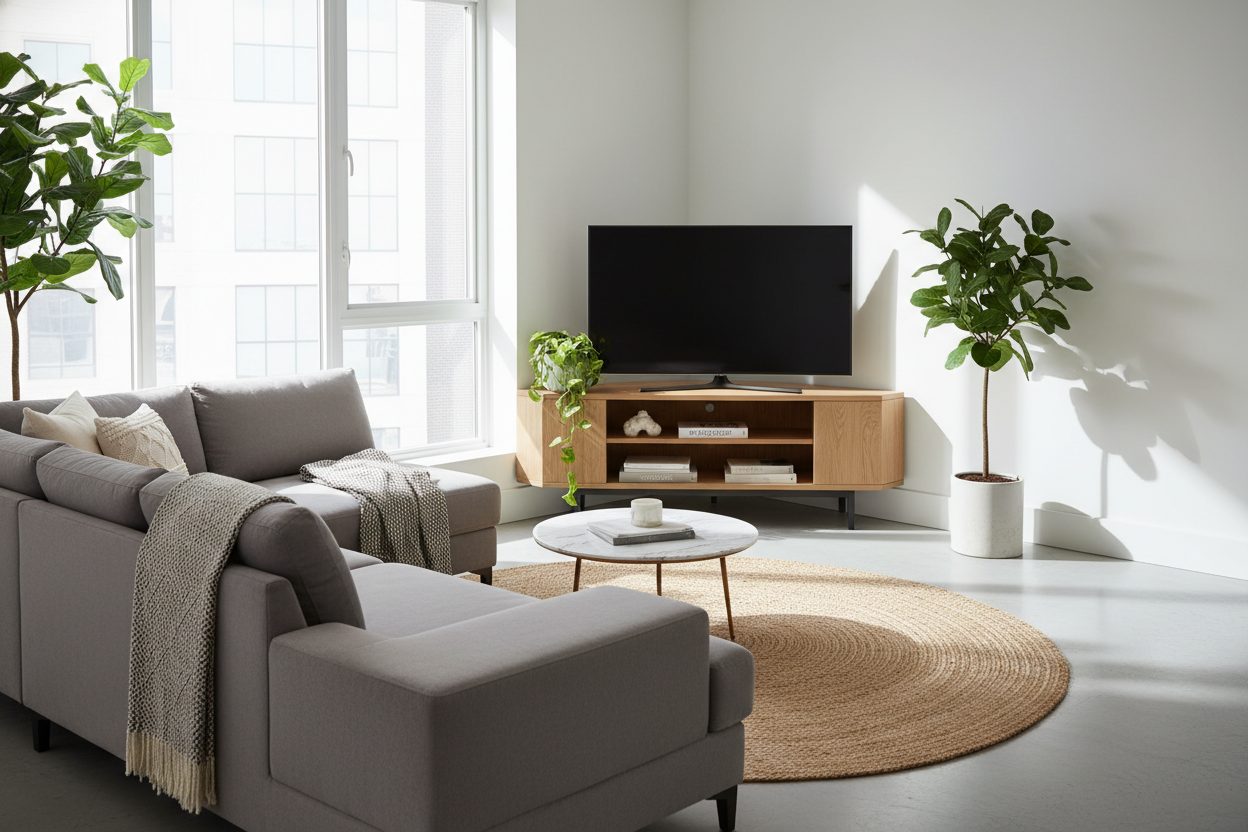
I spent three weeks staring at my living room floor plan like it was a Rubik's cube I couldn't solve. Between the floor-to-ceiling windows and the radiator that eats half the north wall, I had exactly zero inches of flat wall space for a television. It is a classic old-house problem that makes you want to sell everything and live in a yurt.
After measuring and re-measuring, I realized my only option was the corner. But finding a corner tv stand 48 inch wide that didn't look like a cheap laminate relic from 1994 was surprisingly difficult. Here is why this specific size is the layout cheat code you probably didn't know you needed.
- Saves Floor Space: It tucks into the least-used part of the room.
- Perfect View: Angling the TV toward the center of the room often improves sightlines for everyone on the sofa.
- Hidden Storage: The deep triangular shape offers more shelf depth than flat consoles.
- Cable Management: The corner naturally hides the mess of wires trailing down to the outlet.
The 'Too Many Windows, Not Enough Wall' Dilemma
Most people spend hours trying to browse standard tv stands only to realize that a rectangular console shoved in front of a window looks like an accident. It blocks the natural light, creates a messy silhouette of plastic wires against the glass, and screams 'I didn't plan this.'
In older homes or modern open-concept lofts, walls are a luxury. You have fireplaces, French doors, and radiators competing for every square inch. A corner unit isn't a compromise; it's a strategic move to reclaim your floor plan. By utilizing the 90-degree intersection of two walls, you free up the long stretches of wall for art or a bookshelf.
Why a Corner TV Stand 48 Inch Wide is the Magic Dimension
When I finally stopped ignoring corners, I realized the 48-inch width is the Goldilocks zone for furniture. At exactly four feet wide, these units are beefy enough to look like a substantial piece of furniture without jutting out so far that they block the walkway.
If you go smaller—say, 36 inches—the unit looks puny and can only support a small screen. But once you hit 48 inches, you have enough surface area to support a 50-inch or even a 55-inch TV. The weight distribution is better, and you get enough interior cabinet space to actually store a gaming console or a soundbar without it overheating in a cramped box.
Finding the Right Proportions for Your Screen
People often get confused by the math. If you are searching for corner tv stands for 48 inch tv setups, you are looking for a stand that is at least as wide as the screen's actual footprint. A 48-inch wide stand is the sweet spot because most 50-inch TVs have a physical width of about 44 inches. This leaves a couple of inches of breathing room on either side so the screen doesn't look like it's teetering on the edge of a cliff.
Dealing with the 'Dead Triangle' Behind the Screen
The biggest downside of a 48 in corner tv stand is the dusty abyss that forms in the triangle behind the unit. It is an awkward, dark space that eventually becomes a graveyard for lost cat toys and dust bunnies. I have learned to treat this space as a utility zone rather than a void.
I suggest dropping a slim LED light strip behind the stand to wash the corner in soft light. It kills the shadows and makes the room feel larger. If the corner feels too dark, choosing a white tv stand can brighten the entire nook. I even tucked a tall, faux floor plant behind my unit once—it added some height and texture without needing any actual floor space.
Before You Buy: The Geometry Nobody Tells You About
Here is the mistake I made: I measured the front width but forgot the wall depth. A corner tv stand 48 inches wide at the front requires about 32 to 34 inches of clear wall space on both sides of the corner. If you have a window frame that starts 20 inches from the corner, a 48-inch stand is going to overlap that window.
Do not be tempted to 'size up' unless you have a massive room. If you look at a corner tv stand for 65 inch tv, you'll find it eats up nearly four feet of wall space in both directions. In a standard 12x12 room, that is a massive chunk of your living area gone. Stick to the 48-inch width for a balanced look that keeps your floor plan open.
Personal Experience: My MDF Disaster
I once bought a cheap corner unit made of thin particle board with a 'paper' wood finish. Within six months, the weight of my older, heavier TV caused the center to bow. Now, I only buy units with a solid wood frame or high-density MDF. It costs $100 more, but it won't sag when you add a soundbar and a couple of heavy books. My current setup is a solid birch unit, and it hasn't budged in three years.
FAQ
Will a 55-inch TV fit on a 48-inch corner stand?
Yes, usually. A 55-inch TV is typically about 48 inches wide. As long as the TV's legs are centered or the stand is wide enough for the base, it will fit, though the edges of the TV will be flush with the edges of the stand.
How do I hide cables in a corner stand?
Most corner units have a pre-drilled hole in the back panel. Since the stand sits in a corner, you can also bundle wires with Velcro ties and drop them directly behind the unit into the 'dead triangle' space where they won't be seen from the front.
Is a corner TV stand better for small rooms?
Absolutely. It uses space that is normally wasted and allows you to angle your seating more creatively, often making a small room feel less cluttered than a long, flat console would.

Dejar un comentario
Este sitio está protegido por hCaptcha y se aplican la Política de privacidad de hCaptcha y los Términos del servicio.