










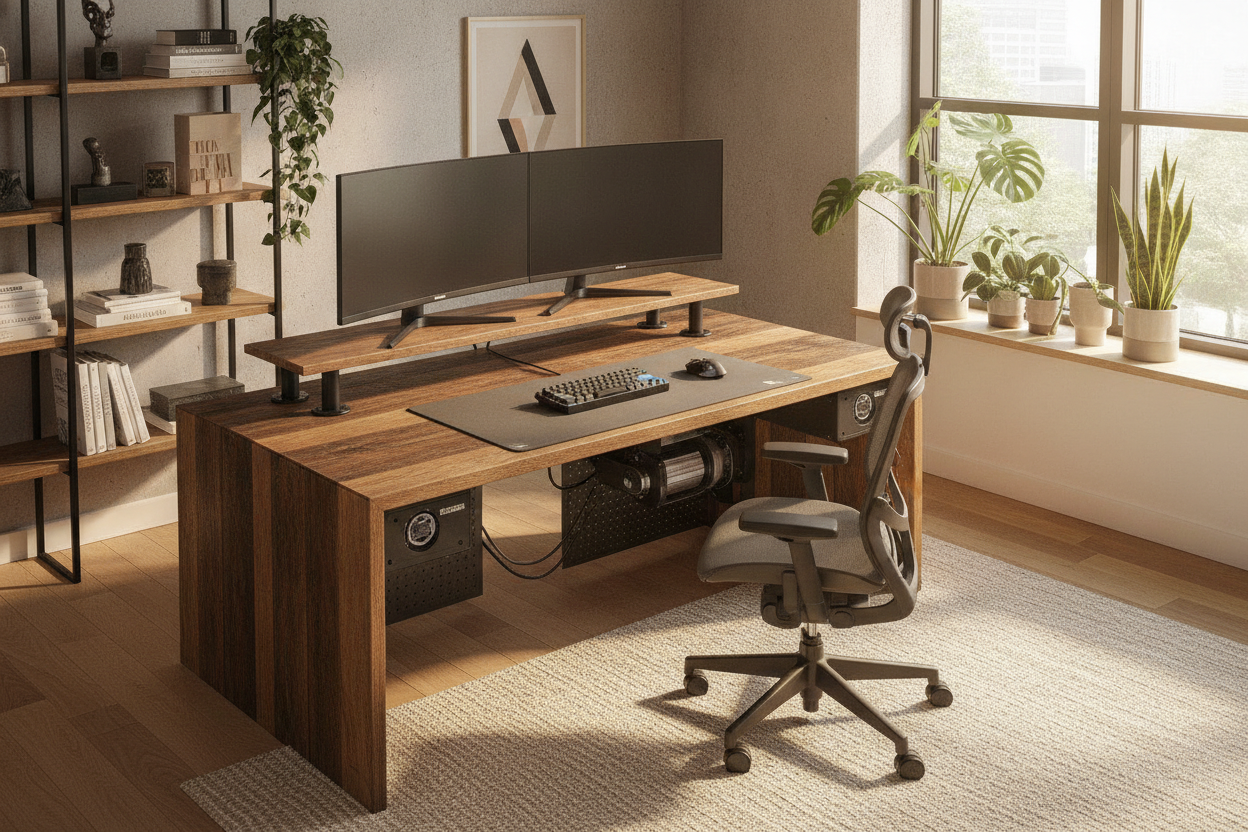
I spent three years staring at a particle-board desk that shook every time I typed a Slack message. It was fine for a while, but eventually, the sag in the middle became impossible to ignore. I wanted something that felt like a permanent piece of furniture, not a temporary solution from a flat-pack box. That is when I decided to attempt the legendary reddit diy standing desk build.
- Solid wood is incredibly heavy—get a helper or prepare for a back workout.
- Sanding and sealing the wood takes longer than the actual assembly.
- A high-quality motor is non-negotiable for a butcher block top.
- Pre-drilling pilot holes will save you from a catastrophic wood split.
Down the r/Workspaces Rabbit Hole
It started with a late-night scroll through r/Workspaces. You know the look: a perfectly oiled slab of walnut or birch, minimal cables, and a motorized frame that glides silently. My current setup was a standard writing computer desk I bought on a whim during a clearance sale. It was narrow, shallow, and made of that hollow honeycomb cardboard that screams 'entry-level apartment.'
I realized that if I wanted a desk that didn't vibrate when my cat jumped on it, I had to move away from the big-box store furniture. The 'Reddit special'—pairing a kitchen butcher block with a heavy-duty standing frame—seemed like the ultimate hack. It promised the luxury of a $1,500 custom desk for about half the price. But as I quickly learned, the internet tends to gloss over the part where you have to actually build the thing.
I spent weeks lurking in r/StandingDesk, reading debates about dual-motor versus single-motor systems and the structural integrity of different wood species. I wasn't just looking for a place to put my laptop; I wanted a workstation that felt like an anchor for my entire room. The goal was simple: a 60-inch solid wood surface that could go from sitting to standing without making my monitors look like they were in an earthquake.
The Anatomy of the Internet's Favorite Desk
The core of this build is a solid wood countertop. Most people go for the 1.5-inch thick birch or oak blocks you find in the kitchen section of a hardware store. Unlike the thin veneers you find on most office furniture, this is a massive, heavy slab of raw timber. It’s dense, it’s beautiful, and it’s heavy enough to crush a toe if you aren't careful. You aren't just buying a tabletop; you're buying a piece of a tree.
To move that much weight, you can't go cheap on the legs. I looked into several options before settling on an adjustable height standing desk with electric lift frame. When you're asking a motor to lift an 80-pound slab of wood plus two monitors, a heavy PC tower, and a microphone arm, you need something with serious torque. A cheap, single-motor frame will struggle, groan, and eventually burn out under that kind of load.
The frame needs to be adjustable in width to accommodate the length of your wood. Most butcher blocks come in 4-foot, 5-foot, or 6-foot lengths. I went with the 5-foot (60-inch) option, which provides a massive amount of real estate without completely swallowing my guest room. The frame provides the brains and the brawn, while the wood provides the soul. It is a marriage of industrial utility and natural warmth that you just don't get from a pre-assembled unit.
Sourcing the Wood (Without Getting Scammed)
Finding the right wood is the hardest part. I visited three different hardware stores before I found a block that wasn't warped. You have to lay the wood flat on the floor and look for any 'cupping' or twisting. If the wood is even slightly bowed, your desk will never feel level, and your mouse will literally roll away from you. I ended up with an unfinished birch block that felt like a bargain until I realized I had to sand it. You start with 80-grit to get the factory marks off, then move to 120, and finally 220 for that buttery smooth finish. Then comes the polyurethane. Three coats, with light sanding in between, is the only way to protect it from the inevitable coffee rings.
The Assembly Reality Check
Let’s talk about the physical toll. The butcher block arrived on a pallet, and the delivery driver left it in my driveway. I live on the second floor. Hauling a 75-pound, 5-foot-long slab of wood up a flight of stairs by myself was the first mistake. It is awkward, slippery, and surprisingly sharp on the edges. By the time I got it into my office, I was sweating and my walls had two new scuffs. If you attempt this, please, for the love of your lower back, bribe a friend with pizza to help you move it.
Once the wood was in place and finished, the actual assembly began. You have to flip the wood upside down, center the frame, and measure the overhang on both sides. This is where precision matters. If the frame is off-center by even half an inch, the weight distribution will be wonky, and the desk might lean when fully extended. I spent an hour just measuring and re-measuring. I used a chalk line to ensure the frame was perfectly parallel to the edges of the wood.
Then came the drilling. You cannot just drive screws into solid wood with a hand screwdriver. You will strip the screw or, worse, crack the wood. I had to use a power drill to create pilot holes for every single screw. It’s a nerve-wracking process—one wrong move and you’ve drilled a hole straight through the top of your beautiful new desk. But once the frame was bolted on and we flipped it over (another two-person job), the result was undeniable. The desk didn't just stand; it felt like it was part of the floor. There was zero wobble, even at my preferred standing height of 44 inches.
Was the Hack Actually Cheaper Than Buying Pre-Built?
Everyone on Reddit says this is a money-saver, but let's look at the receipts. The wood was $190, the frame was $320, and the finishing supplies (sandpaper, stain, poly, brushes) added another $60. Total: $570. When you compare that to a high-end 71 W height adjustable standing desk that comes pre-finished and delivered to your door, the price gap isn't as massive as you might think. You might save $100 or $200, but you're trading a full Saturday and a lot of elbow grease for those savings.
However, the value isn't just in the dollars. A pre-built desk at this price point usually features a 'desktop' made of MDF or particle board with a wood-look sticker on top. Within a year, the edges start to peel, and the middle starts to dip. My DIY version is a literal tank. If I ever scratch it, I can just sand it down and refinish it. It's a piece of furniture that could easily last a decade. For me, that longevity makes the 'savings' calculation much more favorable, even if the upfront cost was higher than a budget IKEA setup.
3 Things I Wish I Knew Before Drilling
First, plan your cable management before you attach the frame. Once that slab is bolted on, it's a nightmare to move. I wish I had installed a cable tray or routed some channels for wires while the wood was still upside down. Now, I'm stuck using adhesive clips that keep falling off. Proper bespoke desk DIY organization starts with knowing where every power brick and monitor cable is going to live before the first screw goes in.
Second, don't skip the pilot holes. I know I mentioned it before, but it bears repeating. Hardwood is unforgiving. If you try to force a screw in, the friction generates heat and pressure that can split the grain of the wood. Use a bit that is slightly smaller than the screw's diameter. It makes the assembly go faster and keeps the structural integrity of the block intact.
Finally, buy a surge protector that bolts to the underside of the desk. Since the desk moves up and down, you only want one 'umbilical cord' running to the wall outlet. Everything else—your PC, monitors, lamp—should plug into a strip mounted directly to the wood. This prevents cables from getting snagged or unplugged when you transition to standing mode, which is a quick way to crash your computer in the middle of a project.
FAQ
Is a DIY standing desk more stable than a pre-built one?
Usually, yes. The sheer weight of a solid wood butcher block acts as a stabilizer. Cheap pre-built desks use lightweight tops that allow the frame to sway, but a 75-pound top keeps the whole unit planted firmly on the ground.
Do I really need to sand and seal the wood?
Absolutely. Unfinished wood absorbs moisture from the air and oils from your skin. If you don't seal it, the wood will eventually warp, crack, or become permanently stained. A simple water-based polyurethane is easy to apply and dries fast.
Can I build this desk by myself?
You can do the assembly alone, but you definitely need a second person to help you move the wood and flip the desk over once the legs are attached. Attempting to flip a 120-pound completed desk solo is a great way to break the motor or your floor.

Dejar un comentario
Este sitio está protegido por hCaptcha y se aplican la Política de privacidad de hCaptcha y los Términos del servicio.