










I currently have a condensation ring from a glass of iced tea sitting right next to my mousepad. Three years ago, that sight would have triggered a minor existential crisis involving rolls of paper towels and frantic scrubbing. I knew that within twenty minutes, the cheap laminate on my old desk would start to bubble and peel away to reveal the crumbly, grey particleboard underneath.
But my current setup is different. I finally graduated to bamboo standing desks, and honestly, I am never going back to the wood-look stickers of my youth. If you are even a little bit messy—or if you just live a real life where things get dropped and drinks get spilled—you need a surface that does not treat a drop of water like a fatal wound.
Quick Takeaways
- Bamboo is naturally denser and more water-resistant than standard MDF or pine tops.
- It resists the 'bubbling' effect common with laminate and particleboard furniture.
- The natural grain hides minor scratches and daily wear better than solid-colored surfaces.
- Solid bamboo is heavy; you need a frame with a high lifting capacity.
The Particleboard Graveyard (How I Got Here)
Before I wised up, my home office was a revolving door of disposable furniture. I fell for the trap of the $90 flat-pack desk more times than I care to admit. Those desks look great for exactly three weeks. Then, life happens. You set down a mug without a coaster, or you accidentally ding the edge with your vacuum cleaner. Once that thin layer of plastic laminate is breached, the game is over. The 'wood' inside acts like a sponge, expanding and warping until your desk looks like a topographical map of the Andes.
I remember one specific desk—a dark walnut laminate—that I ruined by simply cleaning it with a slightly-too-damp microfiber cloth. The edges started to fray, catching on my sweaters and leaving little flakes of brown plastic on my floor. It felt temporary. I was tired of owning furniture that felt like it was biodegenerating while I was still using it. I needed something that could handle a dropped stapler or a spilled Americano without requiring a trip to the dumpster. That is when I started looking into denser materials that didn't cost as much as a solid white oak heirloom table.
Why Bamboo is Secretly Bulletproof
The secret to why a standdesk bamboo top survives my chaos is simple: density. Bamboo isn't actually wood; it is a grass. To make a desk, manufacturers shred it, dry it, and then compress it under thousands of pounds of pressure with eco-friendly resins. The result is a slab that is significantly harder than most common hardwoods like oak or maple. When I drop my heavy mechanical keyboard or a metal water bottle, it doesn't leave those deep, jagged gouges that soft pine would. It just bounces off.
Then there is the moisture factor. Because the fibers are so tightly packed, liquids don't penetrate the surface immediately. I have left coffee rings on my desk for an entire afternoon (don't judge me), and they wipe off with zero residue. Unlike MDF, which swells the moment it gets humid, bamboo stays incredibly stable. This is especially vital if you live in a humid climate or a basement office where 'real' wood tends to expand and contract, eventually cracking the finish. With bamboo, the surface remains flat and smooth, year after year, regardless of how many iced coffees I sweat all over it.
It Doesn't Look Like a Soulless Corporate Cubicle
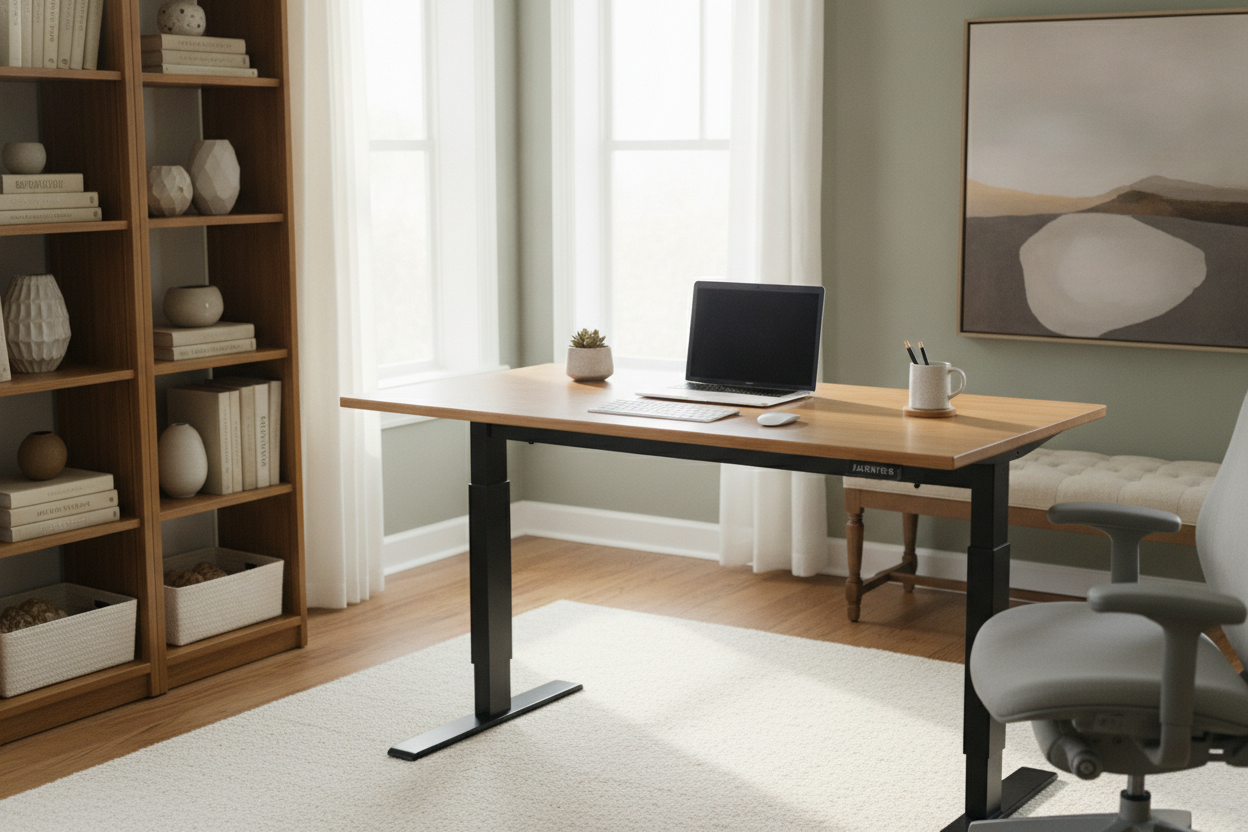
One of my biggest hesitations was the 'look' of bamboo. I had this vision of 90s-era tiki bars or cheap cutting boards. I was worried it wouldn't fit my mid-century modern aesthetic and would instead look like a piece of outdoor patio furniture that accidentally made its way inside. I Judged Bamboo Desks Until I Actually Worked at One and realized how wrong I was. Modern bamboo tops are often carbonized, which gives them a rich, honey-toned warmth that looks more like premium teak than cheap grass.
The grain is subtle and organic, which helps break up the 'tech' feel of a home office. When you have two monitors, a ring light, and a forest of cables, your room can quickly start feeling like a server closet. The natural texture of the bamboo brings a bit of the outside in. It blends seamlessly with my walnut bookshelf and my linen-upholstered chair. It feels like a piece of furniture, not just a piece of equipment. Plus, every slab has unique nodes and patterns, so it doesn't have that repetitive, printed look you get with cheap veneers.
The Weight Factor: Make Sure Your Frame Can Lift It
Here is the one thing no one tells you: solid bamboo is heavy. This isn't a hollow-core door from a big-box store. A 1-inch thick bamboo slab has some serious heft to it. If you are buying a DIY top and pairing it with a cheap, single-motor frame, you are going to hear that motor crying for help every time you hit the 'up' button. You need a frame that is rated for at least 200 pounds to account for the top, your monitors, your heavy-duty monitor arms, and that stack of books you keep meaning to read.
If you are going big, I highly recommend the 71 W Height Adjustable Standing Desk. That 71-inch span of bamboo is massive, and you need a dual-motor system that won't wobble when you're at full standing height. If you try to put a slab that size on a flimsy base, your monitors will shake every time you type. For those in smaller apartments who still want that durability, the Adjustable Height Standing Desk With Electric Lift System 54 Desk With Memory Presets is a better fit. It gives you the same 'bulletproof' surface but in a footprint that won't swallow your entire bedroom. Just don't underestimate the weight during assembly—get a friend to help you flip it over once the legs are attached.
My Final Verdict After 6 Months of Chaos
I have been using my bamboo setup for over half a year now, and it is the first time I haven't felt the need to 'baby' my furniture. The edges are still crisp—no peeling or fraying in sight. There are no mysterious white rings from forgotten mugs, and the motor still glides silently because I chose a frame that could actually handle the weight of the slab. It is a relief to work at a desk that is tougher than I am. If you are tired of your workspace looking like a 'before' photo in a home renovation show, make the switch to bamboo. It is the only material I have found that actually stands up to the reality of a 40-hour work week and a persistent caffeine habit.
FAQ
Is bamboo louder than wood when typing?
Not significantly. Because it is so dense, it actually has a very solid, dampened sound. It doesn't have that hollow 'drum' effect you get with cheap laminate tops.
How do I clean a bamboo desk?
Just use a damp cloth and a drop of mild dish soap. Avoid harsh chemical cleaners or anything abrasive. Honestly, usually just a dry microfiber cloth is enough to get the dust off.
Does bamboo fade in the sun?
Like any natural material, it can lighten slightly over years of direct, intense sunlight. If your desk is right against a south-facing window, just use a UV-blocking film or close the blinds during peak hours, but it is much more UV-resistant than many stained woods.


Dejar un comentario
Este sitio está protegido por hCaptcha y se aplican la Política de privacidad de hCaptcha y los Términos del servicio.