










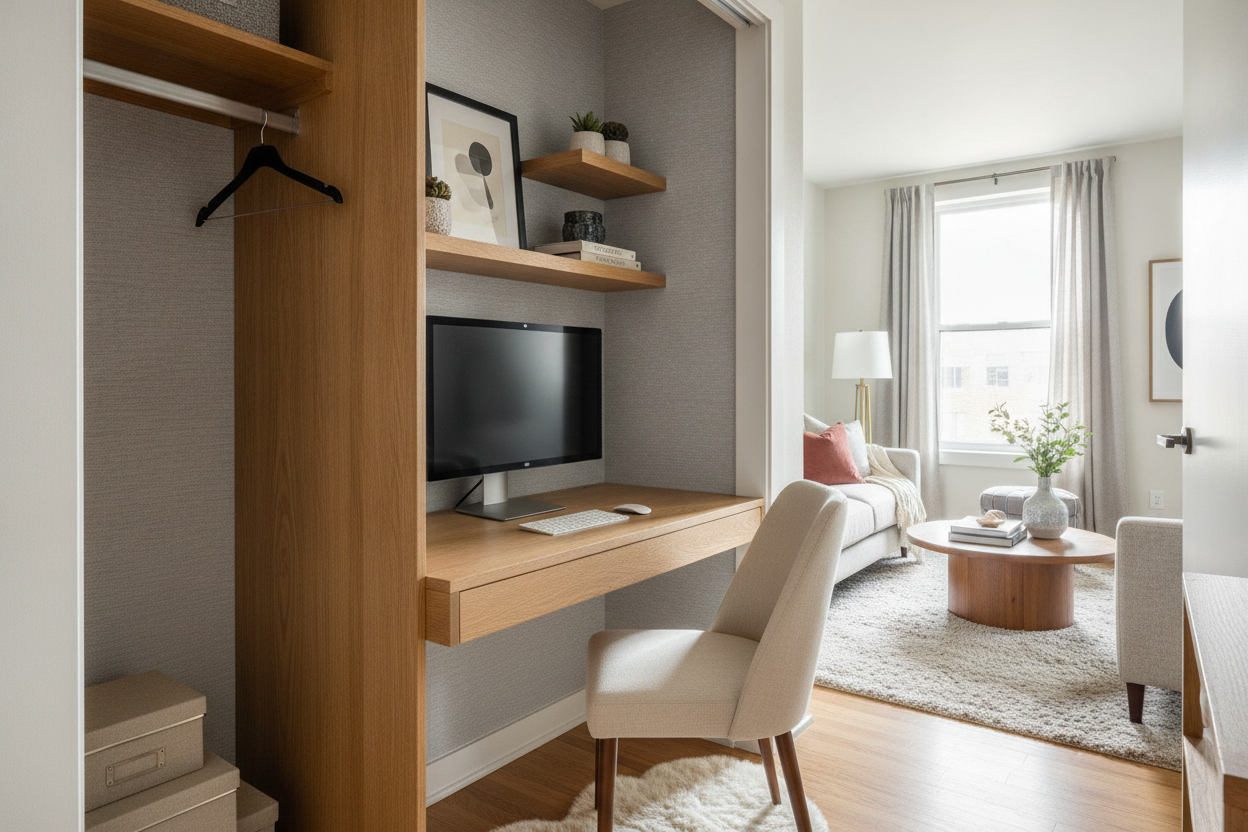
I spent six months trying to convince myself that my mid-century velvet sofa was a ‘creative hub.’ It wasn't. It was a one-way ticket to a chiropractor and a very distracted mind. If you're currently balancing a laptop on a stack of books at your kitchen table or, worse, typing from bed, we need to talk about the tall skinny computer desk.
Living in a 500-square-foot studio means every inch of floor space is a premium. I didn't have room for a traditional office, but I did have a reach-in closet filled with half-empty boxes and coats I never wear. By clearing out the junk and finding a desk that prioritized height over width, I reclaimed my sanity and my spine.
Quick Takeaways
- Verticality is your best friend in small apartments; if you can't go out, go up.
- A 24-to-30-inch width is the sweet spot for fitting into standard closet frames.
- Integrated shelving (a hutch) eliminates the need for separate, bulky filing cabinets.
- Closing the closet door at 5 PM is the best mental health hack for WFH burnout.
The 'Working From the Couch' Era Had to End
We’ve all been there. You start the morning with your laptop on your lap, feeling productive. By noon, you’re slumped over like a wilted plant. By 3 PM, your neck is screaming, and you’ve spent more time adjusting your throw pillows than actually answering emails. I realized that without a dedicated surface, my brain never truly switched into ‘work mode.’
The problem is that most ‘small’ desks are still too big. They’re deep enough to eat up half a walkway or wide enough to block a door. I needed something with a footprint so small it could practically disappear. That’s when I stopped looking at the floor and started looking at my walls. I realized a tall skinny computer desk could provide the surface area I needed by using the vertical space I was currently wasting on empty air.
Why Going Vertical Beats Going Wide Every Time
Traditional desk shopping is a trap for apartment dwellers. Most retailers want to sell you a sprawling L-shaped workstation that belongs in a corporate cubicle, not a cozy living room. I spent weeks measuring my corner, realizing that even a modest desk would make my walk to the kitchen feel like an obstacle course.
The breakthrough came when I considered swapping out a bulky corner setup for something with a much narrower profile. A tall slim desk uses shelving units built right into the frame. Instead of spreading my monitors, notebooks, and coffee across a 60-inch wide table, I stacked them. My printer went on the top shelf, my reference books on the middle, and my laptop sat on a slim 24-inch surface. I saved about four square feet of floor space, which, in a studio, feels like gaining a whole new room.
Anatomy of the Perfect 'Cloffice'
If you’re planning to put a desk in a closet—the ‘cloffice’—you have to be ruthless with your tape measure. Most standard reach-in closets are about 24 inches deep. You want a compact writing computer desk that sits flush or slightly recessed so you can actually shut the doors when the day is done.
Look for a desk height of around 29 to 30 inches for the main surface, but make sure the overall height hits at least 60 inches. That extra verticality is where your storage lives. I opted for a model with a built-in hutch. It feels less like a cramped corner and more like a library nook. One mistake I made: I didn't check the width between the desk legs. Make sure your office chair can actually slide all the way under, or you'll be sitting three feet back from your screen.
Cable Management in a Dark Box
Closets aren't exactly known for their abundance of natural light or power outlets. To avoid a 'punishment corner' vibe, I ran a heavy-duty power strip along the baseboard. I highly recommend looking for a desk with an integrated socket built into the desktop. It’s a total lifesaver for charging your phone and laptop without diving under the furniture every morning.
For lighting, I stuck a few battery-powered LED strips under the hutch shelves. It brightens up the workspace and makes the monitor easier on the eyes. Without good lighting, a closet office can feel like a tomb; with it, it feels like a high-end command center.
Getting Your Floor Space Back
The best part of this setup isn't just the ergonomics; it's the psychological boundary. When I worked on the couch, work was everywhere. Now, when I’m done, I push in my chair and close the closet doors. The 'office' is gone. My living room is a living room again.
If you don't have a spare closet, don't give up. I’ve seen people use these desks for repurposing dead apartment zones like that weird three-foot gap at the end of a hallway. A tall, narrow footprint fits almost anywhere. It’s about being smart with the volume of the room, not just the square footage of the floor.
FAQ
Will a 24-inch wide desk be too small for two monitors?
It’s tight. If you use two 27-inch screens, they will overhang the sides. I suggest using a dual-monitor arm that clamps to the back of the desk to reclaim the surface space, or switching to one large ultrawide monitor.
How do I stop the desk from wobbling on carpet?
Tall, skinny furniture can be top-heavy. Most of these desks come with wall-anchor kits—use them. Especially if you’re loading up the top shelves with heavy books, bolting it to a stud is the only way to ensure it stays steady.
What kind of chair works best for a closet office?
Skip the massive executive 'boss' chairs. They have a huge footprint and won't fit in a closet. Look for a 'task chair' with a small wheelbase or a stylish armless swivel chair that can tuck completely under the desk surface.

Dejar un comentario
Este sitio está protegido por hCaptcha y se aplican la Política de privacidad de hCaptcha y los Términos del servicio.