










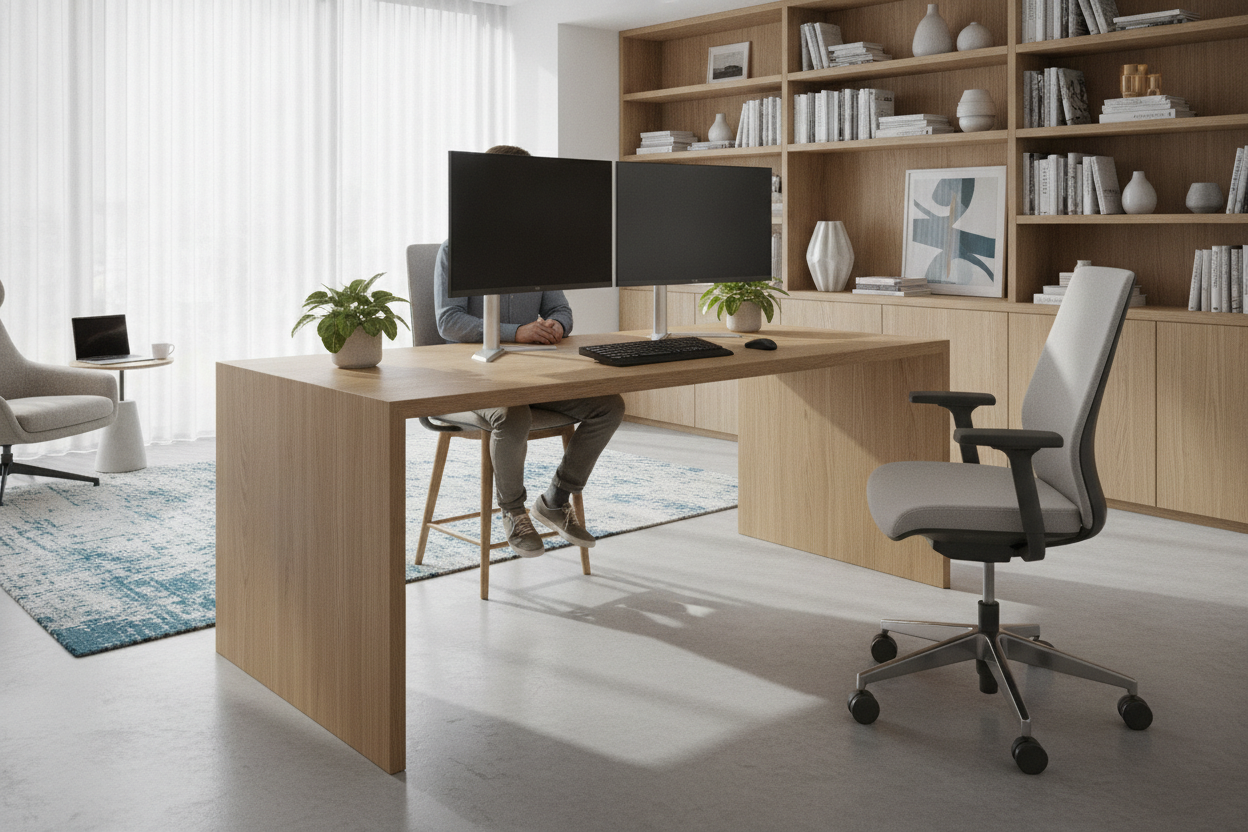
I am 6'2", which isn't exactly giant territory, but in the world of office furniture, it might as well be. For years, I thought the dull ache in my lower back and the red marks on my knees were just the price of being a writer. I’d sit down at my standard 29-inch table, and within twenty minutes, I was slumped over like a question mark.
The problem is that most furniture is designed for a 5'9" person. When you're taller, you don't just need more legroom; you need a workspace that doesn't force your spine into a C-curve. Switching to tall desks changed my entire physical relationship with my work. It wasn't just a purchase; it was an ergonomic intervention.
Quick Takeaways
- Standard 29-inch desks are built for the average height, leaving anyone over 6'0" in a posture trap.
- Look for a minimum height of 31 inches for seated work to prevent knee-banging.
- Knee clearance is the most overlooked measurement; you need at least 27 inches from floor to the underside of the desk.
- Avoid DIY hacks like bed risers; they sacrifice stability and look terrible in a professional home office.
The 29-Inch Standard Is a Lie for Anyone Over Six Feet
Walk into any big-box furniture store and you'll see the same number over and over: 29 inches. That is the industry standard for desk height. It’s a number based on a mid-century 'average' body that simply doesn't account for the longer femurs and torsos of the modern tall person. When I used a standard desk, I had to choose between two evils: lowering my chair so my knees fit (which destroyed my elbows) or raising my chair and hunching my neck to see the screen.
Shopping for tall computer desks is a lesson in frustration because most manufacturers don't list the under-desk clearance. They'll tell you how wide the top is, but they won't tell you if a human with legs can actually sit there comfortably. If you're tall, that 29-inch surface isn't a desk; it's a shelf that happens to be in your way.
I remember my first 'real' office job. I spent the first week trying to figure out why I was so exhausted by 3 PM. It wasn't the workload—it was the fact that I was basically doing a sustained crunch just to reach my keyboard. Once I started looking for extra tall desks that actually hit the 31 or 32-inch mark, the fatigue vanished.
Why Your Spine Is Begging for a Tall Computer Table
The 'tall person slouch' isn't a lack of discipline; it's a mechanical necessity. If your keyboard is sitting too low, your shoulders naturally roll forward. Your head follows, and suddenly you’re putting 30 pounds of pressure on your cervical spine. A tall computer table solves this by bringing the entire work surface up to meet your natural arm height.
When I finally upgraded to a dedicated tall office desk, the first thing I noticed was my eye line. I wasn't looking down at my monitor anymore. I was looking through it. My neck tension, which I’d spent hundreds of dollars on massages to fix, disappeared in about two weeks. It turns out I didn't need a deep tissue rub; I just needed four more inches of steel under my workspace.
Don't underestimate the psychological impact of a tall home office desk. There is something incredibly demoralizing about feeling too big for your own furniture. It makes you feel like a guest in your own home. When your desk actually fits your frame, you feel more settled and, honestly, more productive.
What Actually Makes a Big and Tall Desk Good?
If you're hunting for a big and tall desk, don't just look at the overall height. You need to look at the 'apron'—that piece of wood or metal that runs under the desktop. Many desks claim to be 30 inches tall, but they have a 3-inch drawer or support beam that eats up all your legroom. You want a thin profile with maximum clearance. I aim for at least 27 inches of clear space from the floor to the first obstruction.
Stability is the next big factor. When you raise a desk's center of gravity, it tends to wobble. I’ve tested tall computer desk options that felt like they were made of toothpicks. Look for T-style legs or a heavy steel frame. If you can shake the desk with one hand and your coffee sloshes, keep looking. It’s also worth considering that finding a truly tall desk for standing is just as crucial as finding one for sitting; many standing desks max out at 45 inches, which is still too short for the 6'4" crowd.
Materials matter here, too. Avoid the cheap particle board. When you’re dealing with the extra leverage of a taller frame, you want solid wood or high-grade MDF. I once bought a 'tall' desk made of thin laminate, and the legs started to splay outward after six months because they couldn't handle the height-to-weight ratio. Go for kiln-dried hardwoods or heavy-gauge industrial steel if you want it to last a decade.
Please Don't Just Put Your Desk on Bed Risers
We’ve all been there. You’re desperate, your back is screaming, and you see a four-pack of plastic bed risers for ten bucks. It seems like a genius hack. Let me tell you from experience: it is a disaster waiting to happen. Bed risers are designed for static loads—beds that don't move. A desk is a dynamic environment. You’re typing, you’re leaning, you’re moving your mouse.
I tried the riser trick with an old table, and it was like working on a trampoline. Every keystroke made my monitor vibrate. Not to mention, it looks incredibly tacky. If you’re trying to build a professional workspace, plastic blocks from a dorm room supply store aren't the vibe. It’s time to stop the DIY bleeding and invest in a properly proportioned writing computer desk that was actually engineered for your height.
A dedicated tall office desk is built with the proper bracing to handle the height. It’s not just about the inches; it’s about the geometry. When you use risers, you're bypassing the safety features of the original design. Save your equipment and your dignity—buy the right furniture the first time.
Fitting Extra Height Into Awkward Home Offices
One concern people have is that tall furniture will make a small room feel cramped. It’s a valid worry. A massive, chunky desk can dominate a guest room. However, a tall small desk with a minimalist frame can actually make a room feel airier because it leaves more visual space underneath. It’s about the 'leggy' look rather than the bulk.
If you're working in a tight corner, don't assume you're stuck with a tiny, low table. Some of the best setups I’ve seen involve a tall computer desk tucked into a nook. You might even find that a corner configuration is better for small rooms because it provides that extra legroom without eating up the center of the floor. It gives you a 'cockpit' feel where everything is within reach but your knees aren't pinned against the wall.
The key to styling these pieces is balance. If you have a tall desk, pair it with a chair that has a high back. If you use a low-profile chair with a high desk, the proportions look like a mistake. Match the scale of your furniture to your own scale, and the room will naturally feel more cohesive.
FAQ
How high should a desk be for a 6-foot person?
For someone 6'0", a desk surface height of 30 to 31 inches is usually the sweet spot. However, pay more attention to the leg clearance; you want at least 27 inches of open space under the desk so you aren't constantly bumping your thighs.
Can I just use a standing desk as a tall seated desk?
Absolutely. In fact, electric standing desks are often the best tall computer desks because you can micro-adjust the height to the exact millimeter that feels right for your posture. Just make sure the minimum and maximum heights fit your specific range.
Are there specific chairs for tall desks?
Yes, you’ll want an executive chair or a drafting chair with an extended gas lift. If you buy a tall desk but keep your old, low-range chair, you’ll just end up reaching upward, which causes shoulder strain. The goal is to keep your elbows at a 90-degree angle.

Dejar un comentario
Este sitio está protegido por hCaptcha y se aplican la Política de privacidad de hCaptcha y los Términos del servicio.